

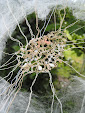
Although this
image is a bit fuzzy, because it was taken through the shop window, the
macrogauze at the back shows exactly how the vertical warp threads move. The
warp threads in this case are hung in a line together across the header, but are
then separated and moved at angles to cross and twist with each other, to form
the geometric patterns, until they finally merge on the lower rung, in a line,
in the same alignment as the header threads.

It was also
interesting to see so many of Collingwood’s drawings, notes and photographs in
a separate display, exploring his designing and working methods. The shop
window image also shows how the pieces are made into three dimensional
structures with the help of fine steel rods placed diagonally from one integrated
steel rod to another. This clever engineering solution also means that the
pieces are woven flat, can be stored flat and potentially displayed flat until
the diagonal steel rods are put in place.

Some of the
details of the macrogauzes reveal how carefully they were designed and worked.
The exact nature of their construction and the thread placement is stunning. If
you want to find out more about Peter Collingwood and his work, he wrote
several books about weaving and his archive is held at the
Crafts Study Centre, University for the Creative Arts, Farnham.

No comments:
Post a Comment