Showing posts with label brise-bise. Show all posts

Wednesday, 6 August 2025

Casements and brise bise – curtains from the 1930s


I found this combination of curtains in a 1933 Lace Furnishings catalogue and thought they made an interesting pair. The casement net curtain is the one with the all over pattern and was designed to be hung down the length of a window. It could have been gathered at the top or left as a panel. The householder would have bought a length of the net (35 inches wide) and made up the curtain herself, so she would have had to make an allowance for a hem at the bottom and a turn over at the top of the curtain, to make a channel for the hanging rod. The brise bise fabric (16 inches wide) was designed to be hung half way down a window rather than from the top, in the style we know as a café curtain. It wouldn’t have required any sewing as it is finished at the bottom and  there is already a channel for the hanging rod or cord at the top. I can imagine the curtains being used in a kitchen, with the brise bise across the lower half of the windows and the larger curtain over the window panels on the back door. I like the way just a small part of the main design has been used on the brise bise, to link the two curtains together without overwhelming the smaller curtains.

Both these curtains were made from artificial silk (a much more evocative name than viscose) and cotton. They were available in dark ecru or could be dyed in a variety of shades which the manufacturers guarantee to be fadeless. Dyed fabrics cost more than the standard dark ecru but unfortunately the catalogue doesn’t include prices. The householder could choose from ivory, champagne, blue, copper, rose, gold, putty, old gold, tango, green or brown. I think I’d go for ivory or champagne so they didn’t make the room too dark, what do you think?

Wednesday, 21 May 2025

Brise bise lace curtains and blinds


Researching more brise bise curtains this week I came across these in a 1933 pamphlet of lace furnishings. Brise bise lace curtains were very fashionable in the early 1930s and were designed to hang across the lower half of a window. The name brise bise comes from two French words, briser meaning to break and bise meaning a light cold wind, so they are designed to stop a light breeze. All the examples in the booklet have an integral channel woven across the top of the curtain through which a rod or wire could be inserted for fixing them. Some of these channels are patterned but others are just plain weave and most have a scalloped lower edge. Brise bise curtains could be gathered along the rod or kept flat against the window and it may be that those labelled as blinds were designed to be used flat. However, it looks as if all the designs could be used either way depending on the preference of the householder.

The fruit design shown at the top is only available in one width (17 inches), but the design of flowers and trellis comes in three sizes (20, 31 or 38 inches). The smaller sizes are those usually associated with brise bise curtains; 38 inches seems quite large for a brise bise, but perhaps the idea was that you could have a combination of matching designs to fit a range of window sizes. The curtains were sold by the yard so would not be finished at the edges, just cut from the roll. Unfortunately there are no details of the manufacturers or the prices and I suspect those details were probably on an order form in the centre of the booklet which has been removed.

Wednesday, 5 July 2023

Brise-bise lace curtains


These pretty brise-bise lace curtains come from a 1904 Peach & Sons catalogue. The Nottingham lace manufacturer produced regular catalogues advertising their lace products including curtains, tablecloths, bedspreads, and other household lace as well as lace clothing, collars and handkerchiefs. Brise-bise curtains were becoming popular at that time and were made to hang across the lower part of the window from a rod or wire. These ones have small brass rings on the top through which the rod can be slotted but others have a channel woven across the top of the curtain for the same purpose. Also advertised with the curtains are newly patented ‘bracketless’ rods for casement or brise-bise curtains. The advert emphasises that they require no cutting and no brackets are required for fixing; they are made of polished brass and come in a range of sizes. The curtains in the image are made in two sizes (26 x 34 or 34 x 36 inches, width x depth) and cost per pair 1/3 for the smaller size and 1/6 for the larger ones. Other, cheaper brise-bise curtains were made from continuous lengths of lace (generally 26 inches deep) and were sold by the yard. The name brise-bise comes from the French briser meaning to break and bise a light cold wind, which I like to think results in the curtains wafting gently in the breeze rather than being buffeted by a gale.

Wednesday, 4 May 2022

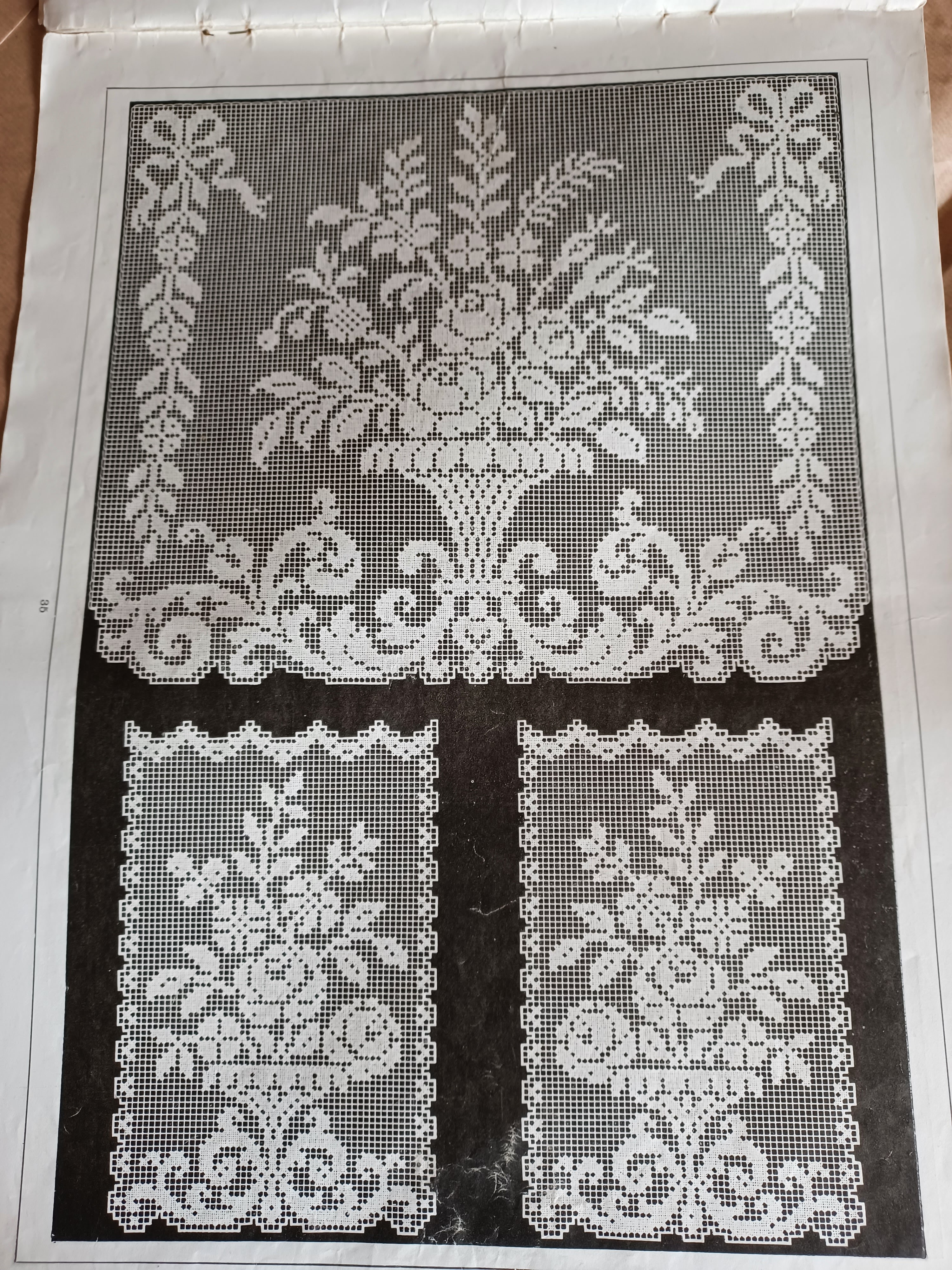
Filet lace curtains


The patterns for these lovely curtains appear in a booklet of filet lace from the early twentieth century. In the index they are labelled as a store curtain and matching brise-bise curtains in the style of Louis XVI. They could have been used on the same window with the store curtain hung on the upper part and the brise-bise curtains hung against the lower panes or they could have been used separately. Brise-bise curtains are what we know as café curtains and only cover the lower half of a window.

The instructions for making the curtains, which are all in French, suggest that the lace should be worked in blocks of 1 centimetre. The dimensions given are 141 blocks for the store curtain and 85 x 55 for the smaller ones. I assume from looking at the pattern that the measurement given for the store curtain is the width. This booklet gives no instructions for working the filet lace but another volume I have, from the same time, shows how to make the background net and work the stitches so I think the expectation was that the lacemaker would know how to do both.