Wednesday, 15 April 2026

A painted lace tablecloth


Over the Easter holiday I was lucky enough to visit Worcester City Art Gallery and Museum where I saw an exhibition of some beautiful portraits painted by John Singer Sargent. He was part of the Broadway colony of artists painting in Worcestershire at the end of the nineteenth and the early part of the twentieth centuries. The exhibition also featured some works by the other artist in the group including ‘Between two fires’ painted by Francis Davis Millet in 1892.

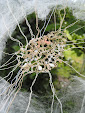
It wasn’t the subject of the painting that attracted me. In fact I felt a bit sorry for the puritan man in the picture who looks rather intimidated by the two maids on either side of him. It caught my eye because of the accurate depiction of the lacework round the tablecloth, which you can see in close up in the photo at the top of this post. It is in fact drawn work where threads are pulled, or drawn, out of the background cloth and the remaining threads are used as a background for embroidery stitches. The horizontal and vertical threads you can see were originally part of the cloth and the diagonal ones were added as embroidery stitches with a needle and thread. The raw edges of the rectangular shapes would have been secured with closely worked buttonhole stitches like the edges in the image below.

However this embroidery, although it looks like the lace in the painting, is not drawn work because the threads used to make the pattern across the open space are thicker than the cloth threads and have been added afterwards as free embroidery.

I was also interested in the caps on the maids’ heads especially as I had been looking at speldenmuts a few weeks before. The ones in the painting are much smaller than the caps from the Netherlands and beautifully painted so you can see the gathers and the spots on the muslin. However I wasn’t sure that embroidered muslin would have been use for servants headwear in the seventeenth century, which is the time that the painting is set. I’m also dubious about the net curtain at the window. I’ve seen several paintings and photographs of similar half curtains at the windows of cottages in the nineteenth century but not in the seventeenth. Who would have thought that a casual visit to an art exhibition would have thrown up so many textile questions!

Friday, 10 April 2026

Religious lace bobbins


I was trying to find some inscribed lace bobbins relevant to the Easter period to blog about this week, but I haven’t managed to find any. T S Huetson in his survey of bobbins in the early part of the twentieth century reports finding lace bobbins inscribed with the words ‘Easter’ as well as ‘Christ crucified’ and ‘Jesus died for me’. The closest I could find were the general religious inscriptions in the image above, reading from left to right ‘I love Jesus yes I do I do’, ‘Thou O God seest me’ and ‘Jesus’. Many lacemakers followed a nonconformist Christian faith, which meant they believed they had a personal relationship with God and their services involved hymn singing and personal reflection. They would have attended newly built chapels rather than the local village church and the children would have attended Sunday school where they learnt stories from the Bible and their significance to contemporary life. Sunday was the Lord’s day and therefore a day of rest when no work was done. Lace pillows were covered over on Saturday evening and not uncovered again until Monday morning when lacemaking recommenced. Religion would have played an important part in the lives of most lacemakers so it is surprising that so few religious bobbins survive. Perhaps it is more of a reflection on the types of lace bobbins subsequent generations have decided to keep and the cheeky ones like ‘Kiss me quick’ or those with names on have proved more popular with collectors and lacemakers.

Wednesday, 1 April 2026

Speldenmuts - pin caps from The Netherlands


I saw this pin cap at Luton Museum (Wardown House Gallery and Museum) and was fascinated by the row of tiny pins around the lace. I was interested to know whether they were just there for decoration or had a practical use. I’ve since been doing some research and found that these caps are part of the regional costume from the south west region of Brabant in the Netherlands.


The caps have a large crown, gathered on to a strip of lace or fabric, attached to linen ties to secure the cap. These ties would have been pulled tight and tied in a bow at the nape of the neck to keep the crown in place so that it would have kept the wearer’s hair off her face and neatly covered. In most of the caps I have seen the crown area is finely embroidered although whether this was common or only the highly decorated ones have survived I don’t know.


The front part of the cap is made up of a border with a wide scallop sewn from fine lawn edged with lace or entirely of lace. It is attached to the strip of fabric that holds the crown with fine pleats. In many examples the lace seems to be of the Lille type with a wide area of open net with occasional tallies and a floral border along the edge outlined with a thicker gimp thread.

The defining feature of all the caps is the row of pins fixed closely together to make a band of shining silver down the centre of the lappet. Some sources say the pins are copper others say they are stainless steel but so far I have only seen the silver-coloured steel ones. The examples I’ve found in museums all date from the nineteenth century, however some are from the early part and others from the end of the century, reinforcing the theory that these caps were items of regional dress that were kept and reused possibly by different generations, rather than fashion wear that changes over time. As for my original question about the pins, all the sources I’ve seen suggest the pins were decorative and were added to give sparkle to the caps and had no functional use at all.