

Torchon lace
developed from the peasant laces of continental Europe, where it was often made
and used in the home as a decoration for domestic linen. Santina Levey notes
that Torchon means ‘dishcloth’ in French. In the first half of the nineteenth century
Torchon lace was being made in France, Germany and Italy, but in the second
half of the century it was taken up by the English lacemakers of the East Midlands
and by 1900 Mrs Penderel Moody reports that it was also being made in Belgium,
Russia, Bavaria, China, India and some African countries. Part of its appeal for
domestic use is that if it is made of good quality linen thread it is easy to launder
and lasts for many years.

Although
Torchon lace is designed on grids or graph paper this does not mean the
patterns are limited to squares, triangles and diamond shapes. Various types of
graph paper are available including circular and sectional grids. The lace mat
in the image above was worked from a design by Jane Atkinson using a circular
grid and inspired by a motif on a Pueblo Indian pot.

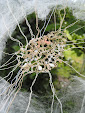
I designed
this three dimensional piece, inspired by modern architecture, using an
irregular grid and leaving spaces between the main elements to allow it to be
manipulated to form a sculptural shape. As you can see, Torchon lace has
outgrown its reputation as a simple peasant lace and is now being used to design
interesting contemporary lace works.

No comments:
Post a Comment