Therese de
Dillmont was an Austrian needleworker and author who ran an embroidery school
with her sister, owned several needlework shops in major European capital
cities and wrote many books and pamphlets about needlework including her famous
Encyclopaedia of needlework, which was published in 1886. She collaborated
with the French thread company Dollfus-Mieg et Cie (DMC) and their joint
publications promoted the company’s threads and became known for their clear
instructions and illustrations.

The booklets included
patterns printed on a strong flexible paper rather like Vilene fabric, which they
called ‘lace paper’. These could be cut out and used directly for working on to
although they do give instructions for pricking through them to make copies if
needed.

The booklet then shows how the design on
the pattern was outlined with a couched thread and the filling stitches
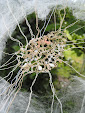
worked across the pattern areas. This image shows how blanket stitch was used
to fill the design and how bars of blanket stitch, worked over a thread, were
used to join areas together. It also shows how the outlines of the design elements
were edged with blanket stitch to give a more three-dimensional appearance
to the lace. I was interested to see that all the images show the stitches
being worked with the needle pointing away from the worker, as I have always
worked them the other way up with the needle pointing towards me, but the final
effect seems to be the same.

The booklet also
gives some suggestions for how the needle-made lace motifs and trims could be
used as decoration for fashion and household items. The designs are beautiful and the instructions are very
clear so I can see why these booklets have stood the test of time and why de
Dillmont’s encyclopaedia is still used by many needlewomen today.