Showing posts with label thread. Show all posts

Thursday, 5 March 2026

Needle-made lace from an old DMC booklet


This lace comes from an old DMC booklet on needle-made lace, which gives patterns, instructions and thread suggestions for the home needlewoman. The author is Therese de Dillmont, which surprised me, because she died in 1890 and this booklet gives the impression of being from a slightly later time, as the fashions are Edwardian rather than Victorian. It led me to do some further research and I discovered that DMC continued to publish books in de Dillmont’s name after her death because her name was such an asset to the company. Another confusion is that her niece had the same name as her and they published books in her name too.

Therese de Dillmont was an Austrian needleworker and author who ran an embroidery school with her sister, owned several needlework shops in major European capital cities and wrote many books and pamphlets about needlework including her famous Encyclopaedia of needlework, which was published in 1886. She collaborated with the French thread company Dollfus-Mieg et Cie (DMC) and their joint publications promoted the company’s threads and became known for their clear instructions and illustrations.

The booklets included patterns printed on a strong flexible paper rather like Vilene fabric, which they called ‘lace paper’. These could be cut out and used directly for working on to although they do give instructions for pricking through them to make copies if needed.

The booklet then shows how the design on the pattern was outlined with a couched thread and the filling stitches worked across the pattern areas. This image shows how blanket stitch was used to fill the design and how bars of blanket stitch, worked over a thread, were used to join areas together. It also shows how the outlines of the design elements were edged with blanket stitch to give a more three-dimensional appearance to the lace. I was interested to see that all the images show the stitches being worked with the needle pointing away from the worker, as I have always worked them the other way up with the needle pointing towards me, but the final effect seems to be the same.

The booklet also gives some suggestions for how the needle-made lace motifs and trims could be used as decoration for fashion and household items. The designs are beautiful and the instructions are very clear so I can see why these booklets have stood the test of time and why de Dillmont’s encyclopaedia is still used by many needlewomen today.  

Thursday, 29 May 2025

Large scale bobbin lace with alternative bobbins


I started this bobbin lace a few weeks ago using an assortment of unusual bobbins. I posted about it at the time (19 March) and explained that I was using them mainly because I needed large bobbins that would hold long lengths of thread. The lace worked up quite quickly because of its large scale and I’ve now finished all 3 metres of it and am attaching it to a net curtain for a piece of work that will be exhibited in the summer.

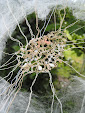
The alternative bobbins all worked very well, including the old spools that I used for the ‘hairy’ paper thread and the ball of hemp thread that I secured with a rubber band to stop it unwinding. The main problem with the hemp thread was that it had a tendency to twist. I hoped that pinning it in place while I made the lace would be enough to straighten it and keep it where I wanted it, but I found that for the longer loops that wasn’t enough and now it’s off the pillow many of them have twisted again. They are supposed to represent sound waves and should therefore be straight so I will have to secure them individually to the curtain which is annoying as it’s giving me extra work. In contrast, the paper thread had a tendency to flatten, so the hairy bits didn’t protrude as much as I’d hoped, but I managed to solve that, as I worked, by teasing them out with a long pin after every few rows. I want them to be obvious because the work is based on a story in a book and I wanted to reference the link between the lace sound waves and the paper pages of the book. The good news is that the threads all lasted the entire length of the lace, including the hemp and the paper threads which I was worried might run out, so the only bobbins I had to rewind were the weavers. I’m pleased with the way the work is progressing so far and the next task is to embroider text on to the curtain. I’ll let you know how I get on with that in a few weeks’ time.

Wednesday, 13 September 2023

Winding lace bobbins clockwise and anticlockwise

Traditionally English lacemakers wind the thread on their bobbins in a clockwise direction and continental European lacemakers wind theirs in an anticlockwise direction – why the difference? According to Pat Earnshaw, in her book on Threads of lace, It is all linked to the S and Z twists on the threads they used. She notes that in the nineteenth century, continental lacemakers generally used a hand-spun Z twisted, S plyed linen thread, while English lacemakers had easier access to mechanically Z spun cotton threads. The twist of the thread is important in bobbin lacemaking as the cross and twist of the basic stitches itself introduces an S and Z twist, respectively, as the work progresses. Therefore each twist will partially unwind an S spun thread while each cross will restore its stability. Thus English lacemakers were attempting to counteract the effect of their Z spun thread by winding their bobbins in a clockwise direction. Pat also suggests that the ring of beads, or spangle, that is used as a weight on English East Midlands bobbins may also have been a response to counter the twisting of the thread on the bobbins.