Wednesday, 12 June 2013

Light and line


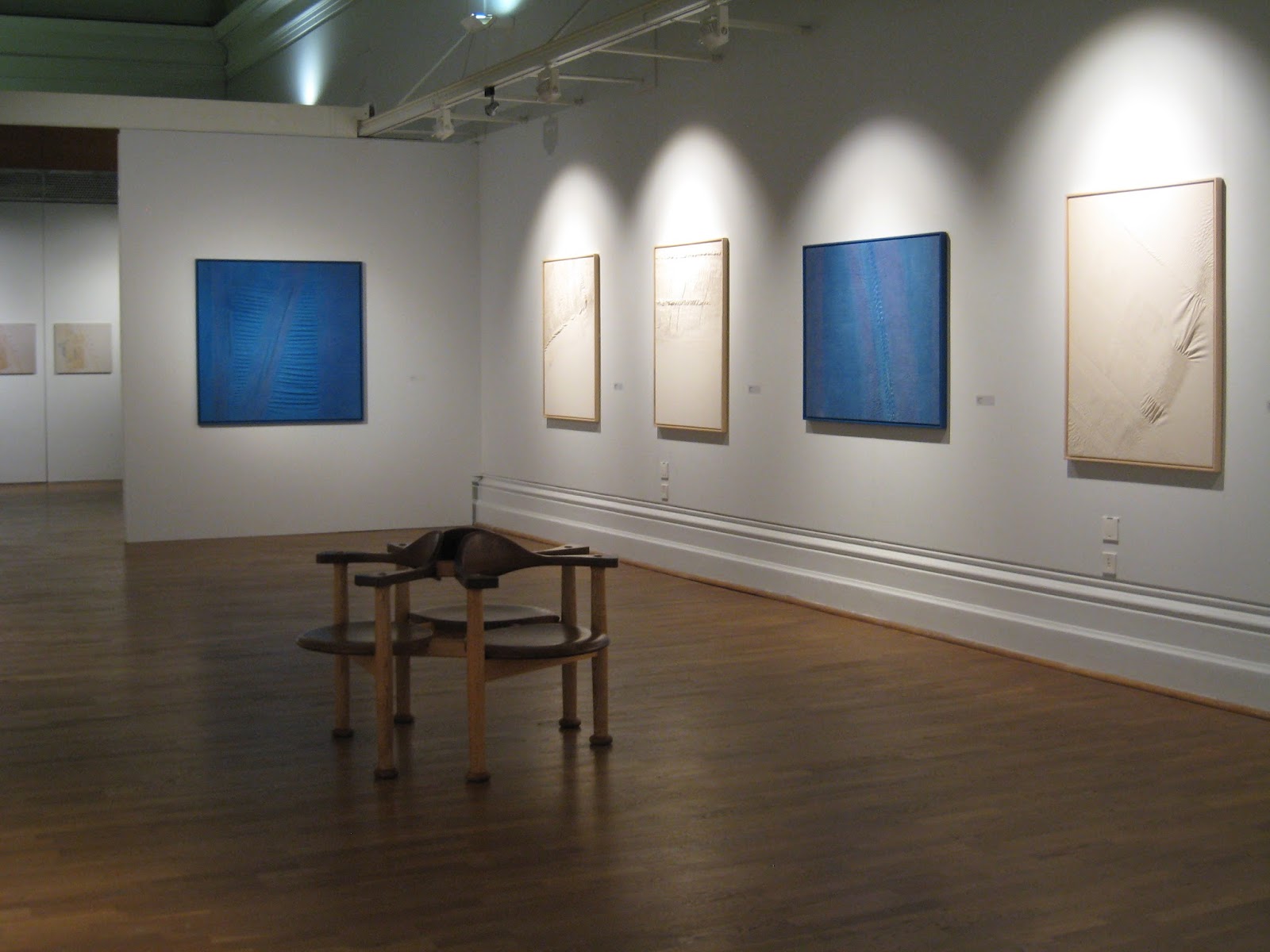
This exhibition at Nottingham Castle brings together the work of Polly Binns and Anne Morrell. Although at first sight their work seems quite different because Polly works in muted cream tones and Anne mainly in vibrant colours, they are inspired by the same observed moments in the natural world, particularly tidal areas. I liked Polly’s recent work especially the ‘Tide worn’ series of muted dyed panels with simple stitching and seaming representing the intertidal area. Anne’s ‘Verdure’ panels also included simple running stitches and I did not appreciate their luminous quality until I moved down the gallery and saw them from a distance. I also liked her ‘Palimpset’ which includes gathering, cleverly shaped and stretched, so the gathers appear off set, like tidal marks on the shore. It is an interesting exhibition which highlights the connections between the two artists.

Saturday, 8 June 2013

Gawthorpe Hall: lace exploration day


The Gawthorpe Hall lace collection is extensive, both in the number of items and its range. The bulk of the collection was made by Rachel Kay-Shuttleworth throughout the twentieth century and many of the pieces have her notes attached to them. Because Miss Rachel was a collector she obviously tried to find samples of all types of lace, so the collection is wide ranging and includes bobbin and needle lace as well as tambour and needle run laces. At the recent Lace exploration day we were shown lace from the sixteenth century through to the twentieth. Many of the pieces are exquisite including some lovely point de gaze, and a beautiful Duchesse flounce and lace dress panel, but some of the more simple samples are interesting for the techniques they show. It is a wonderful collection and it was lovely to have the chance to see so many interesting pieces.

Thursday, 6 June 2013

Festival of neighbourhood


I like the use of the windows and window frames in this exhibition outside the Royal Festival Hall. It is part of the Festival of neighbourhood and celebrates the liminal spaces of home – windows, doors and gardens – in particular gardening and growing, in beds and window boxes. The use of the window frames reminded me of Chiharu Shiota’s work.

Monday, 3 June 2013

Courtly style: Tudor and Stuart dress


This was an interesting study day at the V&A to coincide with two exhibitions: ‘Treasures of the royal courts’ at the V&A (see my blog of 19 April) and ‘In fine style’ which I’m hoping to visit later this month. Tessa Murdoch, the curator of the V&A exhibition began the day by explaining some of the background to the show and how the exhibits had been borrowed from Russia. I found the talk by Jenny Tiramani the most interesting. She has a wealth of knowledge and imparted it in a lively style. Her theme was how the silhouettes of the courtly styles were created by hidden structures such as pasteboard and wire to hold up collars; baleen ‘whalebone’, ivory and willow to maintain skirt and bodice structures; and stuffing from horse hair, cotton, wool and straw to pad out skirts and breeches. Claire Thornton talked superficially about embellishments on clothing. Angus Patterson gave a fascinating talk about the design and embellishment of armour, which turns out to be far more complicated and decorative than I had realised. Richard Williams also gave an excellent talk on dress in paintings, explaining the change that occurred in painting styles throughout the period. The Tudor painters, Holbein, and the miniaturists, accurately showed every thread of lace for example, but Van Dyke painting the Stuart court just gave an impression of lace and ornament. Instead of ornament, Van Dyke indicated the status of his sitters by their languid pose – a pose still used today, as Richard showed us, for example by members of the Bullingdon Club. Natasha Awais-Dean ended the day by talking about jewellery and in particular her research into hat ornaments. Another subject I knew little about but will take more interest in following Natasha’s excellent introduction. It was an interesting day, giving a general overview of dress and embellishments of the period and I’m looking forward to seeing the In fine style exhibition.

Friday, 31 May 2013

Waddesdon Manor lace collection


I spent an interesting morning looking at samples from the lace collection at Waddesdon Manor yesterday. I particularly admired the examples of Chantilly lace – a flounce and a fan, but there were also exquisite pieces of needlelace as well. The visit was arranged as part of the Lace 21 project, which is seeking proposals for lace interventions in the house for an exhibition in 2014.

Tuesday, 28 May 2013

Nottingham Contemporary


I finally managed to get to see Nottingham Contemporary last month. It’s an art gallery in the Lace Market area of Nottingham, but the reason I wanted to see it was not for what it houses but for the lace embedded in the concrete façade on the outside of the building. The lace was worked by Louise West based on a piece of Valenciennes style machine-made lace produced by the Nottingham lacemaking company of Richard Birkin in 1847. If you want to see how the lace was developed from an antique sample to concrete slabs, Louise has the details and lots of photos on her website. It’s great to see Nottingham celebrating its lace history at a contemporary site in this way.

Friday, 24 May 2013

Oversized lace


I’ve been making this oversized ninepin lace edging out of string (it's 8 inches wide) for an exhibition at the Crypt gallery in July called ‘The fabric of memory’. I will be showing large images of lace and fabric and oversized pieces of lace and fabric to complement them. Working on such a large scale has been interesting. I’ve had to scale up my bobbins to carry the amount of string required. I’ve been using tapestry bobbins and sticks of bamboo and I’ve found that keeping a short thread between the bobbin and the work is the easiest way of working. I’ve also used false picots rather than traditional Bedfordshire ones as they are easier to manage in string. Tensioning the lace has been tricky too because my pins are small in comparison to the work, but using larger pins or nails would have destroyed the polystyrene ‘pillow’ I’m working on. I’ve had to work one small section at a time, mainly so I don’t get backache, and also because the lace takes up so much space on the pillow. So much for all the technical problems – the lace is almost finished and I hope it looks good in the Crypt in July.