Thursday, 11 May 2017

Michael Brennand-Wood


It was interesting to hear Michael Brennand-Wood in conversation with Liz Cooper at the Crafts Study Centre talking about his work in the current exhibition entitled ‘Artists meet their makers’. The exhibition, curated by Liz, celebrates recent collaborations between Master Weavers from the West Dean Tapestry Studios and well known artists. Michael talked about his collaboration with Master Weaver Phil Sanderson to produce ‘Transformer’ a tapestry formed from a fusion of images taken from international lace and textile traditions to assemble the shape of a transformer. Rather than Michael giving Phil a completed artwork to reproduce, the two men worked together to produce the final piece.
Michael sent Phil images, from which he produced samples, and together by remixing the images the final work was produced. Asked about the collaborative process Michael said he knew Phil well and trusted his judgement and praised his skill at mixing subtle colours to interpret the design. Liz commented on the care taken to dye the range of colours required. Michael’s only criticism was that he would have liked the piece to have been larger. Phil agreed and said he too would have preferred a larger piece. Phil also noted that the aim of tapestry weaving is not to copy the artist’s design blindly but to retain the essence of the artist’s work within a tapestry framework - something beautifully achieved in this case. If you want to see the piece for yourself the exhibition is at the Crafts Study Centre, Farnham until 1 July.

Wednesday, 10 May 2017

Design ideas for another gothic lace veil


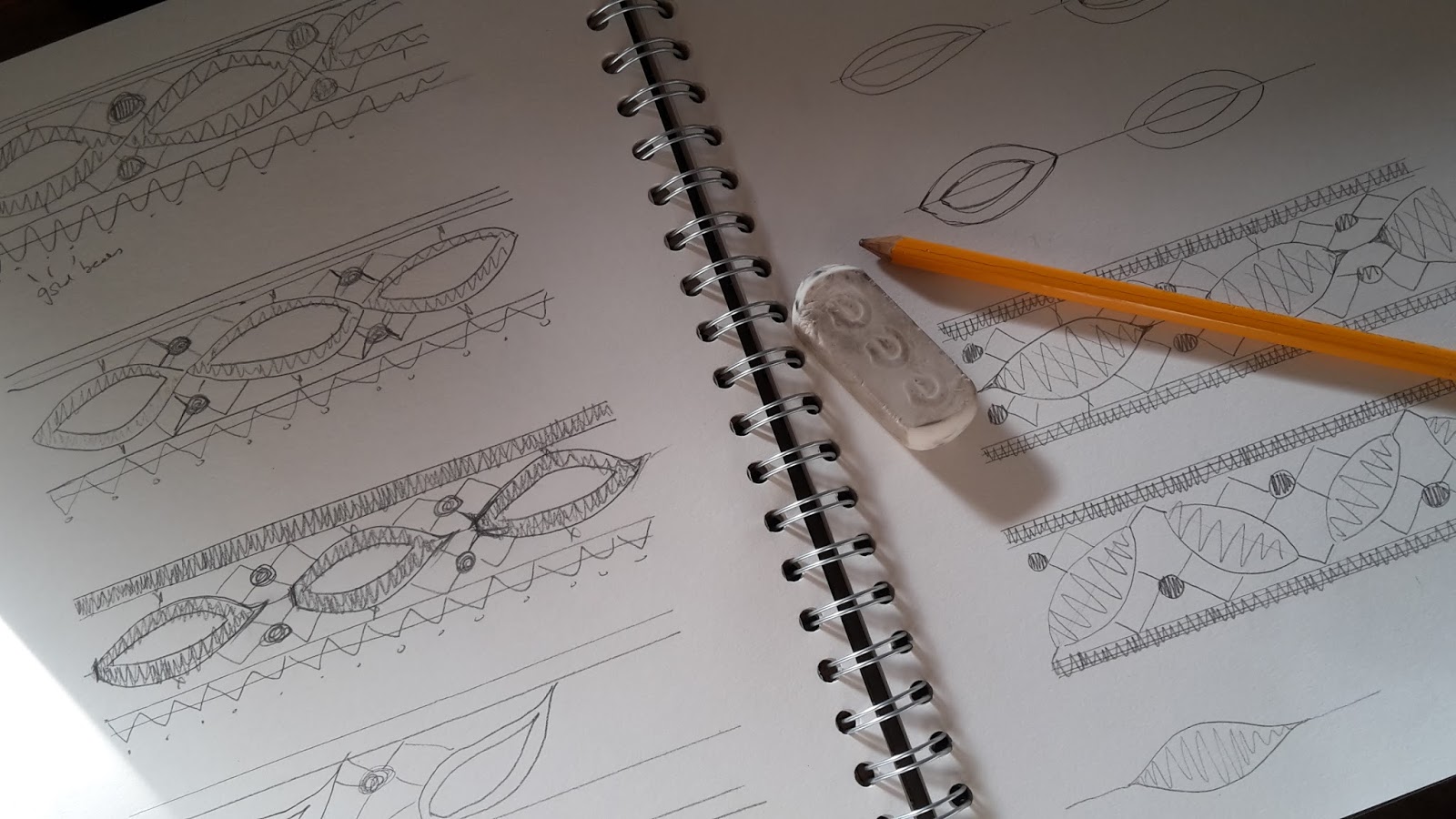
Having talked about my early bobbin lace designs last time I thought I’d show you my latest lace design ideas this time. Some of you may know that I produced a body of work for the Knitting and stitching show last year on the theme of veils – all of them linked to nineteenth century gothic heroines or writers in some way. Although that exhibition is over I still have ideas for more veils so have started putting some thoughts on paper. The one I’m working on at the moment will be another black veil and will suggest a widow’s mourning veil. However, the bobbin lace trim around the edge of the veil will incorporate the leaves and berries of the poisonous deadly nightshade (Atropa belladonna) suggesting that the widow’s state might not be entirely unexpected! I’m thinking of including a slight touch of gold in the lace too, just to suggest that the widow may be aiming for glamour rather than mourning and perhaps has come into money! The veil will be titled ‘Belladonna’.

Wednesday, 3 May 2017

Designing bobbin lace


Preparing a talk on designing bobbin lace made me go back and look at some of my earliest attempts at designing. These pears were one of my first designs and are basically outlines with fillings in the central areas. My inspiration came from two places, first of all, the garden, as we have several pear trees, but also Ann Collier’s book ‘Creative design in bobbin lace’. Her book gave me the confidence to have a go at designing and showed the way by describing how braid lace can be used to form the outline of a design. She also has a chapter on filling stitches that can be included within in the braid outline to give the design more interest and make the lace more stable. For this design, I first drew the outline of the pear as a continuous braid, allowing a split in the central area for the pip. Then selected some plait and picot fillings that suggested the texture of pears for the interior. Once I’d finished my bobbin lace pears I then needle laced some leaves incorporating wire into the edges to give them a slightly more three-dimensional appearance. It is a simple design, but for me it represents a huge step as it started me on a journey of lace design that I’m still enjoying.

Wednesday, 26 April 2017

Inspiration for an installation


I’ve been looking through old copies of Craft magazine and came across some inspiration for an installation I’m designing. I’ve been commissioned to produce a contemporary response to the Battle of Britain lace commemorative panel and as part of my response I would like to design an installation commemorating the airmen who lost their lives during the series of battles that constitute the Battle of Britain. I would like to produce a work that fills the room so Chiharu Shiota’s piece ‘In Between’ which fills the room with threads she uses to ‘draw in the air’ seemed very apposite as a way of linking lives with the air and the land. Angela Woodhouse’s ‘The waiting game’ also struck a chord, not because of her subject matter, but because I have been considering the use of parachutes and this suggested the idea of using a vast parachute to fill the room. Najla ElZein’s installation ‘The wind portal’ also suggested the propellers of vast numbers of aircraft. None of these ideas were what the original artists had in mind and I will not be copying any of them, but they have been very useful in crystallising ideas that have been running through my head and will help me define my own installation

Tuesday, 18 April 2017

Embroidered sleeve ruffles


I’ve been reading a beautiful book by Heather Toomer called ‘Embroidered with white’ which describes the eighteenth century fashion for Dresden lace and whitework in general. It is lavishly illustrated with photographs of lace and also includes drawings and patterns by Elspeth Reed, in the same style as those used in Janet Arnold’s books. Heather explains that sleeve ruffles in this period were made separately from the chemise and gathered onto a tape. They would have been sewn onto the band at the end of the chemise sleeve for wear, but would have been removed for laundering as they required special care. Rather than being circular many of them had a wider section that fell below the elbow such as the one in the image. They were often made in sets with perhaps a matching apron and cap. Although the ruffle in the picture only has one layer they were often made with several layers and some were embellished with the addition of a lace edging. They are beautiful items and with the current fashion for ruffled sleeves perhaps they’ll make a come back?

Tuesday, 11 April 2017

Lace in Rome


I haven’t found much lace in Rome but did come across several ecclesiastical shops selling vestments for priests, which had some lace in their windows. The selection here all came from one shop and included a variety of types. The main image shows needle lace and cutwork.

While the second image includes some handmade bobbin lace as well as chemical lace and the tape lace that is common in Brugges but made in the Far East. I assume they’re used to edge vestments and other church linen such as altar cloths.

Wednesday, 29 March 2017

Brise-bise lace curtains

I keep coming across the term brise-bise in my curtain research so decided to find out more. Brise-bise or Brisby net curtains are short curtains that hang across the lower part of the window. The name comes from the French for ‘wind breaker’. They tend to have a channel along the selvedge for a rod or wire to be passed through, which is attached to either side of the window and often a scalloped lower edge. They were popular in the early twentieth century, hung across the lower part of a sash window. CafĂ© curtains are similar, short curtains, which became popular in the 1950s. They could be hung singly but were sometimes hung in tiers with one curtain across the upper part of the window and another over the lower part. Like brise-bise curtains they were often made with a channel for a hanging rod or sometimes had tab tops or loops through which the rod was inserted.