

To make the
lace you need a base on which to form the initial circle of threads, enough
pins to keep them in place and some crochet cotton. It is ideal if the base
circle of threads is made with one continuous thread, with a little left over
to start the weaving process. To begin the work, the weaving thread is passed
alternately over and under two of the foundation threads, drawing the thread
down into the centre of the circle as you can see in Fig 2 above. Once you have
made a complete circle you reverse the direction and work another circle in the
opposite direction, and then work a third circle to make a compact and firm
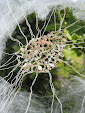
centre. The circle can then be embellished in various ways by catching clusters
of threads to make different patterns as you can see in Fig 3.

When the
weaving is finished the pins holding the foundation threads at the edges are
removed to release the completed wheel. If the last round of knotting is close
to the pins holding the foundation threads, the removal of the pins leaves an
edge of picots, which can be used to attach the wheels to each other or to a
linen background with buttonhole stitches.

To make a
larger piece of lace you can join more wheels to each other and fill in the
gaps between them with small squares or rounds of the lace. The magazine
suggests making these smaller shapes on a Briggs No 2 lace wheel, which seems
to be part of a set of Teneriffe wheel frames, which can be bought in brass or
tortoise-shell. In the image the wheels and squares all seem to fit together
beautifully but I can imagine it would be quite hard in practice to get them to
fit neatly together. The magazine recommends not drawing up the stitches
tightly but leaving ‘a certain amount of elasticity’. I can see that Teneriffe
lace is portable and inexpensive, as the magazine suggests, and would have been
ideal for a busy woman who wanted a project that could be picked up and worked
in odd moments, as well as taken to a tea party to work while seeing friends,
but I think all the sewing required to join the wheels together at the end
would have been quite tricky.

No comments:
Post a Comment