Showing posts with label mat. Show all posts

Wednesday, 17 July 2024

Needlelace stitches


I’m always amazed at what beautiful lace can be made with just a some thread and a sewing needle. This lace mat is a simple design of leaves and flowers worked on a large scale and clearly shows the variety of needlelace stitches that can be used to provide different textures and densities. The lacemaker would have begun with an outline of the main parts of the design couched onto a backing fabric and would then have worked filling stitches into the open areas. After that she would have made the bars that link all the parts of the design together. And finally she would have worked blanket stitch around all the outlines, possibly over a couched thread to raise the outlines slightly, to add definition to the design. The finished lace would then have been detached from the backing fabric.

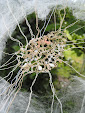
The filling stitches are all variations of blanket stitch, which can be worked across the area to be filled, either close together to form a dense area or wide apart to form an open one. A line of thread can be taken across the area and the stitches worked over that to add density. The blanket stitches can also be worked in pairs or groups to give a more brick-like appearance and these can also be worked over a line of thread as a variation. The image above shows two types of double net stitch (where two blanket stitches are worked in pairs across the area to be filled) and one example of double net stitch worked over a line of thread, showing a few of the possible variations.

This photo shows a small sample of double net stitch, showing how it is worked across the area to be filled by making blanket stitches into the loop left between the stitches of the previous row. If a line of thread is taken across the work it is incorporated into the line of stitching. As you can imagine any number of stitches can be grouped together to vary the density and appearance of the lace – the possibilities are endless.

Wednesday, 5 June 2024

Crochet lace


There are many types of crochet lace, including Irish crochet lace and hairpin crochet, but today I’m looking at the type of crochet lace patterns that were popular homemade crafts in the 19th and 20th centuries. The instructions for many of these designs were easily available in women’s magazines, needlework books and craft leaflets, many of them produced by the thread manufacturers. The equipment was a simple hook and thread and the work was portable and easy to pick up and put down if the housewife had a few moments of leisure between household tasks. The majority of these crochet items were made at home for use in the home.

Mats and doilies, like the one in the main image, were popular, but crochet was also used to make lace trimmings for clothing and household linen, such as this example from Therese de Dilmont’s encyclopaedia of needlework, which mimics needlemade reticella lace.

Another reason why crochet was such a versatile craft for the homemaker is that items could be made from a collection of smaller squares or medallions, which were easier to work than one large piece of lace, and could be assembled to form the finished larger item once enough squares had been made. An example is this chair back, which is also illustrated with instructions in de Dilmont’s encyclopaedia.

It is no longer fashionable to incorporate so much lace in interior design, but many families have heirloom pieces of crochet lace made by their forebears and although we do not use them in our daily lives we should acknowledge their beauty and not dismiss the level of skill involved in their construction.

Thursday, 15 February 2024

Miss Channer’s lace mat


Catherine Channer was actively involved in the revival of the East Midlands handmade lace industry in Britain in the early twentieth century. She was a lacemaker, teacher and researcher and I’ve written about some of her work in this blog before. Today I’m looking at Miss Channer’s mat which she designed in the early 1920s using the technique for pricking the ground that she had developed following research into old lace patterns and their origins (see this blog of 24 October 2023). An image of the mat was published in her book Practical lacemaking published in 1928 which was one of the few textbooks for students and gave instructions and patterns for Bucks point lace. 

The mat in the book had been worked by Mrs Dixon of Clapham, Bedfordshire in about 1926 and is now in the collection of the Cecil Higgins Art Gallery in Bedford. The mat became famous as a challenge for skilled lacemakers in 1991 when Ruth Bean published Anne Buck’s book about Miss Channer entitled In the cause of English lace. A supplement was published at the same time comprising an image of the mat and a full sized pricking of it, which had been adapted by Patricia Bury from an earlier version in her collection. Since then many lacemakers have worked it and their handiwork can be seen by searching for ‘Miss Channers mat’ on the internet. No instructions were given for the original mat or for the version published in 1991 so it is also interesting to see how it has been worked by different lacemakers and the varying number of pairs of bobbins they used to complete it. I have never made Miss Channer’s mat but I do admire the skill and patience of those who have.

Wednesday, 26 May 2021

Lace antimacassars


The images of these lace antimacassars come from a furnishing catalogue dated 1933-34. Antimacassars were small mats laid over the back of easy chairs in the 19 century to protect the fabric of the chair from macassar oil which was used by men as a hair dressing. However they seem to have been originally used in the 18 century to protect furniture from wig powder. They were clearly still being sold in the 1930s to prevent stains from hair products and grease rather than wig powder or macassar oil. The earliest mats were made to match the furnishing fabric but by the 19 century the fashion was to have decorative mats that contrasted with the fabric of the chair and this is the style of these 1930s designs.

I would have thought that white lace antimacassars would have become dirty fairly quickly but perhaps that was part of their purpose, to show how clean the house was kept as they would have required frequent laundering. The antimacassars in my catalogue were sold by the dozen. Unfortunately there are no prices but the buyer received an assortment of three designs, presumably four of each pattern to allow for the regular washing required. This suggests they were aimed at a home with four easy chairs whose owner was not particularly concerned about the design, as only one representative design is given for each set – perhaps their function was more important than their appearance. They were quite large with the rose design at the top being 24 by 36 inches and the floral one with the leaves measuring 18 by 27 inches. I hope that they were easy to wash and iron for the sake of the poor laundress.

Wednesday, 21 April 2021

‘Me too’ bobbin lace mat

I have finally finished my ‘Me too’ bobbin lace mat but now have to tidy up all the ends either by sewing them in or cutting them off depending on where they left the work. I was hoping with this continuous type of lace that there wouldn’t be quite so many ends to tidy up but of course you can only wind a certain amount of thread round a bobbin and when that runs out you have to tie in a new thread. Also the text in the centre of the mat was quite fiddly involving lots of beginnings and ends which also leads to a lot of threads to deal with at the end. It will be good to get the work off the pillow and see what it looks like from the front as I've been working it from the back. I’m now planning the next mat in this series of subversive lace mats commenting on the constraints of domesticity. I have certainly enjoyed working this type of tape lace and feel I have got to know the technique much better, which means I have a better idea of how to design for it. I will definitely use it again for the circumference of the mat and as much of the centre as possible. I now have to decide on my text for the next one and then start designing around it.