Showing posts with label needlelace. Show all posts

Wednesday, 18 June 2025

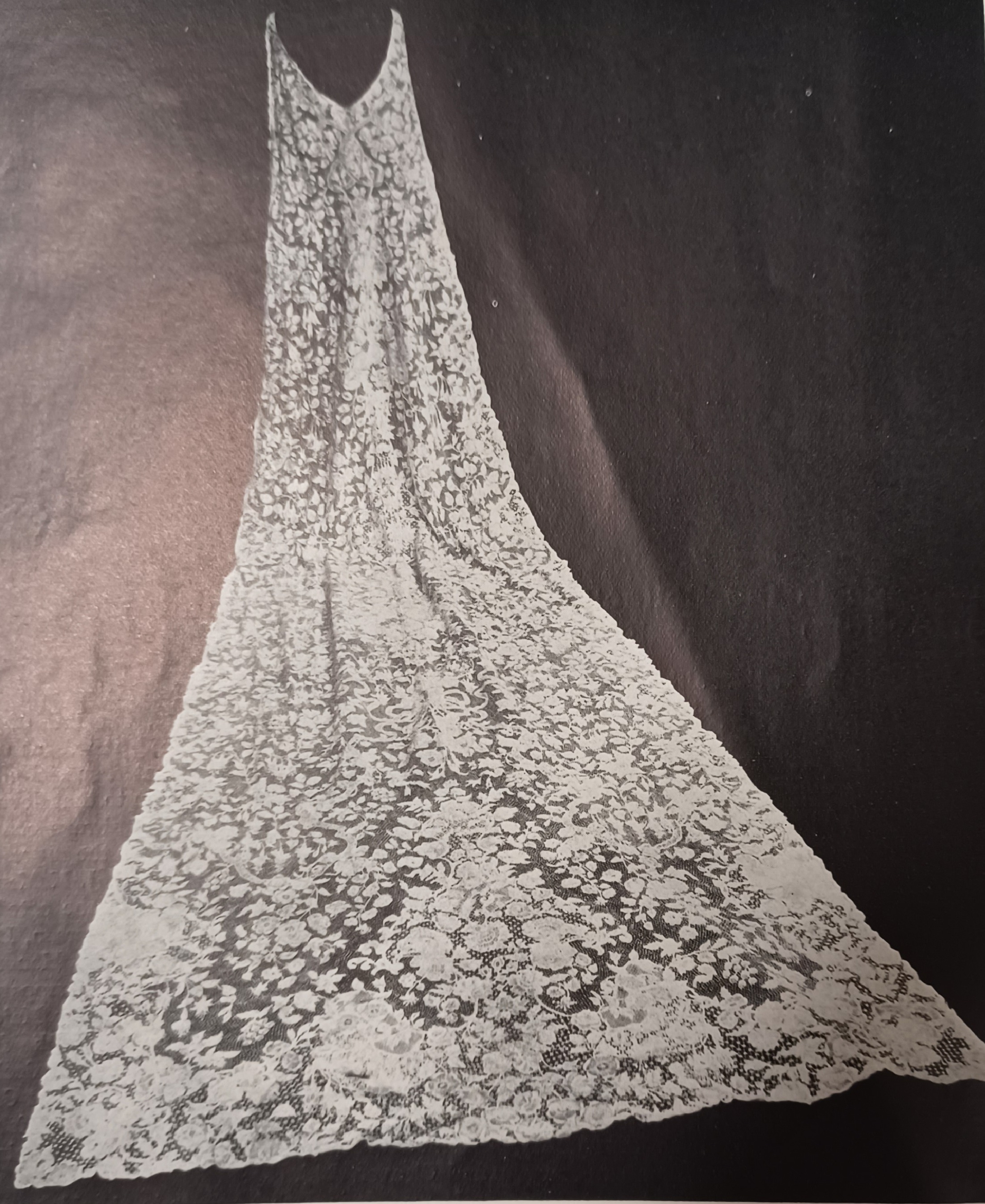
Queen Mary’s lace court train


Queen Mary was an avid collector of art and artefacts and her lace collection was the subject of an article in The Connoisseur magazine of June 1928. Pride of place in the collection went to the court train of Irish needlepoint lace that was made for her to wear at the Coronation Durbar in Delhi in 1911. The train was commissioned by a group of influential ladies from Belfast, including the lady mayoress, who set up a committee and raised funds for the work. There was little time between the King’s accession and the Durbar so the train had to be made in 6 months. The Presentation Convent of Youghal in County Cork was given the task, and it is reported that 60 skilled lacemakers work in relays through the day and night to make the lace on time. It was estimated that one lacemaker would have taken about 30 years to complete the task alone.

The pattern includes scrolls and flowers, including the may flower as a reference to the Queen who was known as Princess May before her coronation. The lace is made with a needle and thread and the work is basically made up of blanket stitches and their various combinations to form intricate patterns.

 This type of needlelace is suited to collaborative work because the individual motifs are made separately by the lacemakers and then assembled and joined together with more fine needlelace. Each worker has her own specialism, such a drawing out the patterns, laying down the outlining cord, working the stitches or assembling the motifs and joining them with net stitches. It is a huge achievement to have completed a work of such intricacy, accuracy and beauty in 6 months and we should marvel at the skill of the Irish lacemakers involved in the task.

Wednesday, 17 July 2024

Needlelace stitches


I’m always amazed at what beautiful lace can be made with just a some thread and a sewing needle. This lace mat is a simple design of leaves and flowers worked on a large scale and clearly shows the variety of needlelace stitches that can be used to provide different textures and densities. The lacemaker would have begun with an outline of the main parts of the design couched onto a backing fabric and would then have worked filling stitches into the open areas. After that she would have made the bars that link all the parts of the design together. And finally she would have worked blanket stitch around all the outlines, possibly over a couched thread to raise the outlines slightly, to add definition to the design. The finished lace would then have been detached from the backing fabric.

The filling stitches are all variations of blanket stitch, which can be worked across the area to be filled, either close together to form a dense area or wide apart to form an open one. A line of thread can be taken across the area and the stitches worked over that to add density. The blanket stitches can also be worked in pairs or groups to give a more brick-like appearance and these can also be worked over a line of thread as a variation. The image above shows two types of double net stitch (where two blanket stitches are worked in pairs across the area to be filled) and one example of double net stitch worked over a line of thread, showing a few of the possible variations.

This photo shows a small sample of double net stitch, showing how it is worked across the area to be filled by making blanket stitches into the loop left between the stitches of the previous row. If a line of thread is taken across the work it is incorporated into the line of stitching. As you can imagine any number of stitches can be grouped together to vary the density and appearance of the lace – the possibilities are endless.

Wednesday, 17 April 2024

‘Modern’ point lace


My 1882 edition of the Dictionary of needlework describes how to work this type of needlelace which was a popular pastime in the late nineteenth century. It describes point lace as any needlelace, except cut and drawn work, which is worked in buttonhole stitches on a parchment pattern. It goes on to explain that this modern type of point lace has been made since 1855, particularly in France where it is known as dentelle renaissance. The materials required are tracing cloth on which to draw the design, Toile Cire (which seems to be oil cloth) ‘to give firmness to the lace while in progress’ so I assume it is used as a backing cloth for the work, needles, linen braids and linen thread. A variety of linen braids were obviously available at the time but the book notes you could also make your own in bobbin lace if you preferred. It recommends using a fine thread such as Haythorne’s linen thread (I assume this is a brand name).

The first step is to draw the outline of the lace onto the tracing cloth and this is the suggested starting pattern. Then tack the braid loosely to the cloth. After that overcast all the edges of the braid, drawing up the thread at the inner edges of the curves so they sit flat. Then join the separate parts of the design with bars as shown by passing a thread across a space three times, buttonholing over the threads to the centre of the bar, where a picot is formed, and then continuing by buttonholing the other half of the bar. The centre of the braid shapes can then be filled with needlelace filling stitches. For beginners they suggest using point de Bruxelles as the filling stitch, which is a series of interlocked rows of loose buttonhole stitches. This seems quite a difficult stitch for beginners, as it is hard to maintain a good tension, but of course Victorian women all knew how to stitch and most were quite adept at something as well-known as buttonhole stitch.

Wednesday, 31 January 2024

Renaissance lace on Elizabethan dress


This lovely lace on the edge of a ruff is depicted on the Rainbow portrait of Queen Elizabeth, which was painted in about 1600, probably by Marcus Gheeraerts the Younger although there is a possibility that the painter may have been Isaac Oliver; it can be seen at Hatfield House.

Early needle lace developed from cutwork, in which fabric was cut away from a background, leaving a pattern of threads that were then oversewn. Eventually the background fabric was dispensed with and the pattern was laid out in threads which were then joined by stitching. The lace on the edge of her ruff shows a combination of these two types of needle lace, with cutwork on the lower part of the lace and a free edging around the outer part of the lace where the stitches were worked on free loops of thread. Early bobbin lace developed from the plaiting of cords, using thread wound on bobbins, to become a more open design and the figure of eight edging round the bodice may be a plaited cord. Patterns for both types of lace were available in pattern books that circulated widely in western Europe.

This pattern comes from Frederic Vinciolo’s pattern book for needle made laces, first published in France in 1587 and dedicated to his patroness, the Dowager Queen of France, Catherine de Medici, who had brought her knowledge of lace from her native Italy. It is similar to the edging on the Queen Elizabeth’s ruff with two layers of lace patterning and a more freely worked picot edging. This type of work was also known as ‘punto in aria’ (stitches in air) and as the book does not include instructions we must admire the lacemaker who could conjure such wonderful lace seemingly out of the air.  

Wednesday, 16 August 2023

Variations in one needlelace pattern

This lace is a lovely mixture of bobbin and needle lace and the way it’s made suggests that it was worked in separate parts by several lacemakers and then combined into the final piece. This practice was common in the nineteenth century as several people working on one piece ensured it was worked more quickly and it also allowed lacemakers to specialise in one type of lace or even one motif.


Concentrating on one detailed part of the design shows how different lacemakers interpreted the same pattern. This area of the lace is a needlelace surround to an area of needlelace ground which holds in place a detailed bobbin lace motif. 

You can see how the two small circular motifs have been worked in a variety of ways. In the upper image they have both been filled with a circle of couronnes, which would probably have been made off the pillow round a pointed former and then added to the work. Making these little circles could also have been delegated to beginners so there was a stock of them to be used when required. 

In other examples, the circles have been worked on the pillow with a series of blanket stitches to form circular shapes. The filling stitches have also been worked differently. In two cases they form a hexagonal shape with picots along the length of the sides and in two other examples the filling stitches are made up of tiny couronnes, embellished with picots, joined together by a pair of twisted threads. 

The final example is completely different from the others. The large circular area has been divided up into quadrants by a cross of bars, each enclosing a little couronne, and the smaller circle has been almost filled with concentric circles of needlelace. The filling stitches are also unique and are made up of a series of triangular woven areas with extended picots. Finding all these different variations in one pattern, in just one piece of lace, highlights the working practices of the lacemakers who worked as a group to make one piece of lace and suggests that these skilled lacemakers were allocated patterns and allowed to interpret them in the way they thought best.

Wednesday, 29 March 2023

Needlelace edging

This beautiful little edging is made entirely with a needle and thread using a technique based on a variation of buttonhole stitches. It always amazes me that some of the most beautiful lace began its life as a simple reel of thread and it is the ingenuity of the lacemaker, using nothing but her hands and a needle, that transforms it into such a fine and delicate fabric. The pattern for this lace would have been drawn on a firm piece of card which would have been attached to a thick piece of supporting fabric and could then have been worked in the hand or attached to a firmer base such as a lace pillow. The shape of the pattern would have been couched down first using a thick outlining thread, tacked down through all the layers. The buttonhole filling stitches would then have been worked between the couched threads in a finer working thread. Once the main areas had been worked, the filling net stitches round the flower would have been worked and final embellishments such as the spots on the net would have been added.

Once the entire lace was completed the tacking stitches used to secure the original outline would be cut between the pattern and the backing so that the lace could be removed from the pattern. This design could have been worked by several lacemakers specialising in different parts of the work with some concentrating on the main motif or the outside edge while others assembled the separate pieces and added the net filling. I’m pleased to see that this lace has clearly been well loved as its original footside is missing and it has been reattached to a machine-made edging for reuse, showing that all the hard work that went into its construction was appreciated.

Wednesday, 30 November 2022

Damascene lace

Damascene lace is an adaptation of Honiton pillow lace invented in the late nineteenth century as a hobby lace. It incorporates Honiton lace sprigs and braid lace joined by corded bars and does not include any filling stitches. It can be quite simple to make if the Honiton motifs and the braid are ready bought or more complicated if the lacemaker works her own motifs and braid in pillow lace. To make the lace, the pattern is drawn on calico and the sprigs are tacked in place. Once they are positioned the braid is also tacked down following the pattern. Where the braid touches another part of braid the two are overcast together. The braid and motifs are then joined with bars made by running several threads from one to the other and making a series of close buttonhole stitches along their length. A little ready-made picot edging has also been added to the edge of this lace to finish it off neatly. Once all the elements are joined together the tacking threads are removed and the lace can be lifted off its calico backing in one piece. If the worker bought the components this would be a simple way to make dress decorations, such as this sleeve edge, as it required competent sewing skills but no lacemaking expertise.   

Wednesday, 20 July 2022

Revival of needlepoint laces


I’ve been reading about the revival of Venetian style needlepoint laces throughout Europe during the 1880s as part of my research into ‘imitation’ laces. These heavier more structured laces became fashionable as trimmings on clothing at this time. This led to lacemakers copying examples of seventeenth century laces but also in many cases remodelling actual pieces of old seventeenth century lace. Belgian lacemakers famed for the expertise of their needlelace copied many of these seventeenth century designs so skilfully that it is thought some Venetian merchants ordered the lace and sold it for high prices to visitors to Venice as genuine seventeenth century work. It is very difficult to distinguish it from the original lace although one tell-tale sign is the use of cotton thread instead of the original linen thread as cotton thread was not used for lace making until the 1830s. However, hand lacemakers soon had competition in the form of chemical lace made by embroidering patterns on to a sacrificial backing material which was then chemically removed and which superficially imitated the more solid Venetian styles very well. The lace in the image is a modern interpretation of needlepoint lace.

Wednesday, 13 July 2022

Lace shawls, collars, pelerines, scarves, berthas and fichus


These shoulder coverings were all popular at different times during the 19 century and in many cases it is difficult to classify them. Scarves and stoles look very similar as do pelerines, fichus, berthas and collars depending on their width and when they were made. The examples here all come from the lovely ‘Lace in fashion’ exhibition which is currently on display at Wardown House Museum in Luton. Not only do they show the range of different fashions they also show how lace changed during the century from the entirely handworked, such as the fichu made in Bedfordshire Maltese lace, to a beautiful black machine lace collar.

There is a lovely wide Duchess collar of mixed Brussels bobbin and needle lace showing how the two types of handmade lace were traditionally combined and the image shows a detail of a beautiful dress including both types of Brussels lace applied to a machine lace background showing how handmade and machine lace were often combined. There is also a fichu combining pillow lace with machine lace as well as scarves with Honiton bobbin lace applied to machine made net. Several of the other collars have a machine net basis including a Limerick lace collar and another tamboured shawl. Other Irish laces popular in the second half of the 19 century are also represented with a Carrickmacross applique lace bertha, and an Irish crochet collar. I was also interested to see some examples of ‘imitation’ lace following on from my recent blog posts. The exhibition includes two Chantilly lace shawls one handmade and the other machine made; difficult to tell apart without close inspection as would have been the case when they were worn. There is also a chemical lace pelerine worked in the style of Irish crochet and a late 19 century collar worked in the style of 17 century lace, so lots of copying and convergence going on. If you want to see more you will have to visit the exhibition which includes much more lace than the few pieces I’ve described here and is well worth a visit. It is open until 11 September.

Tuesday, 21 June 2022

Imitation lace – one late 19 century view


I was amused by an entry in my 1882 Dictionary of needlework on imitation lace, as surely that is a description that could apply to most types of lace. However, it seems that the focus of the entry is those types of lace made from machine-made braids and handmade fillings that were popular with the domestic audience who would have been reading the Dictionary. The book gives five examples of different ways the technique can be used and the end results are very effective considering the simplicity of the materials. The imitation Venetian lace in the image above is a simplified version of Venetian gros point; an elaborate needlelace that was made in the seventeenth century.  To make the lace you have to trace the design on to calico then tack down machine-made, half inch wide, cloth braid, doubling it where necessary and smoothing it round the curves – by no means an easy task! Then run a fine cord all the way round the edge of the design. When that is done, the open parts of the pattern can be filled in with needlelace stitches of your choice and the main elements of the pattern are then joined together by buttonhole bars. Finally, you have to work buttonhole stitch over the raised cord, all the way round the design in the same way as the original Venetian lace. You can further embellish this raised cordonnet by working a lace edging along its length if you like. The lace can then be removed from its calico backing.

Another example is an imitation Honiton lace. For this one, three types of braid are required; a straight one for the edge and two types of braid made up of continuous leaf shapes, one of half stitch leaves and the other of cloth stitch leaves. The lace is made on a calico foundation as above and you start by tacking down the foundation line of braid at the top. Then the half stitch leaf braid is tacked in place, up and down, just touching the upper braid, to make a zigzag edge. The cloth stitch leaf braid is then laid over the half stitch one, in the same way to make a zigzag, filling the gaps. However, for this one, every other cloth leaf is folded over to make it look like a leaf stalk. Another straight braid is laid under the pattern and the leaf pattern repeated using just half stitch leaves. Where the braids touch they have to be sewn together and bars added to join the sections together. The instructions blithely suggest sewing ‘an ornamental lace edging to the lower edge of the pattern’. This piece certainly seems easier to work than the imitation Venetian lace, but all the designs assume the reader has a detailed knowledge of needlelace stitches and the skill to carry them out with little instruction.

Wednesday, 4 August 2021

16 century open lace ruffs


By the end of the sixteenth century lower necklines became fashionable and the appearance of ruffs also began to change. Many were now worn open with the edges attached to the neckline on either side and pinned to the corners of the bodice. Ruffs were still wide and could be made entirely of lace or made of fine embroidered fabric edged with lace. Both the ruffs illustrated here are made of lace and edged with handmade needlelace.

Both images depict Queen Elizabeth I, the top one is by an unknown artist and was painted in 1590, the second is known as the rainbow portrait by Isaac Oliver and was painted in 1611. The ruffs would have been supported by an underproper (more on those another day) and the diaphanous veil behind would also have been supported with wire. In both portraits the Queen’s bodice is also embellished with fine needlelace so the whole effect would have been quite magnificent.

Wednesday, 14 July 2021

Brussels application lace veil

This beautiful lace veil was shown at the Great Exhibition of 1851 by the Belgian company Delahaye. The description in the Art Journal Catalogue published at the time and from which this image comes states ‘‘The patient labour and perseverance necessary to complete these exquisite additions to the toilette of beauty can scarcely be understood by those who have not witnessed their slow growth in the manufactory, in which years are consumed in the production of a single veil’.

Brussels application lace was indeed beautiful and time consuming to produce as it included both fine bobbin lace and exquisite needle lace. Patricia Wardle in her book on Victorian lace describes the manufacturing process and the specialised workers it involved. The drocheleuse made fine strips of bobbin net for the background net, which were joined together by the jointeuse. Flower motifs were made by the pointeuse in fine needle lace and the relief or more three dimensional areas were worked by the brodeuse. The bobbin lace motifs were also made by two specialist workers; the platteuse made the solid parts of the design and the formeuse added the intricate filling stitches. All of these elements were assembled into the final piece in the workrooms of the lace manufacturer by highly skilled striqueuses. By 1851 when this beautiful shawl was exhibited the background net was much more likely to be machine made rather than the drochel of the early nineteenth century but the other parts of the work would still have been made separately and joined together with ‘patient labour’ as the catalogue suggests. 

Wednesday, 28 April 2021

Fine tape lace with needlelace fillings

In my latest lace mat I’ve been using a form of tape lace that is common in Eastern Europe and involves working bobbin lace in lines that curve and join each other as the work progresses to form the pattern. However there is another type of tape lace, shown in the image above, in which a ready made tape is used to form an outline and the open areas are then filled with needle lace fillings. This type of lace was simple to make and was common in the 16th and 17th centuries in Italy and France. It then fell out of favour but saw a resurgence following the development of machine made lace tape in the 19th century. It is made in many places but became associated with Branscombe in Devon in the mid-19 century where the outlines were made using fine tapes from France into which delicate needle lace filling stitches were added.

The examples here are basic samples I made a while ago but they show how the lace is made. The outlining tape is tacked on to a backing for working using a continuous tape that is folded at joining points and sewn down onto itself rather than cutting it off and having to neaten the edge. When working a curve a basting line is run round the edge of the tape so it can be pulled up neatly to make it smooth. The filling stitches are then made in needle lace using a combination of fine buttonhole stitches worked in various patterns and joined into the work on each side. In this piece I also worked a purl edge around the outside of the design. Once the lace is complete the tacking stitches are taken out and the lace lifted from the backing.

Although the leaf design shows a variety of fairly dense stitches, the simple trefoil here shows how easily the spaces can be filled with just a few twisted threads and spider fillings making the work quick to produce if it is being made for sale. Many commercial handmade lace mats are now made in this way and with their combination of open work tapes and simple filling stitches they can be very attractive.

Wednesday, 7 April 2021

Brussels lace


This lovely little piece of lace is made up of both bobbin and needle lace so I’ve described it as Brussels for want of a better description. The flower motifs inside each scallop are made of a pieced lace, like Honiton, where each spray or series of leaves is made separately on a lace pillow and then combined when the finished article is made up. Alternating scallop edges are also made using this pieced lace technique. However every alternate scallop and the inner edge of each one is made of needle lace and the bobbin lace motifs are joined together, and to the scallop, with a needle lace net ground. Needle lace has also been used to decorate the centre of some of the bobbin lace flowers and to make circular couronnes within the net ground. 


The work is so fine - just look at the tiny picot edgings - it would have been extremely time consuming and different lacemakers would have been responsible for separate parts of the work. The needle lace and bobbin lace motifs would have been assembled and then joined together on a needle lace pillow when the net ground stitches and the filling stitches would have been used to link them all together in the final design.

Wednesday, 17 March 2021

Lace made from human hair


I’ve been looking at 16th century lace and came upon information about lace made from human hair. The example in the image is needlelace from the V&A Museum and is dated 1600. Janet Arnold notes that a silkwoman called Dorothy Speckard supplied Queen Elizabeth I with ‘heare braid’ and ‘two hundred devices made of heare in maner of leaves’. The slightly later fashion for strings of plaited hair looped round the neck or wrist seem to be keepsakes or love tokens but the earlier laces don’t seem to fulfil that function. Mary Jones refers to ‘point tresse,’ a type of lace made from human hair. She says this type of lace was understandably quite rare and commanded high prices. She records that Mary Queen of Scots received some point tresse from the Countess of Lenox, the mother of her former husband Lord Darnley, and that in the eyes of the family this gift exonerated Mary from the implication of having any part in Darnley’s murder. Jones also records that Louis XIV wore a cravat of silvery white hair at his coronation in 1614. Jones notes that point tresse was still being made in the 18 and 19 centuries by ‘Dalecarlian peasant girls’. Unfortunately this type of lace doesn’t last well so there are few examples but I assume it was all needlelace as finding enough human hair to wind round the lace bobbins required for even a simple pattern would have been no easy task.

Wednesday, 18 November 2020

‘Frayed nerves’ needle lace

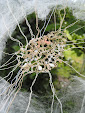
Walking the dog today and looking at the bare branches of the trees reminded me of this piece of lace I made a while ago. Based on nerves rather than branches it still reminds me of this bare, raw season of the year and the feeling of wind and rain tearing everything off the trees, leaving things exposed and vulnerable. It also seemed quite apposite to a time of lockdown and isolation. It’s made of needle lace cordonets and I kept the frayed ends to embed into silk paper and also to reference the title of the piece. As you can tell I’m not an autumn person but I am trying to tune in to the beauty of the season by reading the anthology on Autumn compiled by Melissa Harrison and it is changing my view. I’d always thought of autumn as just a wet cold time we had to get through in the run up to Christmas and then look forward to the spring but Melissa has shown me that it can also be a time of renewal and beauty.

Wednesday, 5 June 2019

Buttonhole stitches in needle lace


Buttonhole stitches are so versatile - they are the basis of needle lace and are also used in white work, embroidery and general sewing. It never fails to amaze me how a skein of thread can be turned into the most delicate needle lace using the humble buttonhole stitch. Therese de Dillmont in her Encyclopedia of needlework explains how to execute the stitch in her section on plain sewing and describes many variations on the basic stitch in her chapter on needle-made laces. She shows how to make joining bars with picots and longer branched bars with double buttonhole stitches to form a more rigid structure. She also describes how to make various ground stitches using more open loosely formed buttonhole stitches, which she calls Brussels stitch. In total, she describes 40 needle lace stitches all based on the same buttonhole stitch model. The image shows a detail of some needle lace showing an open Brussels stitch, another worked over a guiding thread, and open stitches over a gimp composed of several threads forming joining bars. All made using the simple buttonhole stitch!

Wednesday, 8 May 2019

Needle lace sampler of Susanna and the Elders


I saw this lovely needle lace sampler in the Ashmolean Museum in Oxford over the weekend; it is part of the Feller collection. The subject is the Biblical story of Susanna and the Elders, in which two lecherous Elders watch Susanna bathing and then accuse her of promiscuity. She is condemned to death until the prophet Daniel proves her innocence and the guilt of the two men. What intrigued me about the sampler was not the theme but the variety and technical skill of the different panels of needle lace. The top band drew my attention because from a distance I thought it was filet lace but it is actually a type of pulled work based on the grid of the fabric. The second band is much freer needle lace with some applied pieces and beads, although still maintaining the background grid of the underlying fabric. I love the subtle shading in the leaves, and what looks like two squirrels in the tree. The attitudes of the people in the story are beautifully depicted too – Susanna is quite rightly indignant at having her bathing interrupted. Originally the water would have sparkled and the beads in the pool would have glittered making the scene appear quite three dimensional. 
The third layer also keeps the grid but includes needle lace mermaids and boats and a central pattern that has an Art deco look to it and includes some tiny coral beads. The next layer is white cut and drawn work on a very fine scale and the final band is counted thread embroidery in a border pattern of lozenges and acorns. The whole piece is beautifully designed and made; it dates from the late 1600s.

Thursday, 3 May 2018

Needle lace sample


This beautiful little piece of needle lace epitomises what I love about lace – with just a needle and thread, and obviously a lot of skill, you can make the most exquisite lace. The whole thing is handmade using mainly buttonhole stitches looped through the row above. There is very little shading or use of filling stitches but the fineness of the design and the outlining with the thicker cordonette gives it some depth. In fact I think the worker has used a cordonette composed of a bundle of the threads she used to make the main lace rather than using a thicker thread. The stitches in the more open ground work are a little haphazard but I quite like that evidence that the work is handmade. There is also a bit of variation in the motifs at the dip of each arch with some having more ground stitches than others. It’s a lovely piece of lace and I bought it for next to nothing in a bundle with some other lace samples!