Sunday, 12 July 2009

Richard Long


I saw Richard Long’s exhibition Heaven and Earth at Tate Britain. Many of the early works were photographs of interventions he had made in the landscape on walks early in his career and the mounting and labelling were quite old fashioned and quaint. I particularly enjoyed the site-specific mud paintings he had made in the gallery, I liked their freedom and the way the paint splattered off the edges. They are large and run the length of the room and their unpredictability is part of their charm. It seems a shame that they are dismantled and disappear at the end of the exhibition but ephemerality is a feature of Richard Long’s work and most of his pieces only exist in photographs. One room was devoted to his geometric-shaped sculptures made from similar stones. These had a majestic monumentality and the viewers were walking round them quietly as if in a church. I thought the outlines of the shapes on the floor should have been removed once the stones were in place as seeing the outlines made them seem too contrived and spoiled their natural effect.

Eva Rothschild


Eva Rothschild’s installation of interlocking triangles down the length of Tate Britain was very effective. The way they rose and fell over the architecture and accommodated it was impressive. They also formed new shapes and viewpoints as you walked down their length and looked through them into other rooms. They seemed to engage people who were enjoying walking in and out and through them.

Walking in my mind


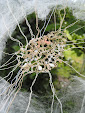
This exhibition at The Hayward comprises ten installations by contemporary artists each depicting a mindscape that the public can enter and walk through. The work of Yayoi Kusama is used to advertise the exhibition and is the most colourful. She has produced an environment covered in red fabric and white polka dots; the floor, ceiling and inflatable structures are all covered in the same fabric with walls of mirrors reflecting the colours back to the viewer. The picture shows some of the inflatable shapes on the roof of the Hayward. Twenty-five trees along the banks of the Thames have also had their trunks wrapped in the same material forming an installation outside the gallery.


I also thought Thomas Hirschhorn’s cave in Cavemanman was a good way of depicting the mind and allowing the viewer to enter into his thoughts. Walking through the ‘cave’ was quite claustrophobic and showed how different parts of life are categorised into different sections yet they all interact and form part of the whole.

I particularly liked the fairy tale-like quality of Chiharu Shiota’s After the dream. In which a dense web of threads intertwining from the ceiling to the walls formed a thicket around a group of overlarge white dresses that seemed to float in a motionless dance in the centre. A narrow tunnel running through the installation allows the viewer to walk through this network and wonder whether the dresses are being protected or ensnared in a deadly web.

Pipilotti Rist’s Sleeping room was another favourite of mine. It consisted of a dark room in which videos of body parts were projected onto two screens and the floor, while small lights circled around, and a disembodied voice repeated a sequence of phrases. The whole experience was very dream-lie and meditative and made you think about your own thoughts and how they interlink.

Saturday, 13 June 2009

Rozanne Hawksley


I have long been an admirer of Rozanne Hawksley’s work so even though this exhibition was in Ruthin (a 4 hour drive away) I had to go to it. It was definitely worth the effort. It is a retrospective exhibition, curated by June Hill, and contains most of the works Rozanne is well known for, including ‘Pale Armistice’, the wreath made of white gloves, and her work relating to ‘The seamstress and the sea’.

I found the memorials to her children and husband very moving and the self portraits drawn while she was grieving were brutally honest. We can all empathise with these feelings. Her pieces relating to sailors and the sea obviously drew a great response when she showed ‘The seamstress and the sea’ as can be seen by the display of streamers inscribed by visitors to the exhibition.

I was also fascinated and repelled by reliquaries when visiting Italy, so the way Rozanne uses them in her work, making them beautiful yet horrific is just how I felt about them. Her use of gloves as signifiers of people is also clever as they are such personal items yet easily discarded, as she shows so well in ‘In whose name’ and ‘Continuum’.

A fascinating exhibition and excellent catalogue, I hope it tours to a venue closer to home so I can pay it another visit.

Subversive spaces


This exhibition in the Whitworth Gallery, Manchester aimed to examine the legacy of Surrealism in domestic spaces and the city. It included work from Surrealist artists such as Giorgio de Chirico and Rene Magritte and from contemporary artists who use the surreal in their work. It was divided into two areas: psychic interiors and wandering the city.

Psychic interiors dealt with subversion of the domestic interior and included Tony Oursler’s The most beautiful thing I’ve never seen and Robert Gober’s untitled leg sticking out from the wall. It also introduced me to the work of Francesca Woodman. I was intrigued by her ephemeral photographs of herself disappearing behind wallpaper and a fireplace.

In the section on wandering the city I was attracted by the idea of liminal spaces, passages and boundaries and the way people suspend everyday behaviour during mundane journeys leaving themselves open to new experiences. I was intrigued by the photographs of Marie-Ange Guilleminot walking round the streets at night in a luminous gown producing eerie photographs like illustrations in a gothic novel.

I found this exhibition fascinating but because it was so far to go I had limited time to view it. Since returning home I have read the informative catalogue and found out more about some of the artists who were new to me and I will go and see it again when it is shown at Compton Verney later in the year.

Viking Museum, Oslo


The most impressive exhibits in the Museum were the Viking boats, not just their size but their shallow draught and complete lack of shelter for the occupants. They were displayed very well so you could walk round them and then climb up to viewing areas to see them from above. The Museum also contained various artefacts that had been found during the excavations.

Cultex in Norway


This exhibition, curated by Lesley Millar, brought together three partnerships of textile artists from Norway and Japan. Machiko Agano worked with Anniken Amundsen, Yuka Kawai and Eva Schjolberg collaborated and Kiyonori Shimada and Gabriella Goransson worked together. Each artist exhibited their own work and then produced a collaborative piece with their partner.

Machiko Agano produced free hanging shapes cut from photographs of items related to the everyday life around her in Japan. These were mirror coated on one side which produced distorted reflections and worked very well in combination with Anniken Amundsen’s woven ‘creatures’ when they were displayed together in a greenhouse in the museum grounds. I found this the most successful collaboration because the works enhanced each other.

Yuka Kawai had produced beautifully delicate cylindrical woven pieces that hung from ceiling to floor. These were complemented by the paper cylinders of Eva Schjolberg and her twisted spiral forms in the grounds of the museum.

Kiyonori Shimada had transformed an area of the museum by installing walls of white nylon fabric that rustled as the viewer walked past, completely changing the atmosphere of the room. As you emerged from the tunnel of fabric you were led into a room containing Gabriella Goransson’s net-like basket forms made from linen fibre. The contrast highlighted both works. From the window it was also possible to see Gabriella’s pod forms nestling in a large tree in the museum grounds.

The Norwegian venue was gallery F15 in Moss; the exhibition will also tour to Japan and the UK. The artists and curator have produced a blog of their experience of working together at http://www.cultex.org/.