This symposium on 3 October at the Sackler Centre was linked to the current V&A exhibition Telling tales. The day opened with Professor Maria Nikolajeva talking about the traditions and history of fairy tales with reference to the links between stories around the globe and explained why fairy tales matter. She told us that myths are true but fairy tales are magic, unreal, entertaining and instructive. Catherine Hyde is an artist who has produced ethereal lustrations for many fairy tales. She spoke to us about her work and a recent commission she had been involved in producing illustrations for The princess’ blankets by Carol Ann Duffy. Emma Laws, based at the V&A, gave an illustrated talk about the collection of illustrated fairy tale books held by the V&A with many beautiful examples from Dulac and Rackham. In the afternoon Margaret Rustin, a child psychotherapist at the Tavistock Clinic, and Michael Rustin, Professor of Sociology at the University of East London spoke about the relevance of fairy tales and how he genders are portrayed in them. In the final panel discussion the speakers revealed that their favourite fairy tales were the snow queen and baba yaga.
Thursday, 15 October 2009
Introducing fairy tales: Meaning and making
This symposium on 3 October at the Sackler Centre was linked to the current V&A exhibition Telling tales. The day opened with Professor Maria Nikolajeva talking about the traditions and history of fairy tales with reference to the links between stories around the globe and explained why fairy tales matter. She told us that myths are true but fairy tales are magic, unreal, entertaining and instructive. Catherine Hyde is an artist who has produced ethereal lustrations for many fairy tales. She spoke to us about her work and a recent commission she had been involved in producing illustrations for The princess’ blankets by Carol Ann Duffy. Emma Laws, based at the V&A, gave an illustrated talk about the collection of illustrated fairy tale books held by the V&A with many beautiful examples from Dulac and Rackham. In the afternoon Margaret Rustin, a child psychotherapist at the Tavistock Clinic, and Michael Rustin, Professor of Sociology at the University of East London spoke about the relevance of fairy tales and how he genders are portrayed in them. In the final panel discussion the speakers revealed that their favourite fairy tales were the snow queen and baba yaga.
In praise of shadows
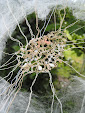
This exhibition at the V&A included work by lighting designers who use low energy lighting and alternative energy sources. The title comes from the essay on aesthetics written by Junichiro Tanizaki. Cyclo by Marie-Virginie Berbet was an interesting idea that adapts the lighting conditions depending on the user’s activity levels. Fragile future by Drift was a beautiful combination of dandelion seed heads and small light bulbs that formed a wall decoration. Medusa by Mikko Paakkanen was also fascinating; made of fibre optic rods it expands and contracts, forming first a narrow cone and then a round ball of light. Sonumbra by Loop at the end of the exhibition provided a mesmerising spectacle as light in the electroluminescent wires of the sculpture followed their paths in a delicate lace design. Having helped Loop to learn about lacemaking for their first Sonumbra installation I was impressed at the intricacy of their latest version and how beautifully the light flowed through it.
Telling tales
This exhibition at the V&A showcases design objects that are evocative and symbolic of fairy tales rather than being utilitarian. The exhibition is divided into three areas: the forest glade, the enchanted castle and heaven and hell. The exhibition begins in a forest glade, divided into areas by hangings of printed tree branches. Like the Garden of Eden, it is a place of innocence and enchantment with birdsong and soft lighting but the threat of menace lurks reflecting the woods of many fairy tales. Nestling among the trees are Tord Boontje’s chairs and wardrobe and Jurgen Bey’s Linen cupboard house, a romanticised fairy tale home that links sanctuary and defilement.
The second scene is the interior of the enchanted castle. One half of the room is papered with a large design of eighteenth century wallpaper, the other is mirrored, glittery, brash and luxurious. The innocence of the forest glad has been replaced with worldliness and decadence. The high status goods on show here are subverted through the use of inappropriate scale or materials. It includes Joris Laarman’s heatwave lace radiator and Jeroen Verhoeven’s Cinderella table.
The final area returns us to judgement, the afterlife and memento mori. The walls are plain and most of the objects are viewed through open holes into a room beyond, suggesting that we haven’t yet reached this state but giving us glimpses into it. The exhibits include Wieki Somers’ high tea pot made from a pig’s skull with its water-rat fur tea cosy and the lovers rug by Fredrikson Stallard made up of two conjoined pools of ‘blood’.
This exhibition was cleverly staged and presented, showing how modern designers are producing design-art pieces for the commercial market that have a narrative based on fantasy and the spirit of story telling.
Sarah Waters
Sarah Waters was talking about her book ‘The little stranger’ at the Independent Woodstock Literary Festival 2009 at Blenheim on 20 Sept 2009 in conversation with John Walsh (a columnist at the Independent). She started by explaining that she had been an avid reader of ghost stories as a child. She particularly likes the stories of MR James because they expose the reader obliquely to horror/the supernatural. She likes the Gothic because it is about vulnerable people: children are powerless and experience random acts of cruelty. The irrational element of the Gothic appeals to her.
Poltergeists feature in her book and she explained they are associated with repressed women and teenage girls; repressed sexuality. Talking about the ending of her book she said she hoped the undecidability of the ending gives it extra power. She wrote several different endings and hoped she had chosen the one that was ambiguous but not irritating. Each of the main characters has flaws that make them the possible source of the poltergeist activity. I spoke to her afterwards and got her to sign a copy of the book. I told her about my work on the uncanny and gave her a flyer describing it. She was very helpful and encouraging.
Handbuilt
This small Crafts Council exhibition was exhibited in the corridor of the Sackler Centre. The most interesting piece was the bent and spiralling wooded sculpture by Charlie Whinney shown here. He has also used the same technique to decorate the entrance and windows of Harvey Nicholls. Other artists in the exhibition were Ptolemy Mann with her woven colour blocks, Eleanor Long and Gary Breeze.
Mary Butcher open day at the V&A
Mary Butcher is currently one of the artists in residence at the V&A exploring contemporary basketry. She had an open day at her studio in the Sackler Cente on 18 September. It was very interesting to talk to her about the residency and see what is required. It takes up far more time than she envisaged and it can be a lonely experience so you have to network and be proactive. She asks all visitors to contribute to a large wall piece she is making but has not yet had time to make any new work of her own.
Last night forever by Andrea Gregson
This site-specific ‘cabinet of curiosities’ by Andrea Grigson was made following a period of research at the Garden Museum in London. It was a long cabinet on stilts placed in the central space of the Museum with peep holes at eye level along its length for viewers to look into. Andrea had studied Vauxhall Pleasure Gardens (1661-1859) and depicted scenes from the gardens along the length of the installation. The glimpses afforded of the grottoes, arches, Italian gardens, ruins and seats was fascinating and more enjoyable because it was observed gradually and incompletely through the peep holes.
Subscribe to:
Posts (Atom)