Since my research
into net curtains started I have become interested in machine made lace, both
the mechanics of its production and the beautiful lace that results. The image
above is part of a panel showing Nelson’s column in Trafalgar Square and what I
like about it is the clever way the shading and depth of design are achieved (which I hope you can see - the image looked fine on the computer but not so good in this post).
Most of the information I have gleaned so far comes from the books and research
carried out by Pat Earnshaw. From her I discovered that the Nottingham Lace
Curtain Machine which produces not only curtains but other large scale lace
furnishings, such as bedspreads and tablecloths, was invented by John Livesey
in about 1846. The feature of this type of lace is its ability to produce large
pieces of lace and its straight sided mesh as opposed to the hexagonal mesh of
the Leavers lace machine. By 1851 there were 100 curtain lace machines in
operation in the Nottingham area and many lovely curtains were displayed at the
Great Exhibition in London that year. My next step is to find out how they
achieve that lovely shading.
Tuesday, 21 April 2015
Tuesday, 14 April 2015
Forensics: the anatomy of crime
This is a
fascinating exhibition at the Wellcome Collection, much of it dealt with the
science and history of forensic examinations, which was interesting, but I also
enjoyed the artistic elements too. In particular Frances Glessner Lee’s
miniature dioramas of crime scenes ‘The Nutshell Studies of Unexplained death’
which were made as teaching aids for detectives. Alphonse Bertillon’s photographs
of victims were harrowing yet artistic as he used a very high tripod to capture
them creating an unusual ‘God’s eye view’ of the crime scene. In contrast to
these real images, Corinne May Botz had recreated and photographed crime scenes
using dolls as victims, her ‘Dark bathroom’ was quite unsettling. Perhaps
because the images were staged it was easier to examine them closely and take
in their full power rather than exploiting the images of the real victims.
Jenny Holzer’s ‘Lustmord’ was a very dramatic and moving installation
protesting about the use of rape as a weapon of war in the Balkan conflict. It
consisted of a collection of disinterred bones laid out in rows on a table,
many of which were labelled with the name of the victim, the perpetrator and an
observer – a powerful reminder that forensic science can retrieve evidence and
claim justice for the dead. The exhibition runs until 21 June and is well worth
a visit.
Thursday, 9 April 2015
Silk paper for TB lace
I spent
yesterday making silk paper for my series on dust, decay and disintegration and
it is now in the garden drying in the sunshine, as you can see in the image
above. I’m combining lace, silk paper and fabric to make a series of curtains
expressing the idea of dust clogging up the curtains and eventually extinguishing
life and turning the airy fabric to brittle paper. I started with the first
piece yesterday, attaching the lace to the silk paper. I started by adding
threads to the lace, to use as anchors, which I could embed in the silk paper
(see below).
I then
sprayed the whole thing with a fine mist of water and then with a dilute silk
fibre medium (see above). Once the spray has been added it’s important to
ensure all the fibres have been coated so I use dilute medium and a brush to
make sure the piece is wet through, then leave it to dry. By this morning it
was dry enough to move off its plastic backing and take it out into the
sunshine, because the two outer net layers keep everything in place. With the
help of the sun it should be dried out later today and I’ll be able to remove
the net layers. I’ll keep you posted on the progress.
Monday, 30 March 2015
Textile conferences
I’ve been to
a couple of conferences in the last two weeks (The erotic cloth and the Textile
Society research symposium) both fascinating in different ways. The speakers at
The erotic cloth were mainly established researchers in the field, while those
at the Textile Society tended to be PhD students talking about their research,
so the day did not have a theme but gave an interesting overview of current textile
research. There were many interesting papers at both events, but those most
relevant to my work included Angela Maddock’s talk about folds and cloth
related to Giovanni Battista Moroni’s painting of Il tagliapanni (the cutter of
cloth). I also enjoyed Claire Jones’ depiction of cloth and puberty in
Victorian marble sculptures which linked to my research into the animate and
inanimate. Samantha Broadhead’s paper on the fetishizing of cloth in Hitchcock’s
film Rebecca also included some very atmospheric net curtains, while Grace
Williams’ research into the use of fabric in stage magic and disappearing women,
contained some wonderful images of carpets concealing bodies, both in her own
practice and that of Anette Reimer. At the Textile Society day, I was
interested in Alexandra Lester-Makin’s research on early medieval embroidery, because
I am interested in this period of history but also because she discussed the
idea of objects having a life, a theme she explored from an archaeological
point of view, but one that interests me from a practice and fictional stance.
Both conferences were stimulating and varied and were great opportunities to
discuss ideas with fellow textile researchers.
Thursday, 19 March 2015
Photographing lace
I’ve been
trying to take photos of my lace again and have decided that the best way of
doing it is to take close ups. It’s so difficult to get an overall view of most
of the larger projects I make and when I do manage it all the details get lost.
I also find with my net curtain and silk paper pieces that because they are
transparent, the background is important. It’s no good having an ethereal piece
of lace with an image of buildings behind it. I have tried taking photos in the
garden, and that was quite successful but the slightest breeze can move the
lace, which can lead to interesting effects but can be annoying, depending on
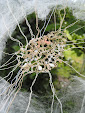
the piece. So today I have concentrated on close ups, the image above is from ‘Frayed
nerves’ which includes needle lace ‘nerves’ embedded in silk paper. I think the
close up makes an interesting image regardless of the subject and at least it
focuses on the lace!
Wednesday, 11 March 2015
Lace and science
Collecting
some images of scientific subjects depicted in lace has confirmed what an
excellent medium lace is for depicting biological and medical subjects. The
piece above is a detail from a piece I made entitled ‘Thread of life’ showing a
bundle of foetal cells dividing. Both bobbin and needle lace are excellent for
depicting cells and histological structures as well as nerves, muscle fibres
and other medical forms such as bacteria and viruses. Lace nets, both regular
and irregular, can be used to suggest cellular structures, while intertwining plaits,
threads and tallies can suggest nerves and other fibres. As you can see on my
website lace can
be used not just to depict biological images but also to represent concepts
such as loss of memory and genetics. I’ve also used lace to depict the sleep
cycle but so far no other physical, chemical or engineering subjects – a life
time’s work awaits!
Wednesday, 4 March 2015
Tape lace
I’m working
on a project at the moment for a mat that will use tape lace outlines, like the
one above, entitled ‘Sweet dreams’. For that piece I made an oval edging, using
a patchwork of fabrics, and joined the lace to the inner edge of the fabric as I
worked round it. This time I’m going to use a continuous ‘tape’ of lace using
cloth stitch and twists. I haven’t decided on the colours yet, but although I
want to include some gold I think the other colours will be more subtle. I’ve
always admired the way that many of the continental laces, such as Russian tape
lace, use only a handful of bobbins, yet by working the tape backwards and
forwards can make very intricate designs. That way of working has always seemed
a much easier option than the straight laces that use numerous bobbins,
although you have to keep doing sewings to join the tapes, which could be a
drawback!
Subscribe to:
Posts (Atom)