Friday, 10 March 2017

Parchment lace


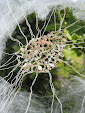
I saw this lovely dress at the Fashion Museum in Bath. It is a court dress from the 1600s and is the oldest dress in their collection. The fabric shimmers because although the warp is silk, the weft is silver metal thread which catches the light. It is decorated with parchment lace (see the close up on the left of the image). It gets its name because the larger elements of the pattern are formed from flat strips of parchment wrapped in silk thread. They are incorporated into the silk bobbin lace as it is worked. (The image combines two photographs from the book Treasures published by the Museum)

Tuesday, 7 March 2017

Lace in fashion at the Fashion Museum, Bath


I enjoyed the Lace in fashion exhibition which ranged from the exquisitely handmade lace of the 1600s to the laser printed lace of today and covered quite a lot in between. I thought the lace in the handmade section was breathtaking. It included a Brussels Duchesse wedding veil from the 1860s that included bobbin and needle lace applied to a machine made net and a point de gaze needle lace shawl from the same period. The cape in the same case is also from the 1860s and is decorated with black Le Puy bobbin lace which was fashionable at the time. The cabinet also included a 1980 black dress made by Madame Osborn, the court dressmaker, which included quite large inserts of Venetian gros point from the 1600s, showing that lace was often reused. This was emphasised when I discovered a flounced dress by Catherine Buckley made in the 1970s from painted Nottingham curtain machine lace – I have seen examples of this painted curtain lace in Nottingham so recognised the material at once!

Going round the exhibition it struck me how soon machine lace took over from handmade laces. The evening dress in the image above dates from 1829 and is made of machine-woven gauze resembling blonde lace. A tatted wedding dress from the 1930s was an exception, but it had been made by Anne Goodwin for her grand daughter and was not available commercially. It was also interesting to see how quickly the handmade laces were copied by machine. There were examples of chemical lace mimicking Irish crochet and tape laces resembling bobbin lace. As well as a fabric giving the appearance of Carickmacross lace and a cream silk evening dress by Amalia Machado from 1959 for which pieces of machine lace were sewn on to the completed garment to resemble Chantilly lace.

I like the way the exhibition ranged from demure wedding veils to sexy red and black dresses from recent catwalks. One of my favourites was a 1991 see-through, black, imitation Chantilly lace dress by Karl Lagerfeld which Linda Evangelista wore for a photoshoot for Vogue. I thought it was aposite to end the exhibition with examples of laser cut and laser printed lace as the story of lace has always been about adapting new technology to bring lace up to date. My only complaint was that there was no publication to accompany the exhibition.


Thursday, 2 March 2017

Filet lace


Having seen so many lovely machine lace curtain designs recently, based on a grid format, I’ve been having a look at filet lace. I made some for the City and Guilds qualification, which involved making the filet net lace background as well – the type of thing that is easy once you’ve started and got the pattern going but you feel all fingers and thumbs when you’re trying to get it started. The ‘darning’ as well is not as simple as it seems and requires careful planning beforehand so you manage to cover all the squares evenly and the threads end up in the right place. It’s not really the way I like to make lace, I like the aspect of serendipity, rather than having to organise where each thread is going before I start. There is some beautiful filet lace around though. I remember seeing some lovely examples in the museums in Brugges. It is also the inspiration for much curtain lace so I need to carry on my exploration.

Thursday, 23 February 2017

Sketchbooks for lace designing


I had an interesting day yesterday talking to the granddaughter of Harry Cross, the designer of the Battle of Britain commemorative lace panel. Among the things we discussed was his approach to design and I was surprised to learn that he didn’t use sketchbooks. We are so used to using them today to draw from life, play with ideas, draw diagrams and collect information that not to have one seems amazing. Perhaps the companies he worked for had inspiration books for all the designers to use. I have seen some of these in archives, which may incorporate snippets of lace, fashion designs, pictures of flowers and architecture. Some are for general reference and others have obviously been assembled by individual designers for their own use. I wonder where he tried out his designs though, perhaps on pieces of paper that he then threw away once he’d produced the final design. Or perhaps the lace designers had to keep all the artwork with the design so it couldn’t be taken out of house and copied. However, it may be that the use of personal sketchbooks for designing is a modern idea which began with the development of City and Guild embroidery and textile classes as a way of learning and evaluating. Interesting thoughts that I will follow up!

Tuesday, 14 February 2017

Researching Battle of Britain lace buildings


I spent a very useful day in London seeking out some of the buildings on the Battle of Britain commemorative lace panel that suffered bomb damage. Part of my contemporary response to the panel is to take photographs from the exact spots where the originals were taken, to show how they’ve been renewed, and then print them on to fabric for use in a larger installation. I’ve mapped them all out so I know where they are and I’ve booked a professional photographer to help me take the photos later in the year. This week’s trip was to see whether street views of some of the places are still accessible. I’ve discovered that the original image of St Paul’s Cathedral was probably taken from what is now the centre of a busy road and the one of the Old Bailey was probably taken from a window or roof on the opposite side of the road – neither problem is insuperable but just as well to know in advance! I also visited Susie MacMurray’s exhibition at the Mall Gallery – I’ve long admired her work - the theme was war and conflict, which tied in so well with the rest of the day’s research.

Thursday, 9 February 2017

Lace curtains from the 1930s


I’ve been enjoying looking through the latest net curtain catalogue I bought on ebay. It’s surprising that any of them have survived, as most people, including me, throw catalogues away as soon as they are out of date, but I’m so pleased to come across them as they usually give accurate images of the lace as well as measurements and sometimes prices as well. The first thing that struck me with these curtains from 1933 is that the curtains are not as wide as those from the 1900s which of course reduces the space for the designer. Although the curtains from both periods tend to have a border and a central panel, the later ones are much more compact and the designs seem more solid as a result. I was also interested in the ‘Economic’ curtains shown in the image which include the valance and lace curtains all in one piece. They are quite long (2.5 yards) but only 40 inches wide so seem to have been designed for an urban home, perhaps a Victorian terrace. Unfortunately there are no prices (I suspect the prices were on a loose sheet which has since been lost) so I don’t know how much they cost. The manufacturers were obviously careful not to commit themselves as there is a stern note saying ‘All prices are subject to Market Fluctuations’.

Thursday, 2 February 2017

Nottingham lace curtain stitches


This week I’ve been trying to study the various stitches used by the Nottingham lace curtain machine and understand how they are made. I now have a better idea but still have much more to learn. There seem to be two main types of ground stitch: filet and Swiss net. The filet grounds produce a square net like handmade filet net and they can be single-tied or double-tied at each side, depending on whether the bobbin thread linking the warp and bottom board thread together passes round them once or twice. In Swiss ground the net is not an exact square but forms a V shape, which you can see in the image above. There are then many variations depending on whether every bottom board thread is linked to the adjacent warp, linked to the warp beyond that one, or just twisted round the warp to form a pillar. It is complicated but I am beginning to understand it!