Wednesday, 26 January 2022

Lace responses to Japan


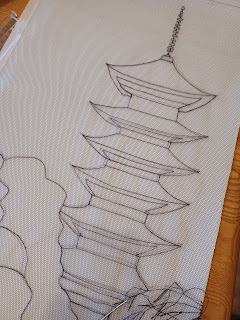
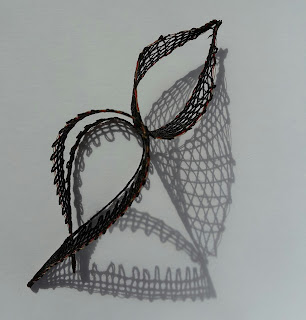
This image of a pagoda at Toji temple in Kyoto is part of my needlerun lace response to the Japanese textile research visit I made with other artists from UCA Farnham a couple of years ago. This piece entitled ‘stone: water: leaf’ is made up of two hangings, one is a realistic image of the pagoda and the temple grounds, the other is an impression of willow leaves. Together with another piece, a three-dimensional miniature bobbin lace sculpture reflecting the roof of the temple, they represent the Japanese sensibility of ‘shin gyo so’, broadly expressed as the realistic, the impressionistic and the abstract. The miniature, abstract, piece (image below) is currently in the exhibition ‘Tansa: Japanese threads of influence’ at the Crafts Study Centre in Farnham until 26 March and then travels to Gallery Gallery in Kyoto where it will be exhibited from 23 April to 8 May.

I’ve been finishing off the two larger pieces today, making channels for the acrylic supporting rods across the top of each hanging and checking they hang well side by side. I also contemplated adding weighting to the bottom of each hanging but have decided they probably don’t need it despite me having dyed some curtain weighting at the weekend to do the job! I also wanted to add a touch of gold and red to the pieces, as the miniature also has a fine outline of both, but I knew I need to see them both hanging up together before I could decide where to add it. Well, as soon as I hung them up, it was obvious where the colour should go to tie both pieces together and link them to the abstract miniature, so adding those threads will be my final task. These two hangings will be exhibited as part of the ‘Tansa: process and making’ exhibition at South Hill Park from 26 February until 3 April.

Wednesday, 19 January 2022

Heartache inscribed on lace bobbins

The inscriptions on these two lace bobbins read ‘Love don’t forsake me’ and ‘A kiss from my true love will ease a wounded heart’ although the bobbin maker didn’t have room to spell out the final word so just used a heart shape instead. I think he was Jesse Compton as his bobbins are quite slim and often include very tightly packed lettering alternately coloured red and blue. Most of his bobbins date from the early nineteenth century and some like this one have discoloured to a yellow colour. The bobbin with red lettering was probably made by William Brown of Cranfield who was working during the middle of the nineteenth century. His bobbins are quite distinctive with neat lettering and several rings of coloured bands at top and bottom. Whether these bobbins were bought by the lacemakers or their boyfriends we will never know, but I do hope that the first wasn't forsaken and the second did receive that kiss of true love. 

Wednesday, 12 January 2022

Filet lace panel of Neptune and fish

The prompt for today’s lace challenge is ‘ocean’ which made me think of this filet lace panel I bought a while ago of Diana and Neptune on the sea with assorted fish and sea monsters. The pattern for this seems to have originated in Germany at the beginning of the twentieth century when there was a revival of filet lace both for furnishing and as a hobby for home lacemakers. However, the origins of filet lace or lacis as it was known stretch back to the sixteenth century and there are numerous pattern books dating from that time, many of which have been repurposed since, so the design could have older origins.

Many designs for filet lace are shown with the pattern marked in small crosses which does suggest that they could also have been worked as embroidered cross stitch. It is also a bit misleading though as the filet technique has no links to cross stitch and in fact is made in a running woven technique. The thread pattern has to be carefully worked out before the worker starts as the thread is woven over and under the meshes of the net in a continuous line vertically up and down the pattern like the diagram above. At points in the design the worker changes direction and works horizontally across the threads already laid this time weaving under and over the laid threads as well as those of the net mesh to give an open but woven appearance. It does produce a firm type of lace though well suited to furnishing.

Wednesday, 5 January 2022

Back in the studio

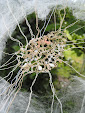
 It’s good to be back in the studio after the Christmas break making lace plans for the new year. I’m very pleased to have work in the current Tansa miniatures exhibition which is currently showing at the Crafts Study Centre in Farnham until 26 March. I will also have some larger pieces of lace in the complementary exhibition at South Hill Park in Bracknell from 26 February until 3 April. The work at both venues is the result of a research visit by UCA textile researchers to Japan in 2019, following which we and some of the Japanese artists we visited encapsulated our responses to the trip in textiles. I feel especially lucky to be able to show some work in the current pandemic when so many venues are closed. The miniature works are also travelling to Japan in April to be exhibited at Gallery Gallery in Kyoto which is also a great honour. As well as the Japanese themed pieces I’m also still working on my unhomely doily series hoping to produce a group of them for exhibiting. I’ve published a couple of papers in Textile the journal of cloth and culture this year, one on the lace designer Amy Atkin (the image above shows a detail of my textile response to that work) and another on textile responses to domestic trauma. I’m currently writing a chapter for a textile book on Belgian war lace and have started the research for another paper on the work of Harry Cross who designed beautiful machine lace curtains and the famous Battle of Britain lace panel. I like to have a mixture of practice and writing so I’m looking forward to the new year and getting back to work.

Wednesday, 15 December 2021

Feminism, Amy Atkin and lace in Textile journal

 I’m delighted that my paper based on the life and work of Amy Atkin has now been published in Textile the Journal of Cloth and Culture. The title is ‘Neo-Victorianism, feminism and lace: Amy Atkin’s place at the dinner table.’ It was published online in the summer but is now in the printed journal which means I have some free copies to give away! As you will know by now if you follow this blog, Amy Atkin was the first female Nottingham machine lace designer but relinquished work on marriage as did so many other women of her time. The paper and my practice response focus on this aspect, looking at the domestic constraints women experienced at the beginning of the twentieth century and comparing Amy’s training and career with that of other female designers of the time, such as those at the Glasgow Art School. I used lace mats for my practice response entitled ‘The marriage bond’ which was inspired by the use of place settings in ‘The Dinner Party’ by the second wave feminist Judy Chicago. Each mat includes a lace design inspired by Amy’s work tacked in place to suggest how easily women’s careers can be torn away. They also include wording from the marriage ceremony ‘for better, for worse, for richer, for poorer’ highlighting the change in women’s circumstances on marriage. Neo-Victorianism reflects on the justification for using Amy’s life to comment on feminism from the viewpoint of the twenty-first century. If you’re interested there are 50 free copies available from the link below – first come first served! https://www.tandfonline.com/eprint/YYE6JXYJEBRQA3IRC5YR/full?target=10.1080/14759756.2021.1933346


Wednesday, 8 December 2021

The pickadil

This strange object which looks like some type of ancient helmet is in fact an early seventeenth century pickadil which was used to support an open lace ruff or a standing band of linen and lace. It gave its name to the famous London street because a local tailor, named Roger Baker sold pickadils from his shop and house on what was originally Portugal Street but which subsequently became known as Piccadilly. 

Although the pickadil was used to support a lace ruff or band so only the lace could be seen from the front, it was designed to show at the back of the head. This example from the Victoria and Albert Museum reveals decorative stitching at the back and eyelet holes through which ribbons were slotted to attach it to a small stiffened collar on the gown. It is made up of several pasteboard sections joined together and covered in silk and is padded on the inside of the neck edge to make it more comfortable to wear. Making pickadils was skilled work and clearly very profitable in the case of Roger Baker.

Wednesday, 1 December 2021

Stars in filet lace


I posted some images of filet lace earlier in the week and was asked how the star motifs were made. My answer was that I didn’t know but luckily I’ve found a woman who does – Therese de Dillmont, who has the answer to almost every needlework question in her amazing encyclopaedia. The star she shows us how to make in the book covers 16 squares of net. She tells us to fasten the thread to the centre of the panel then carry it in a diagonal line from left to right, under the far corner of the block and back to the opposite corner of the square, under the corner, and repeat (she repeats it three times).

Once you’ve done that you make the same stitches across the first diagonal to make an X. Then do the same with vertical and horizontal lines over the X to make a plus shape with the threads on top.

Once you’ve formed the basic star shape like this you weave the thread round in a circle over the straight threads and under the diagonals but not through the net and fasten off at the back. It sounds quite straightforward and does give a lovely effect. The example from the encyclopaedia has more rows of threads in it than the one in the top image but the latter was worked commercially so speed and sparing use of thread was probably more important than an ideal technique.