Showing posts with label Japan. Show all posts

Wednesday, 26 January 2022

Lace responses to Japan


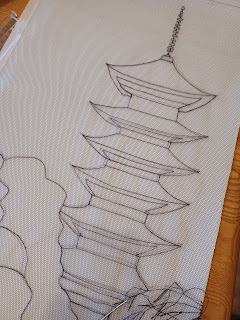
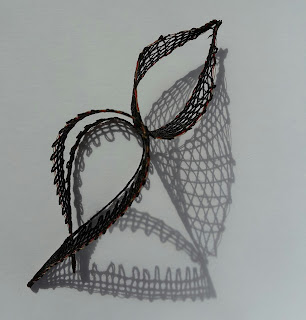
This image of a pagoda at Toji temple in Kyoto is part of my needlerun lace response to the Japanese textile research visit I made with other artists from UCA Farnham a couple of years ago. This piece entitled ‘stone: water: leaf’ is made up of two hangings, one is a realistic image of the pagoda and the temple grounds, the other is an impression of willow leaves. Together with another piece, a three-dimensional miniature bobbin lace sculpture reflecting the roof of the temple, they represent the Japanese sensibility of ‘shin gyo so’, broadly expressed as the realistic, the impressionistic and the abstract. The miniature, abstract, piece (image below) is currently in the exhibition ‘Tansa: Japanese threads of influence’ at the Crafts Study Centre in Farnham until 26 March and then travels to Gallery Gallery in Kyoto where it will be exhibited from 23 April to 8 May.

I’ve been finishing off the two larger pieces today, making channels for the acrylic supporting rods across the top of each hanging and checking they hang well side by side. I also contemplated adding weighting to the bottom of each hanging but have decided they probably don’t need it despite me having dyed some curtain weighting at the weekend to do the job! I also wanted to add a touch of gold and red to the pieces, as the miniature also has a fine outline of both, but I knew I need to see them both hanging up together before I could decide where to add it. Well, as soon as I hung them up, it was obvious where the colour should go to tie both pieces together and link them to the abstract miniature, so adding those threads will be my final task. These two hangings will be exhibited as part of the ‘Tansa: process and making’ exhibition at South Hill Park from 26 February until 3 April.

Wednesday, 30 June 2021

Reflections on Japan: shin gyo so


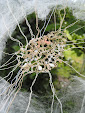
I’m making some lace for a series of exhibitions to be shown next year. My work for this exhibition is informed by the Japanese sensibility of ‘shin gyo so’ which can broadly be expressed as ‘the realistic, the impressionistic and the abstract’. I’ve taken as my starting point the gardens at Toji Temple in Kyoto and my piece will result in two hangings and a miniature three-dimensional lace sculpture. The hangings will represent aspects of the garden and the sculpture is modelled on the corner of the temple roof. I’ve made a bobbin lace pattern for the sculpture and am now working on the hangings, which will both be needlerun lace on net. The sizes of the hangings are based on kimono cloth and wrapping cloths so they are both quite narrow. The longer hanging is a depiction of the gardens, to represent shin, and the smaller one depicts a branch of maple leaves for gyo. I’ve drawn out my design and have recently been scaling it up to the right size. I’ve also cut out my net for the hangings – easier said than done as the line of the scissor blade interferes with your sight line of the net holes! As you can see, I’ve also been trying out some threads for the needlerun lace. Laying the nets on top of each other has also produced some interesting interference patterns, which you can see in the image, but I’m not sure whether adding applique to the mix will confuse things or help with shading – it’s a work in progress!

Wednesday, 27 November 2019

Printing and dyeing in Japan


It’s always interesting seeing other people’s tools and working processes. We were lucky in Japan to see several master craftsmen at work and also to see their workshops and some of the behind-the-scenes work of other people in their ateliers. Most wouldn’t allow photography in the studio but we were able to see some of the tools in museums. The image above is of a stencil and cutters in the Hosoo Gallery Museum. These stencils are widely used in Japan and we were lucky enough to see them being used in the Edo Komon stencil printing process in Tokyo. As well as stencil printing we also saw resist fabric painting in Kanazawa, which was a similar process to silk painting with fine gradations of tone producing beautiful effects. 

As well as printing and painting we also saw a variety of types of dyeing. The image shows a woman demonstrating the technique of arashi shibori in the tie dye museum at Arimatsu. There are two ways of doing this technique. She is using a fine hook to catch the material which she then softened in water to form a long tower which she twisted thread around. Her companion was doing basically the same process but didn’t use a hook just laid the fabric over an upright pin to push the farbic into a tower so she could wrap thread round it. Once the fabric has been dyed the threads are removed and a pattern of dots is revealed where the threads held the material. We then took part in a shibori workshop, luckily using a much easier technique. We folded a length of material into a triangular shape and then depending on which part of the triangle we dipped in the dye baths formed various star like patterns on our cloth. I think we’d still be there twisting threads if we’d used the arashi technique!

Wednesday, 20 November 2019

Textile study tour to Japan


I’ve just returned from a fascinating study tour exploring Japanese textiles as well as having a taste of ancient and modern Japanese culture. We travelled to Tokyo, Kyoto, Arimatsu, and Kanazawa as well as the world heritage site of Miyamachokita and visited the workshops of experts in stencil printing, various types of shibori dyeing, ikat weaving, indigo dyeing, and yuzen fabric painting. Many of these experts have been designated national living treasures and they were all the third or fourth generation of their family to continue their particular traditional technique. Their expertise and attention to detail was astounding. 


As well as visiting the ateliers of those master craftsmen, we also visited modern galleries and shops which exhibited and sold contemporary textiles. In Tokyo we visited Reiko Sudo’s stylish Nuno shop. Reiko showed us some beautiful textiles and many of us bought scarves and socks. In Kyoto we were met by Keiko Kawashima who had organised some fascinating opportunities for us including a visit to her own gallery GalleryGallery to see an exhibition of the work of Yasuko Fujino and hear an impromptu talk by Chiyoko Tanaka about her work. It was fascinating to hear how both of them approach their weaving practice. 


We also visited an exhibition of student textile work and a stunning display of different textiles in the Hosoo Gallery (image above). It was interesting to see how many of the traditional textile producers are developing new markets for their work as the use of textiles for kimonos is declining. The decline in the use of kimono was evident in the shops selling secondhand kimonos, jackets and obis, but all provided wonderful buying opportunities for those of us interested in textiles. One place where we did see families wearing kimonos was at a the Hiejinja shrine in Tokyo where there was a celebration of children aged 7, 5 and 3 years of age, all dressed traditionally and having their photos taken. That was just one of the lovely shrines and temples we visited during our trip. 


We also managed to fit in some interesting museum visits including those dedicated to indigo, shibori, weaving and gold leaf. Visiting the Miho Museum proved to be an experience as its position in the countryside among trees and streams and the fact it is situated on a split site, which involves entering it through a tunnel and walkway, made it seem like a pilgrimage. Once there the exhibits were beautifully displayed in the tranquil contemporary setting and there was an interesting exhibition of Bizen ceramics. In contrast, our final day was spent at the Teamlab digital exhibition in Tokyo (image above) which was an immersive light and sound experience – magical in its own way, which highlighted the combination of ancient and modern that is today’s Japan.