Showing posts with label needle-run. Show all posts

Thursday, 9 February 2023

Limerick run lace fillings


One of the beautiful features of Limerick run lace is the lovely filling stitches that are used to add shading and depth to the main designs. This delicate little curtain includes several flower and leaf motifs interspersed with individual flower heads. This type of lace is made by embroidering machine made net, held taught within a frame, using a needle and thread. The main design is outlined in three strands of thread and the filling stitches are then worked inside those areas.

These three leaves are filled with tent stitch; a series of diagonal stitches worked across the underlying lace net. The leaf on the right has been worked at a different angle to the other two, giving a different appearance to the leaf.

Cobweb stitch has been used to fill these three leaves. This is made by zigzagging the thread to form a shape like the crenellations on a castle wall. If the rows of stitches are worked as a mirror image of each other, as they have been here, the finished work gives the appearance of a series of tiny holes.

The final three leaves have been filled with a variation on tent stitch in which the main stitch is elongated and an extra small stitch made between each of the main stitches. The three filling stitches described here just reveal a sample of the many filling stitches that can be used and give an idea of the range of effects that can be produced in this lovely lace.

Wednesday, 25 January 2023

Amy Atkin lace table mats research

Amy Atkin was the first female Nottingham machine lace designer, however, like many other women of her time, she relinquished paid work on marriage which always seemed to me a great waste of talent. Reflecting on her life and work I decided to carry out some practice-based research focusing on the domestic constraints she and other contemporary female designers faced at the beginning of the twentieth century. I studied the archive of her beautiful designs in the Collection of the Nottingham City Museums and decided to base my response on table mats incorporating lace in a reference to Judy Chicago’s use of place settings in her famous feminist work ‘The dinner party’.

The lace panels are my designs inspired by Amy’s archive and are worked in needle run lace on machine net; hers would have been produced on levers lace machines. The lace is merely tacked in place indicating that it could be removed at any time, much like the careers of these talented women, and each mat is embroidered with wording from the marriage ceremony ‘for better, for worse, for richer, for poorer’ highlighting the changes in women’s circumstances on marriage. If you are interested in reading more about the project I’ve written a paper about it in Textile the Journal of Cloth and Culture which is available through the following link


Wednesday, 26 January 2022

Lace responses to Japan


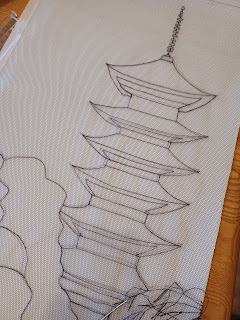
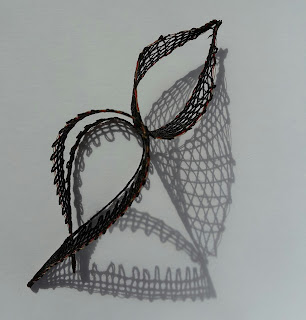
This image of a pagoda at Toji temple in Kyoto is part of my needlerun lace response to the Japanese textile research visit I made with other artists from UCA Farnham a couple of years ago. This piece entitled ‘stone: water: leaf’ is made up of two hangings, one is a realistic image of the pagoda and the temple grounds, the other is an impression of willow leaves. Together with another piece, a three-dimensional miniature bobbin lace sculpture reflecting the roof of the temple, they represent the Japanese sensibility of ‘shin gyo so’, broadly expressed as the realistic, the impressionistic and the abstract. The miniature, abstract, piece (image below) is currently in the exhibition ‘Tansa: Japanese threads of influence’ at the Crafts Study Centre in Farnham until 26 March and then travels to Gallery Gallery in Kyoto where it will be exhibited from 23 April to 8 May.

I’ve been finishing off the two larger pieces today, making channels for the acrylic supporting rods across the top of each hanging and checking they hang well side by side. I also contemplated adding weighting to the bottom of each hanging but have decided they probably don’t need it despite me having dyed some curtain weighting at the weekend to do the job! I also wanted to add a touch of gold and red to the pieces, as the miniature also has a fine outline of both, but I knew I need to see them both hanging up together before I could decide where to add it. Well, as soon as I hung them up, it was obvious where the colour should go to tie both pieces together and link them to the abstract miniature, so adding those threads will be my final task. These two hangings will be exhibited as part of the ‘Tansa: process and making’ exhibition at South Hill Park from 26 February until 3 April.

Wednesday, 21 July 2021

Stylised Japanese foliage for lace designs


I’ve been working on the design for my Japanese pieces and am trying to finalise the design for my medium sized hanging which is to be an impressionic interpretation of foliage. My inspiration is an overhanging bough of maple leaves I photographed while I was in Japan but I’m trying to see how other types of foliage are depicted in Japanese designs. The image above comes from a woodcut of a variety of leaves showing how a several leaves can be used together.

I also rather like the way these bamboo like leaves are silhouetted against the moon and I might incorporate something of that style in my larger hanging.

The way these willow leaves overlap is also very pleasing and I do have a willow tree in my larger design so I might try and emulate the way the leaves overlap each other. Even though I’m working from my own photographs of foliage I can’t just copy what I saw, to make an effective design does mean I have to translate the photograph into a textile design which needs to have clear outlines so seeing how others have done that is proving very useful.

Wednesday, 30 June 2021

Reflections on Japan: shin gyo so


I’m making some lace for a series of exhibitions to be shown next year. My work for this exhibition is informed by the Japanese sensibility of ‘shin gyo so’ which can broadly be expressed as ‘the realistic, the impressionistic and the abstract’. I’ve taken as my starting point the gardens at Toji Temple in Kyoto and my piece will result in two hangings and a miniature three-dimensional lace sculpture. The hangings will represent aspects of the garden and the sculpture is modelled on the corner of the temple roof. I’ve made a bobbin lace pattern for the sculpture and am now working on the hangings, which will both be needlerun lace on net. The sizes of the hangings are based on kimono cloth and wrapping cloths so they are both quite narrow. The longer hanging is a depiction of the gardens, to represent shin, and the smaller one depicts a branch of maple leaves for gyo. I’ve drawn out my design and have recently been scaling it up to the right size. I’ve also cut out my net for the hangings – easier said than done as the line of the scissor blade interferes with your sight line of the net holes! As you can see, I’ve also been trying out some threads for the needlerun lace. Laying the nets on top of each other has also produced some interesting interference patterns, which you can see in the image, but I’m not sure whether adding applique to the mix will confuse things or help with shading – it’s a work in progress!

Wednesday, 3 March 2021

Needle run Limerick style lace curtains

I bought this pair of dainty lace curtains at a busy market and wasn’t sure at the time whether they were machine or hand made lace. Clearly the curtains themselves were hand made as they were small cafĂ© curtain, with small hand-stitched brass rings at the top and seemed to have been cut down from a larger piece of lace. At first glance I thought they were made of machine lace because of the repetitive patterns, the solid cloth stitch and the amount of detail involved in the motifs. However on closer inspection I was delighted to find that the lace motifs had been needle run on to the net by hand in a technique similar to Limerick lace. 


I noticed that each motif was slightly different to the others, in particular the fillings of the main flowers and leaves and in some cases the fillings had been worked at different angles.


 Also the threads of the embroidery went through the net in different ways and looped round the net in a way that would have been impossible for a machine. I’m now wondering who the original lace was made by and what it was used for before it became a pair of small lace curtains.

Wednesday, 6 January 2021

Looking forward: lace plans for 2021

The beginning of the year is traditionally a time for plans and resolutions. I’ve started the year by taking part in Jane Fullman’s Instagram lace challenge, which runs throughout January, and is a great way of looking at your own work through a different lens and discovering interesting work by other people. So a good start to the year. I’m finalising the paper I’ve written about my dinner mats project inspired by the life and work of Amy Atkin, the first female Nottingham machine lace designer, and have various other writing projects on the go as well. As far as practice is concerned I’m working towards a group exhibition resulting from a study trip to Japan, which will be shown in the Craft Study Centre at Farnham and Gallery Gallery in Kyoto in 2022 and hopefully some other venues too. I’m also continuing with my series of doilies inspired by feminism and the unhomely and once I have a collection ready will be looking for an exhibition space for those and for the dinner mats project. However, exhibiting is not easy at the moment so I may have to be a little bit inventive in finding venues or even attempt an online exhibition.

Thursday, 12 November 2020

‘For better; for worse’ Amy Atkin lace mats

I’ve had a busy week writing about my response to the life and work of the first Nottingham machine lace designer, Amy Atkin, who although very successful had to give up work on marriage. The idea for using lace mats came from the work of the second wave feminist Judy Chicago who used place settings for famous women in her monumental installation ‘The Dinner Party’. She used complete place settings for her guests but I’ve just made place mats for Amy Atkin. Each one includes a strip of lace inspired by her lace designs, but only tacked in place, to show how easily women’s careers can be taken away from them and that domestic duties still have a huge influence on women’s lives. Each one also has part of the wording from the marriage service embroidered on it ‘for better, for worse, for richer, for poorer’ to reference the fact that she had to give up work when she married. Studying Amy Atkin’s life and lace designs, feminism, and the work of Judy Chicago has been interesting and making a practice based response seemed the appropriate approach to the research so writing about it is a great way to pull all those strands together.

Wednesday, 20 May 2020

‘Marriage lines’ lace table mats


More progress has been made on my lace mats based on research into early twentieth century women who had to leave work on marriage. In the end I decided to embroider the text using couching so the four mats each have a phrase from the marriage ceremony: ‘for better; for worse; for richer; for poorer’ embroidered across them. I bottled out of using a marker pen for the writing because although it seemed to disappear quite effectively when I ironed it on my sample I was worried, probably unjustly, that it might not work properly on the final mat so I wrote the text on paper in indelible ink and used that as a pattern under the fabric. I also had to make some decisions about attaching the lace to the mat.
The lace represents the creative work of Amy Atkin and women like her and I wanted to show how easy it was to strip that work and life away. My initial thought was to use pins. I like the sharp piercing nature of pins and their hint of veiled aggression, which seemed to match with the subject, but I decided that it would be difficult to send the pieces to exhibitions like that as they might come loose or even injure someone! I therefore decided to tack the lace in place instead. I wanted the tacking to be obvious though, so I decided to use a red thread, which is often used to symbolise women. I think the red thread works well and I can always add a line of pins as well if I’m exhibiting the work myself.

Wednesday, 13 May 2020

Amy Atkin lace table mat project


I’ve been making decisions about my lace table mats inspired by the life of Amy Atkin. If you follow this blog you’ll know I had some decisions to make about the appearance of the mats. Well, I’ve decided to insert the lace into the fabric of the mats rather than attach it at the side. I’m using ready made mats and I think if I cut them in half I can use half a mat, then my lace, then a section slightly less than a quarter of the mat. I came to that decision by folding the mats in different arrangements and adding the lace then photographing the result and comparing all the variations. The mats will also have the words of the marriage service ‘for better, for worse, for richer, for poorer’ embroidered on them in a reference to Amy, and other women of her generation, having to give up work when they married. I’ve been experimenting with fonts for the text. I want something cursive and old fashioned so I’ve been seeing what’s on the computer and trying a bit of writing. I’ve also been experimenting with some embroidery stitches for the text. I’m favouring couching at the moment having tried stem stitch, running stitch and chain stitch. Progress is being made – watch this space!


Wednesday, 6 May 2020

Amy Atkin lace project


I’m getting on well with my Amy Atkin project – you’ll remember that she was the first female machine lace designer in Nottingham. The final piece will be four table mats with lace insertions in a reference to the theme of The dinner party by Judy Chicago which celebrates the lives of influential women. I’ve now made the lace for all four place mats using a needle run technique, which is basically embroidery on machine net, similar to Limerick lace. Although I don’t think Amy designed for needle run lace (her designs are all for machine lace), the early Nottingham laces were based on fine embroidery on machine net so I feel it is a suitable technique for the project. It also means that although I’ve been inspired by her designs my four designs have been specifically made for a different technique. One of the interesting things about Amy’s career, and that of other women of her time, was that she had to give up work when she married so my work will reflect that. The lace will only be temporarily attached to the fabric of the mat so that it can be removed at a moments notice, rather like her career, and the mats will each be embroidered with the words of the marriage ceremony ‘for better, for worse, for richer, for poorer’. My current preoccupation is deciding how big the mats should be, whether the lace should be inserted or attached to the side, what font to use for the text, and which stitch to embroider it in. A work in progress!

Monday, 17 February 2020

Amy Atkin project - needle run lace


As you can see I’m getting on well with my Amy Atkin lace project. This is the first panel and I’ve almost completed it. The design is mine, based on motifs taken from Amy Atkin’s designs housed in the Collection of the Nottingham City Museums. I’m using needle run lace on machine made net. This is an old technique originally used in the nineteenth century before the invention of lace machines that could produce patterned lace. At that time all patterning had to be added to plain machine made net manually by young women called ‘lace runners’ using needles for embroidery, small hooks for fine chain stitching, or fine sewing for adding material in an applique technique. I’m using needle running in a more fluid modern way to outline my design and produce some areas of shading. Of course, Amy Atkin’s designs would have been produced on modern Levers lace machines that would have produced the net and pattern at the same time, but needle running is the closest I can get to a traditional lace technique working from my studio
.

Wednesday, 12 February 2020

Amy Atkin lace designs


I’m making progress on my Amy Atkin lace project. The image shows my sketchbook and preliminary ideas for the finished lace. Amy Atkin attended Nottingham art School in the early 1900s and claimed to be the first female machine lace designer in Nottingham. Some of her designs and other items are held in the Collection of Nottingham City Museums, which is where I saw them. I decided against working her designs directly because they didn’t fit the short narrow format I’m using and also because I am working them in needle run lace on machine net rather than using a lace machine, which is what she designed them for. I’ve designed four panels using motifs from her designs and working in the same way as she did with a large motif at the base of the design and stylised flowers and foliage leading up from that. I’ve just finished the first panel and found the needle run lace worked well. It’s a technique I used on my response to the Battle of Britain lace panel and has relevance to the early machine lace trade, before the invention of the jacquard pattern system, when much decorated lace was made by using a needle and thread to add the pattern to plain net, so it seems relevant to the work of a machine lace designer.

Wednesday, 27 March 2019

Exhibition of my Battle of Britain lace panels ending


My Battle of Britain lace panels and the parachute installation will be taken down at Bentley Priory next week, which means this is the last week they are all on exhibition. It will be sad not to have them on show anywhere but they have been seen at three venues in separate areas of the country: Nottingham; Gawthorpe Hall; and London; so they have been widely seen. It was certainly an interesting project which introduced me to many interesting people and widened my knowledge of the Battle of Britain and the RAF and I hope I managed to convey some of that in my work. My current project on Amy Atkin, the first female machine lace designer, is certainly different but I’m sure will also lead to new knowledge and I hope some insights into the role of women in design in the early twentieth century.

Wednesday, 23 May 2018

Commonwealth flowers in lace


I was intrigued to see that Megan Markle’s lovely wedding veil was edged with the floral emblems of the 53 Commonwealth countries. For my recent Battle of Britain panel I also use the floral emblems of some Commonwealth countries to represent the allied airforces involved in the battle (some are shown in the image above). My task was easier than that of the royal embroiderers as I only had a few to find, however, I do understand the process they must have gone through as trying to embroider plants you’ve never seen is not easy. I had to look on the internet for images of wattle (for Australia) and silver fern (for New Zealand), which is probably what the royal embroiderers had to do, and I guess that Harry Cross, the designer of the original Battle of Britain panel in the 1940s would have had to use an encylopaedia. Our styles of lace are also different, Harry Cross’s design was produced on a lace machine, while mine is handmade needlerun lace on net. I haven’t seen good close ups of the royal lace yet, but some of it seems to be applied to the net rather than worked into it – it may be a mixture of the two. Some of the images I’ve seen suggest that the flowers were embroidered on organza which was then cut out and appliqued on to the veil. It is certainly stunning and I hope to see some more images soon.

Wednesday, 11 April 2018

Instructions for tambour lace


I’ve been looking at some of the net-based embroidered and needle-run laces as I found the technique quite successful in my Battle of Britain lace panels. This week I’ve been reading Irish lace making by Eileen C O’Connor (the image comes from the booklet), as these types of lace are particularly associated with Ireland and, in fact, are now most commonly known as Limerick and Carrickmacross lace. I was very surprised to read her instructions for tambour lace which say that the working net should be tacked onto the design marked on linen paper. If you have ever done any tambour lace you will realise that the tambour hook passes through the net and picks up the thread that makes the chain stitch from below the net, therefore you can’t do it with something tacked on to the net! Further reading discloses that the designs ‘are intended to be worked with a needle and thread’. That makes sense as far as the working is concerned – you are making chain stitches with a needle and thread through the net, above the pattern, which is removed when the lace is finished. However, can it be described as tambour lace? I had always thought the definition of tambour lace was that it was made with a tambour hook. Perhaps that’s wrong, and it just describes lace patterns on net utilising chain stitch, after all if the result is the same does the technique matter?