Wednesday, 16 August 2023

Variations in one needlelace pattern

This lace is a lovely mixture of bobbin and needle lace and the way it’s made suggests that it was worked in separate parts by several lacemakers and then combined into the final piece. This practice was common in the nineteenth century as several people working on one piece ensured it was worked more quickly and it also allowed lacemakers to specialise in one type of lace or even one motif.


Concentrating on one detailed part of the design shows how different lacemakers interpreted the same pattern. This area of the lace is a needlelace surround to an area of needlelace ground which holds in place a detailed bobbin lace motif. 

You can see how the two small circular motifs have been worked in a variety of ways. In the upper image they have both been filled with a circle of couronnes, which would probably have been made off the pillow round a pointed former and then added to the work. Making these little circles could also have been delegated to beginners so there was a stock of them to be used when required. 

In other examples, the circles have been worked on the pillow with a series of blanket stitches to form circular shapes. The filling stitches have also been worked differently. In two cases they form a hexagonal shape with picots along the length of the sides and in two other examples the filling stitches are made up of tiny couronnes, embellished with picots, joined together by a pair of twisted threads. 

The final example is completely different from the others. The large circular area has been divided up into quadrants by a cross of bars, each enclosing a little couronne, and the smaller circle has been almost filled with concentric circles of needlelace. The filling stitches are also unique and are made up of a series of triangular woven areas with extended picots. Finding all these different variations in one pattern, in just one piece of lace, highlights the working practices of the lacemakers who worked as a group to make one piece of lace and suggests that these skilled lacemakers were allocated patterns and allowed to interpret them in the way they thought best.

Friday, 11 August 2023

Japanese aesthetics of recycling exhibition at Brunei Gallery, SOAS


This exhibition on Japanese recycling focused on textiles and paper although there were some examples of kintsugi repaired pottery. I particularly enjoyed the mended and patched Boro textiles that are shown on the press release in the image. The term Boro comes from boroboro which means something tattered or repaired and many of these pieces have numerous layers and a variety of stitches holding the fabric together. Although these clothes reflect the poverty of those who originally owned them they are beautiful items and are often a record of several members of the same family. There were also several examples of washi paper which had been recycled by layering them together to make wrapping cloths or cut into fine strips and twisted to make paper thread. One example of the use of paper thread was a type of undergarment called an asehajiki, also known as a sweat repeller, made in a lace ground of alternate four thread plaits and two thread twists, so it resembles a strig vest. A replica is being reproduced by Sian Bowen as part of a residency at Kew Gardens, which was also exhibited. There were also two examples of this type of lace in garments from the permanent collection, both worked in the same way but with just one twist between the plaits, forming a denser fabric. Unfortunately photography was not allowed. I’ve never seen examples of this type of lace in Japan before and it was not worked with any type of bobbins or thread holders – although the tangle of threads suggested it would have been easier with some!

Wednesday, 2 August 2023

Threads exhibition at the Arnolfini Gallery, Bristol

This textile exhibition, co-curated by Alice Kettle and Arnolfini, brings together the work of 21 international artists and makers to ‘breathe life into materials’ and celebrate the power of textiles to tell stories. Some narratives are personal others explore wider global events but they all make connections between people and places, memory and cultures. Public engagement is much to the fore and on the day I visited dancers were moving among the audience, there was a live commentary in the gallery and the audience was encouraged to join in, sit on cushions and watch, or sew and draw. There were also workshops taking place on the upper floors of the gallery all of which added to the lively ambience of the exhibition.

There were so many interesting exhibits that it is impossible to mention them so I’ll just talk about a few of my favourites. The image here is of Ground by Alice Kettle, a huge embroidery which is part of a series called Thread bearing witness which incorporates images drawn by refugees in the Calais refugee camps reflecting on stories of migration. 

Esna Su’s series of vessels The Burden II ‘My trousseau’ (image at the top) captivated me, initially because of its lace-like quality and also its theme of textile as part of a bride’s trousseau. Each vessel is tied like a fabric bag and includes a small crochet doily or piece of lace (detail above), suggesting the bundle of clothes and domestic fabrics a refugee or bride might carry with them to a new home. These wearable sculptures that fit the shape of a human body are a poignant reminder of the domestic upheaval faced by refugees.

I also found Mounira Al Sohl’s work Mina El Shourouk ila Al Fahmah very moving. This Lebanese artist uses a large, red, tent-like structure to bring together women’s stories of struggle and loss with quotes from the women, embroidered images and song and in this way uses storytelling to bring their memories to life. 

A series of pieces by Anya Paintsil also covered interesting themes relating to her Welsh and Ghanaian heritage. In particular Cwympo ni’n dau, wel dyna I chi dric (We both fall over that’s the trick) a title taken from a Welsh nursery rhyme. This work depicts Rhiannon, a character from Welsh mythology falsely accused of murdering and eating her newborn son who was sentenced to carry strangers on her back for 7 years. Here the artist links that story to the themes of burden and blame that are often place on women in society. 

Celia Pym’s series of Mended paper bags were also an interesting development of her mending and repair series of darned clothes. She produced the bags during the Covid pandemic as a response to the amount of packaging building up in her home. I also enjoyed seeing the stitched cubes of Richard McVetis with their tiny black stitches measuring time. Olga de Amaral’s Viento II also reflects on time with its incorporation of Japanese paper and gold leaf. 

Ifeoma U Anyaeji also considers materials in her installation, Ezuhu ezu [In (complete)] produced as part of a residency at Arnolfini. She uses discarded plastic bottles and bags and by transforming them, using a hair braiding technique from her homeland in Nigeria, asks us to consider the value we place on discarded objects. As you can tell, I thoroughly enjoyed the exhibition and would encourage you to visit if you are in the Bristol area as I’ve only covered a few of the exhibits here. It runs until 1 October and the Arnolfini also has an excellent bookshop and cafĂ©!

Thursday, 27 July 2023

Lace and poetry

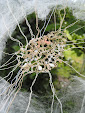
I was reading a book about the textile artist Gerhardt Knodel and was intrigued by the quotations in the book, including one of my favourites, T S Eliot’s Burnt Norton which begins ‘Time present and time past are both perhaps present in time future’. Much of Knodel’s work is ethereal even though it is often on a large scale and I will write more about him another day. I also like to reference poetry and literature in my work and the image shows part of a triptych I made inspired by W B Yeats’ He wishes for the cloths of heaven. It’s such a lovely poem and quite short so I’ll repeat it here: 

Had I the heavens' embroidered cloths
Enwrought with golden and silver light
The blue and the dim and the dark cloths
Of night and light and the half-light
I would spread the cloths under your feet
But I, being poor, have only my dreams
I have spread my dreams under your feet
Tread softly because you tread on my dreams

As you can guess the image is of the blue cloth of night. The lace is free bobbin lace and it's embedded in dyed silk paper fibres to give the impression of yearning for love and finding a space for dreaming.


Thursday, 20 July 2023

‘Jack Alive’ inscribed lace bobbins


I was always led to believe that lace bobbins inscribed ‘Jack alive’, like the one in the image, were produced to celebrate the return of a sailor who everyone thought had been drowned at sea. The story was that a ship would be reported lost at sea and all on board would be presumed dead, then months later the young sailor would return to his village, everyone would be delighted and inscribe bobbins to celebrate his return. T L Huetson in his book Lace and bobbins says he has seen too many of these bobbins to justify the theory that they were made for this unusual occurrence. I agree with him. Surely if a young man who had been presumed dead returned to the village the bobbins would have included his name rather than use the generic term ‘Jack’ for a sailor. Huetson suggests that ‘Jack alive’ might have been a common Victorian expression whose meaning we have lost. Well, after some research online, and thanks to The Gale Review, I have discovered that ‘Jack’s Alive’ was a Victorian game, which is described in George Arnold’s 1858 book The sociable or one thousand and one home amusements. Everyone playing the game sits in a circle. A small stick is lit in the fire then blown out leaving sparks. The stick is passed from one person to another round the circle each one saying ‘Jack’s alive’ as he passes it on. The player holding the stick when the final spark dies has to have a moustache painted on their face with the charred stick or pay a forfeit instead. It sounds a lively game, and there are several lace bobbins inscribed with music hall catch phrases, so we know lacemakers enjoyed having popular sayings on their lace pillow, but whether this was the meaning of Jack alive we don’t know for sure.

Wednesday, 12 July 2023

Guipure d’Art

I looked up guipure lace in an encyclopaedia from 1882 this week and was surprised to find that the entry covered 16 pages and dealt with a range of laces I wasn’t expecting, which just shows how lace terms vary over the years. I thought I would focus on the entry for guipure d’art which seemed to me very like what we call filet lace today. Like filet work this lace begins with the formation of a net base which is secured on a wire frame, ensuring that the net is held taught and the squares are drawn out to their full extent. The net is then embellished using various embroidery stitches to form the pattern. Simple darning is used to fill individual squares or to form a line of solid work as can be seen on the right in the image above. Other stitches such as point d’esprit (interlinked and reversed blanket stitches) or point tiellage (an open twisted cross stitch) can be used to form a lighter filling stitch. Solid leaves, triangles and circles can also be worked by close weaving over thread outlines.

This work was obviously popular for the amateur lacemaker in the 1880 as the instructions assume a level of competence. However patterns for this type of work are also found in Federico Vinciolo’s book of Renaissance patterns for lace and embroidery published in 1587, which as you can see in the image, clearly show the variety of stitches to be worked. This type of lace has therefore been made for centuries although given different names at different times.  

Wednesday, 5 July 2023

Brise-bise lace curtains


These pretty brise-bise lace curtains come from a 1904 Peach & Sons catalogue. The Nottingham lace manufacturer produced regular catalogues advertising their lace products including curtains, tablecloths, bedspreads, and other household lace as well as lace clothing, collars and handkerchiefs. Brise-bise curtains were becoming popular at that time and were made to hang across the lower part of the window from a rod or wire. These ones have small brass rings on the top through which the rod can be slotted but others have a channel woven across the top of the curtain for the same purpose. Also advertised with the curtains are newly patented ‘bracketless’ rods for casement or brise-bise curtains. The advert emphasises that they require no cutting and no brackets are required for fixing; they are made of polished brass and come in a range of sizes. The curtains in the image are made in two sizes (26 x 34 or 34 x 36 inches, width x depth) and cost per pair 1/3 for the smaller size and 1/6 for the larger ones. Other, cheaper brise-bise curtains were made from continuous lengths of lace (generally 26 inches deep) and were sold by the yard. The name brise-bise comes from the French briser meaning to break and bise a light cold wind, which I like to think results in the curtains wafting gently in the breeze rather than being buffeted by a gale.