Wednesday, 16 December 2020
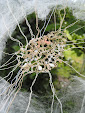
‘Kiss me quick’ lace bobbins

Wednesday, 9 December 2020
Chantilly lace


Any bobbin lace is time consuming to make, and Chantilly is
no exception. For larger pieces such as veils and shawls, which were
fashionable in the mid to late nineteenth century, several lacemakers worked
strips of the lace that were later joined together using invisible stitching
called point de raccroc. Unfortunately this line of sewing is also a weak point
that sometimes comes undone showing where the strips of lace were joined (see
above). Although my sample is coming apart, I found it interesting to see the way
in which the strips had been divided so that the join interfered as little as
possible with the main parts of the design.
Wednesday, 2 December 2020
The Space Between lace catalogue

What a treat – my copy of the catalogue of ‘The Space Between’ handmade lace exhibition, curated by Fiona Harrington for Headford Lace Project, arrived today and I’ve been enjoying browsing through it. I was going to blog about my favourite pieces but I realise that it’s impossible to choose between them so I’ll give you an overview of the exhibition instead. As Elena Kanagy-Loux reminds us in the introduction, lace is a textile defined by its appearance and numerous techniques are used to make it, many of which are found within this exhibition.

As expected, many of the pieces showcasing techniques celebrate Irish laces. Sr Madeleine Cleverly’s chalice cover edged in Headford lace links the past and the present, while Rosie Finnegan Bell’s Carrickmacross lace tree (see above) celebrates the legacy of lacemaking in South Armagh. The heritage of Carrickmacross lace is also the subject of Karen McArdle delicate photobook. The Irish Crochet lace hat exhibited by the Irish Crochet Lace Revival Group beautifully incorporates three types of Irish crochet to display the intricacy of the technique. The fine working of another traditional Irish lace, Borris tape lace, is displayed in Helena McAteer’s round floral d’oyley. Ann Keller describes her bobbin lace fans as Irish Celtic style bobbin lace, which rather than spotlighting one specific type of Irish lace are designed to include Celtic traditions and art within their folds. Of the other lace techniques, Jackie Magnin uses Torchon lace with variations of her own, Olga Ieromina plays with the size and placing of traditional lace, and Tali Berger makes large scale bobbin lace structures using rattan.

Many of the pieces were made as a response to lockdown during the Covid-19 pandemic. One of these is ‘Le Messenger’ by Elisa Gonzalez made using free bobbin lace techniques inspired by the colours and the view of a garden. Daniela Banatova’s intriguing abstract bobbin lace forms (see above) are inspired by the trees and rock formations she finds on her travels. Also in the exhibition is one of Mary Elizabeth Barron’s Torchon lace river series based on the Logan River, made from threads she has created from clear plastic packaging to highlight the impact of plastic waste on the environment. Moving from the earth to the sky, Ashla Ward’s complex black crochet pieces were inspired by exploring the darkness in the spaces between the stars in the night sky. Kim Lieberman also incorporates images of the sky in her bobbin lace piece, which comes from a series of works inspired by territories. Her images are taken from banknotes around the world and the chaotic (or wild) ground which holds the currency in a flux explores the interdependence of us all.

Nature on a smaller scale is depicted in Andrea Brewster’s
tatted coral forms and Eleanor Parkes’ needle lace insects. Eithne Guilfoyle’s image
of red deer shows the versatility of Limerick lace, while Theresa Kelly’s
vessels (see above) inspired by tree bark show the contemporary possibilities for
Carrickmacross lace. M Merce Rovira and Atena Pou were also inspired by nature,
their free bobbin lace sculpture captures the feeling of a soft breeze under an
oak tree. Rather than depicting nature, Saidhbhin Gibson interacts with it by, for
example, temporarily covering scars on trees and cacti with delicate needle
point lace.

Moving from embellishments for nature to those for the body. Roisin de Buitlear’s lace engraved glass visor reminds us of veiling. It speaks of fragility and vulnerability and as such it is a tribute to front line workers in the Covid-19 pandemic. Malgorzata Szpila showed two lovely bobbin lace necklaces, one of falling golden leaves (see above), and the other of frozen silver leaves. Angharad Rixon used silver wire worked in free bobbin lace over a stone found on the beach to reflect the passing of time (see below) and Jane Fullman also worked bobbin lace in wire to produce beautiful patterned pendants and flowers. Suzanne Plamping’s delicate circular hanging inspired by reflection also uses metallic threads. In contrast to these smaller pieces, Kara Quinteros used large scale experimental bobbin lace to produce a bodice and skirt using ethically sourced yarns.

Family ties are celebrated by Rachel McGrath who uses Irish crochet lace and hair to capture an essence of her past. Two artists exhibited self portraits: Eleanor Parkes’ is representational and made from bobbin and needle lace, while Vesna Sprogar’s is pixelated and composed of bobbin lace and tatting. Ester Kiely also uses technology in her bobbin lace installation ‘Port San Aer’ (see below), which translates music into lace, and you can also listen to the tune by using the QR code in the catalogue.

Mary St. George, who introduced lacemaking to Headford in 1765, is celebrated by Norma Owens in a series of small round sculptures that incorporate symbolic motifs to represent her life and reflect on the male commentators who tried to belittle her work. Other artists dealing with women’s issues include Amy Keefer whose capsaicin crochet collar considers the lack of means of defence for women throughout history, while Camilla Hanney’s ceramic lace gloves suggest excessive femininity and explore the contradictions involved in traditional handmade lace production. Marian Nunez exhibits two metaphorical works that consider the emptiness of life and the ephemerality of beauty, based on Japanese iconography. Ger Henry Hassett’s moving work ‘A black mark’ remembers the souls of the 796 skeletons of babies who died and were buried at the Tuam Mother & Baby Home and the mothers who were scarred by their experiences there (see below).

As well as these beautiful and thought-provoking pieces, which
were exhibited in an art trail in windows throughout Headford, there were two
commissioned works of art. Unfortunately these are not illustrated in the
catalogue so I haven’t seen them, but the artists are Selma Makela who painted
a triptych remembering those who traditionally made lace in Headford and Tarmo
Thorstrom who alters the scale of Torchon bobbin lace by making it in linen and
jute rope.
Despite not being able to travel to Headford I have thoroughly enjoyed visiting virtually through the catalogue. As Elena says in her introduction, lace is not a dying art rather we seem to be ‘on the precipice of an exciting revival’. It is encouraging to see contemporary lacemakers exploring new paths as well as celebrating the revival of traditional lace. If you would like to discover more about the Headford lace project or order a catalogue for yourself you’ll find all the information on the website www.headfordlaceproject.ie
Wednesday, 25 November 2020
Thomas Lester and Bedfordshire lace


This image shows pages from Lester’s exercise book of
designs in the Cecil Higgins collection. He was designing point ground lace in
the early 1850s but after visiting the Great Exhibition, and in particular
seeing that Honiton lace was not only a more free style of design but also was
held in higher regard and fetched a higher price, he began designing Bedfordshire
lace in a freer style using plaits to join the elements rather than grounds,
which he used as filling stitches instead.

The designs often feature realistic plant forms and animals
and the source of these may have been books of natural history, illustrated
periodicals or Owen Jones’ The Grammar of Ornament which was used as a teaching
aid at art schools. Such realistic natural designs were popular at the time and
feature for example in Honiton and Brussels lace as well as other textiles. In
the 1862 International Exhibition Thomas Lester was awarded a medal for his new
type of lace, which he called ‘Bedfordshire white fancy lace’. He died in 1867
but the Lester family continued their lace manufacturing business in Bedford
until 1905 and won medals in several exhibitions including the one in Chicago
in 1893. However, the success of machine lace reduced their business
considerably, particularly following the 1860s when the Levers lace machine became
capable of producing imitation Bedfordshire (Maltese) lace, and they
diversified into art needlework and Berlin work as well as continuing to sell ‘real
lace’.
Wednesday, 18 November 2020
‘Frayed nerves’ needle lace

Thursday, 12 November 2020
‘For better; for worse’ Amy Atkin lace mats

Wednesday, 4 November 2020
Lace making in Bobowa, southern Poland

Subscribe to:
Posts (Atom)