As part of my research into machine made lace I’ve recently been reading about the history of the Simon May lace company, which was based in Nottingham but had many branches worldwide. I was surprised to discover that their napery department, a general term for table linen of all types, was only inaugurated in 1920. This surprised me as tablecloths were made using the Nottingham lace curtain machine and I assumed curtains and tablecloths would have been part of the same department. I also knew Simon May had been producing curtains since the middle of the nineteenth century. However, further reading about this napery department showed that it produced dinner and luncheon sets, tea cloths, runners, and dressing table sets with lace insertions, edgings or embroidery. So it seems that in this department they were making motifs and edgings rather than tablecloths. This section of the book is also illustrated with a photograph of a lace tablecloth so it wasn’t just me who was confused! Another interesting image accompanying the article shows rows of women working at what look like sewing machines presumably making up the table mats. Subsequent reading revealed that tablecloths and mats were indeed made in the curtain department but the ones requiring hand finishing were made in the napery section – puzzle solved!
Wednesday, 27 October 2021
Wednesday, 20 October 2021
Lace for ‘Tansa: Japanese threads of influence’
I’m still working on my lace for the ‘Tansa: Japanese threads of influence’ exhibitions. My pieces are inspired by Japanese textiles and gardens and the sensibility of shin-gyo-so – broadly expressed as ‘the realistic, the impressionistic and the abstract’. The abstract piece is a small three-dimensional bobbin lace sculpture but the other two pieces are black net hand embellished with black thread. Both of these two pieces are hangings, one based on kimono cloth and the other on wrapping cloth. I’ve used this needle run technique before but previously I used white thread and net so I’ve had to make a few adjustments this time. For example, previously I’ve outlined the elements of my underlying pattern in thick black permanent pen but that is very confusing with black thread so this time I’ve outlined everything in red, which shows through the black net much more successfully. Also the black thread shows up more effectively on the black net than the white on white version so I’m adding some net overlays to soften the effect. Both interesting effects that I’ve only realised by actually working with the materials. All three pieces will be exhibited next year in the UK and Japan. The first venue for the lace sculpture is the Crafts Study Centre, Farnham from 4 January to 19 February and the lace hangings will be at South Hill Park, Bracknell from 23 February to 3 April.
Wednesday, 13 October 2021
The rebato – supporting the lace collar
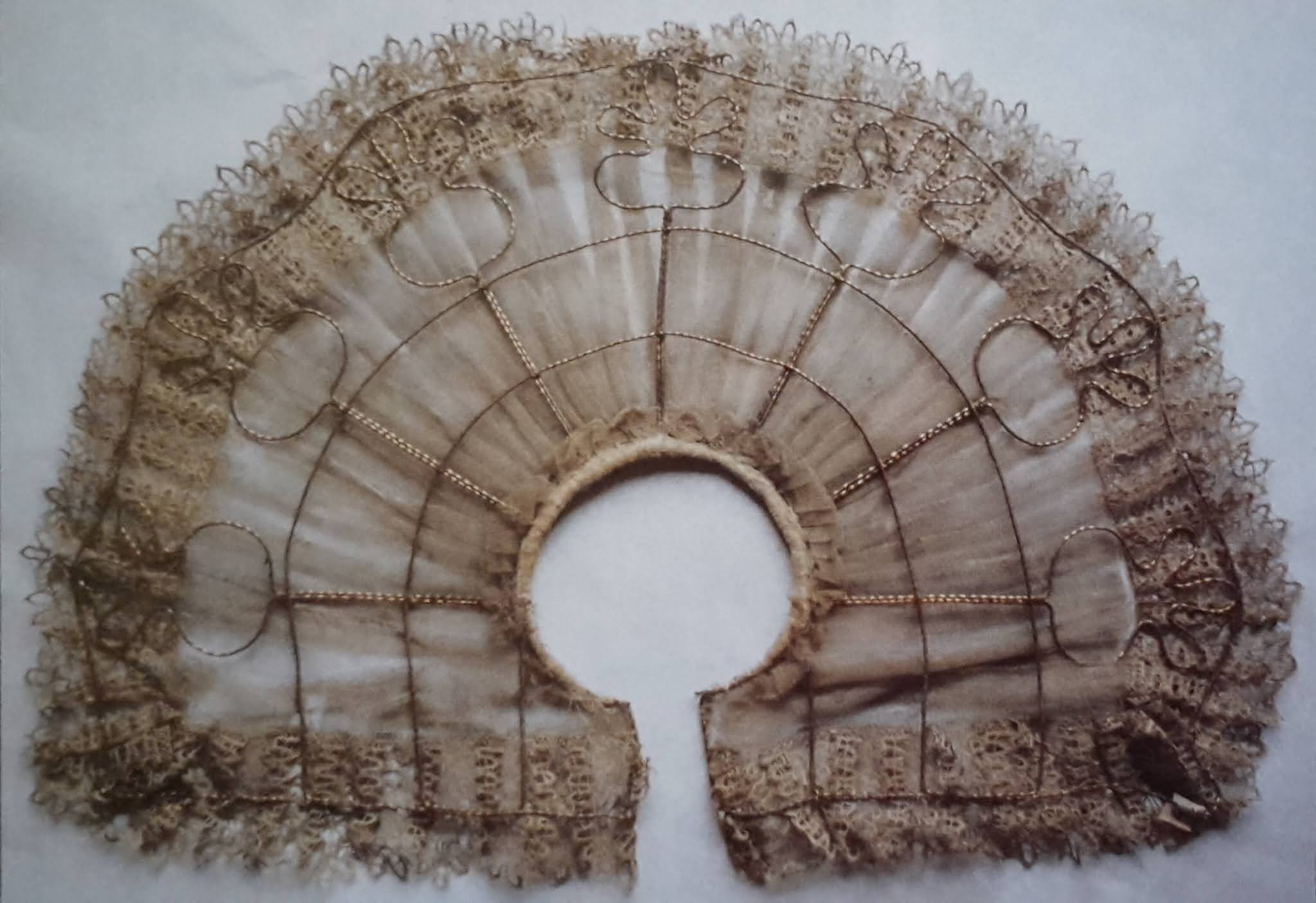
Many lace ruffs were starched to stiffen them and keep them in shape but larger lace collars such as this one were attached to a supporting frame to show off the lace. There were various types of supporting frame but today we’re focusing on the rebato.
Rebatos are wire frames made up of twisted wires, which often
appear quite lacelike in their own right. They would have been made by silkwomen
and some are wrapped in plain or coloured silk or even metal threads which
would glint through the lace collar at the front and appear quite distinctive
from behind and probably looked stunning in candlelight. Many, like this one were
covered in gauze or cotton with a simple lace edging attached round the edge
but others were left plain.
The lace was sewn onto the frame using simple oversewing so
it could easily be removed for laundering, although many incorporated a black
silk edging round the neck edge so the dirt wasn’t too obvious! A basic frame
could also be reused for a different lace collar and any lace scallops
protruding from the edge of the support, like the ones here, would have to be stiffened
with starch to make them stand up.
Wednesday, 6 October 2021
Caroline Bartlett exhibition at the Crafts Study Centre
I had a very enjoyable day earlier this week at the Crafts Study Centre (CSC) in Farnham seeing Caroline Bartlett’s exhibition ‘A restless dynamic’ - the image is a detail of ‘Every ending has a new beginning’. The exhibition includes new work that she has made in response to the archive of Lucie Rie held at the CSC and her collaboration with Issey Miyake.
Looking at continuity and change as it affected both her own
work during the pandemic and that of Lucie Rie, Caroline has produced pleated circular
shapes that reflect on Rie’s use of the potter’s wheel and her colour palette,
as well as referencing the pleated fabrics of Miyake. The shape of the pieces materially
indicating the continuity of the circle while the subtle colour changes within
the pleated fabric speak of change.
The exhibition also includes work Caroline has previously
made in response to other venues and archives including ‘Stilled’ made in
response to Salts Mill (image above) and ‘Listening in’ responding to time
spent in the Whitworth textile archive. There are some interesting themes here
and the work is beautiful, I have just given you a taster, so do go and see it
if you can. It runs at the CSC until 11 December, but note that it isn’t open
on Mondays.
Wednesday, 29 September 2021
Trade beads in lace bobbin spangles
Many of the beads on these lace bobbin spangles were originally made for trading in Africa and North America. Trade beads were made in varying sizes and colours and the Pitt Rivers Museum in Oxford has several trade cards of beads in graded sizes and colour ranges labelled according to the market they were made for. The card labelled ‘Trade beads for South Africa’ has round, plain beads coloured blue, brown and yellow like those in the spangles in the photo. The beads on the Central African trade card are much more decorative with patterns and come in a variety of bright colours and lozenge shapes as well as spheres. The beads were sold by weight and are also known as pound beads. They were imported from Amsterdam and Venice and although their main destination was the shipping companies of Liverpool and Bristol some must also have been sold in the home market as they are quite common on lace bobbins. The traditional beads on lace bobbins are the square cut type made in the lace making areas (like the clear ones on the second bobbin on the right) and I’ve not been able to find out where the lacemakers obtained these trade beads. Perhaps the bobbin makers acquired them and sold them or the lacemakers bought them from travelling salesmen.
Wednesday, 22 September 2021
Texture in bobbin lace
Raised tallies and leaves worked over flatter areas of ground
are also a traditional method for including texture. Tallies are small dense rectangular
woven areas worked generally with two pairs of bobbins, while leaves are made
in the same way but shaped with pointed ends to resemble leaves. Both can be
used in open work or made over flatter parts of the work. As you can see in
this piece I’ve worked a branch of leaves over a half stitch background. This was
done as the work progressed not added later and the bobbins were incorporated back
into the work.
Rolled tallies were also used in East Midlands lace in which
a rectangular tally is made and then rolled back on itself to incorporate the
bobbins back into the work leaving a raised rolled line of weaving on top of
the lace. This image shows a couple of rolled tallies made in the cloth stitch
ground and a line of paired leaves in the background all adding some texture to
the lace.
Wednesday, 15 September 2021
Sketchbooks
I have a sketchbook for each project I do because they are a useful place to keep all my ideas, samples, images of the exhibition space and any reviews after the event. The idea is that they are a repository for all the information to do with that project and are also a record that I can learn from for the future. Many entries are text rather than images and I also include invoices, receipts and copies of important emails. These are so useful, for example, when I start a later project and can’t remember where I bought a particular thread or fabric and how much it cost.
I also keep general sketchbooks where I keep samples and
things I’ve tried out as well as images of interesting things I’ve seen or read
about. My sketchbooks are not particularly beautiful or full of lovely drawings
but they are indispensable documents for future projects.