Wednesday, 26 November 2025

Saint Catherine: patron saint of lacemakers


Saint Catherine is the patron saint of spinners and the lacemakers affiliated themselves to her because of the similarities between their crafts. Her feast day is the 25th of November and it was a holiday known as Catterns in many English lacemaking districts, especially in Northamptonshire, Bedfordshire and Buckinghamshire. Villages celebrated the day in different ways. For example, in Bedfordshire, the people of Ampthill brewed special home-made drinks and baked Cattern cakes made of dough and caraway seeds, while those in Poddington ate their cakes with tea and then danced to fiddle music and ate a ‘great apple pie’. The lacemakers of Wendover in Buckinghamshire called the day Candle day because it was the first day of the autumn on which they started to make lace by candlelight. They also celebrated by cooking and eating ‘wigs’, which were round cakes containing caraway seeds that resembled gingerbread, and drank ‘hot pot’, which was made with warm beer and a splash of rum all thickened with beaten eggs.

As well as feasting and dancing to the music, the children played games such as apple bobbing and jumping the candlestick. There were different ways of jumping the candlestick but in one version the children danced in a circle around the lit candle singing ‘Jack be nimble, Jack be quick, Jack jump over the candlestick’. The name of each child was inserted in the rhyme, and when their name was used they had to jump over the candlestick without extinguishing the light. Many of the candlesticks would have been about 65 cm high and with girls wearing long petticoat dresses the potential for accidents seems very high, but I have not seen any reports of injuries or burns. In some places the festivities ended with the ringing of the church bells or lighting Catherine wheels but Thomas Wright, who recorded all this information, says that the custom of using the fireworks died out in the 1890s.  

Thursday, 20 November 2025

Campaign promoting lace sales after World War II

Browsing through a 1919 edition of the American trade magazine Lace and Embroidery Review I was intrigued by an initiative to revive lace and embroidery sales in the aftermath of the Second World War. To encourage sales The Lace and Embroidery Trade, based in New York, proposed a week long series of events and displays, at the end of April, to promote lace and embroidery throughout the United States. The article promises those reading it, who would have been lace buyers or retailers, that ‘the success of the event is assured’ because fashion magazines, the trade press, newspapers, department stores, specialist shops and the lace trade are all working together to make it so. It just relies on the reader playing their part by advertising in their local newspaper, making beautiful window displays and generally freshening up their department. The article continues by asserting ‘We feel confident you will co-operate to the limit of your ability’ and ‘will enlist the support of your ready-to-wear buyer’ as well as other department heads to display lace trimmed merchandise. No pressure then!

Luckily the Review seems to realise that its readers might need a little help with all this advertising and promoting so it provides templates for them. For example the illustrations above are all available either free or at cost if electroplate images are required.

There are also suggestions for how to use the images for windows cards or newspaper advertising, with appropriate layout designs and text. I think this is a very clever idea as it meant the quality of the advertising would be high, it would also be standardised throughout the country so would have brand appeal and thus link all the events together. The Review also included a page of endorsements from various lace retailers agreeing to take part in the lace week and reinforcing what a great idea the whole event would be, thus encouraging more readers to join in and become a part of it.

Following the lace week, the magazine included images of some acclaimed window displays from New York as well as more letters from those who had taken part and seen their sales increase. The initiative seems to have been successful in its aim of promoting lace sales, which had fallen during the war. In fact one reader from Chicago states that ‘this is the biggest lace and embroidery day we have had in three years and things look encouraging’.

Thursday, 13 November 2025

Splinter net lace from World War II


I saw these examples of splinter net in the lace exhibition at the Castle Museum in Nottingham. They were made by Tatham and Co in the 1950s but are of the type produced in World War II. Splinter nets were applied to windows to stop the glass shattering in the event of bomb explosions. Even small bomb explosions can cause glass to break into sharp fragments and flying or falling glass caused many wartime injuries.

These nets not only protected those inside the house but also people walking past in the street. Instead of splinter net, some householders used strips of paper glued on to the window in a grid or criss-cross pattern. Ideally the strips were fixed to both sides of the window, with those on the outside matching the pattern on the inside. Households were allocated rolls of gummed brown paper for the purpose, which had gum on one side that had to be moistened to make it sticky.

I was surprise by the variety of nets and wondered whether they were used for different purposes. Some of them are simple woven nets while others are patterned. Some are fairly dense, and would have obscured the light making the rooms inside quite dark, and there are wartime accounts saying that some people chose not to use splinter nets because of this reason. I also wondered how householders kept the nets clean, as dirty windows and nets would also have obscure the light, although perhaps that wasn’t a concern if you were in an area that was subject to regular bombing.

Wednesday, 5 November 2025

Exhibition of Peter Collingwood’s macrogauzes


I went to see the exhibition of Peter Collingwood’s macrogauzes at Margaret Howell in London at the weekend and was delighted to see so many of them on display. Although he was a weaver, Collingwood’s macrogauzes tend more towards lace than traditional weaving because the warp threads do not remain vertical, which allowed him to move away from rectilinear shapes. The other lace-like feature of his work is that much of it is three dimensional. He is quoted as saying ‘All along my weaving has depended on finding and exploiting new techniques’ and these are certainly unusual weaving techniques.

Although this image is a bit fuzzy, because it was taken through the shop window, the macrogauze at the back shows exactly how the vertical warp threads move. The warp threads in this case are hung in a line together across the header, but are then separated and moved at angles to cross and twist with each other, to form the geometric patterns, until they finally merge on the lower rung, in a line, in the same alignment as the header threads.

It was also interesting to see so many of Collingwood’s drawings, notes and photographs in a separate display, exploring his designing and working methods. The shop window image also shows how the pieces are made into three dimensional structures with the help of fine steel rods placed diagonally from one integrated steel rod to another. This clever engineering solution also means that the pieces are woven flat, can be stored flat and potentially displayed flat until the diagonal steel rods are put in place.

Some of the details of the macrogauzes reveal how carefully they were designed and worked. The exact nature of their construction and the thread placement is stunning. If you want to find out more about Peter Collingwood and his work, he wrote several books about weaving and his archive is held at the Crafts Study Centre, University for the Creative Arts, Farnham.


Wednesday, 29 October 2025

Queen Mary’s Honiton lace handkerchiefs


A report about Queen Mary’s collection of lace written for The Connoisseur magazine of October 1928 highlights some beautiful lace made in the British Isles. Much of the lace was inherited by the Queen from her royal predecessors but we will focus on three Honiton lace handkerchiefs; two made for the Queen and one for her mother. The main image shows a handkerchief presented to the Duchess of York (later Queen Mary) as a gift, at her wedding in 1893, by the Honiton Lace Guild. The vandyke shape of the handkerchief, made from fine linen, would have been difficult to work accurately and the numerous flower and leaf motifs of the lace would have taken many hours to work. Honiton is a pieced lace, which means that each motif is worked separately. This has the benefit that many lacemakers can work the motifs, which are then assembled and joined together and attached to the linen cloth, by other lacemakers who are skilled in that part of the process. This example is unusual because the motifs are joined together, not by a net of bobbin lace stitches, but by fine plaits of thread made using two pairs of lace bobbins working from one motif to another.

The second handkerchief was made for Queen Mary’s coronation in 1911 and again presented to her by the Honiton Lace Guild. It includes symbolic flora including the rose, thistle and shamrock representing the countries of the British Isles and oak leaves for stability. This time the motifs are joined by a net ground which was probably worked using bobbin lace, although by this time much commercially available Honiton lace was mounted on machine-made net.

The third handkerchief was made for the Queen’s mother, the Duchess of Teck, and is embroidered with her monogram MA standing for Mary Adelaide. It is a pretty design and was presented to her as a gift for her wedding in 1866. The writer of the article notes that at this time the Honiton workers were producing excellent lace for international exhibitions, in an effort to show that their lace was able to compete with that from the great lace centres of the Continent. However, by 1928, when the article was written, women in Britain had more opportunities for employment and fewer were prepared to make elaborate lace for little reward, so commercial lace making in Honiton, and other parts of the British Isles, was declining.

Thursday, 23 October 2025

Frayed nerves: needle lace and silk paper


To have frayed nerves is an expression that has been used since 1870 to mean being worn down or irritated to the point where you feel stressed, anxious and no longer able to cope. As textile people we are aware of threads fraying when they become stressed and worn to the point that they gradually pull apart and thus lose their strength and ability to function.

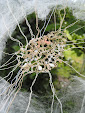
This piece literally show the frayed ends of the threads, and the nerves they represent, lying under the skin. It shows a glimpse of the nerves at a point where a strip of skin has been broken and torn down to reveal them lying underneath. The implication being that the skin was scratched incessantly in a nervous manner until it was torn open to reveal the nerves underneath.

The nerves are made in needlelace, which is worked with a needle and thread, forming a variety of buttonhole stitches. Here the buttonhole stitches are worked, in subtly coloured silk threads, over a core of thicker crochet cotton. The frayed ends of the nerves are embedded in a larger piece of handmade silk paper to form a hanging, with a strip of the silk paper hanging down at the front of the work as if it has been ripped from the main hanging to reveal the nerves underneath. The hanging is backed with a length of silk that has a fine shimmer suggesting the interior of the body. The fine silk paper and the subtle colours of the nerves were designed to suggest the fragility of the human body and the ease with which the nerves can be stressed.  

Thursday, 16 October 2025

Roller blind lace


These strips of lace are advertised in the 1904 Peach lace catalogue as roller blind lace. They are quite wide (about 12 cm) and were designed to be sewn to the ends of roller blinds to make a neat and attractive ending to the fabric. (Interestingly the catalogue refers to this lower lace edging as a valance, which I had always thought referred to the upper part of a window dressing - clearly a research question for another day!) These lace trims are all numbered and priced so I assume the householder could order the length she wanted and make up her own roller blinds, however the company also offers a making-up service. They offer three types of roller blinds: plain linen, holland and union. The styles of blind all seem to be simple rolls of fabric, the only difference being the type of fabric used. Plain linen is self explanatory. Holland is generally a better quality linen cloth, although by 1887 it also referred to cotton fabric, which was usually glazed and sized to make it stronger and less affected by dust. Union is a mixture of cotton and other yarns, usually linen but also wool or jute, it was considered inferior to plain linen. It was glazed and often used for blinds, but had a reputation for not wearing well and the advice was to replace union blinds rather than attempting to wash them when they got dirty. 

The householder could buy plain fabric blinds or have them made up with one of the lace trims. They could also buy blinds with both a trim of lace and an insertion of a strip of lace a few inches above the trim in a matching style of lace, you can see an example of this combination in the image above. The insertion lace in this image (the piece with the straight edges) is about 6 cm wide and the trim 9 cm, but prices are also given for wider laces. The prices in the catalogue show that the linen blinds were the most expensive, followed by the union ones and the holland type were the cheapest, suggesting that the holland used was cotton and not linen. Many late nineteenth century influencers, were opposed to roller blinds because they blocked sunlight and impeded the flow of air, but the number on sale in this catalogue show that they were obviously popular with householders.