Showing posts with label Queen Mary. Show all posts

Wednesday, 29 October 2025

Queen Mary’s Honiton lace handkerchiefs


A report about Queen Mary’s collection of lace written for The Connoisseur magazine of October 1928 highlights some beautiful lace made in the British Isles. Much of the lace was inherited by the Queen from her royal predecessors but we will focus on three Honiton lace handkerchiefs; two made for the Queen and one for her mother. The main image shows a handkerchief presented to the Duchess of York (later Queen Mary) as a gift, at her wedding in 1893, by the Honiton Lace Guild. The vandyke shape of the handkerchief, made from fine linen, would have been difficult to work accurately and the numerous flower and leaf motifs of the lace would have taken many hours to work. Honiton is a pieced lace, which means that each motif is worked separately. This has the benefit that many lacemakers can work the motifs, which are then assembled and joined together and attached to the linen cloth, by other lacemakers who are skilled in that part of the process. This example is unusual because the motifs are joined together, not by a net of bobbin lace stitches, but by fine plaits of thread made using two pairs of lace bobbins working from one motif to another.

The second handkerchief was made for Queen Mary’s coronation in 1911 and again presented to her by the Honiton Lace Guild. It includes symbolic flora including the rose, thistle and shamrock representing the countries of the British Isles and oak leaves for stability. This time the motifs are joined by a net ground which was probably worked using bobbin lace, although by this time much commercially available Honiton lace was mounted on machine-made net.

The third handkerchief was made for the Queen’s mother, the Duchess of Teck, and is embroidered with her monogram MA standing for Mary Adelaide. It is a pretty design and was presented to her as a gift for her wedding in 1866. The writer of the article notes that at this time the Honiton workers were producing excellent lace for international exhibitions, in an effort to show that their lace was able to compete with that from the great lace centres of the Continent. However, by 1928, when the article was written, women in Britain had more opportunities for employment and fewer were prepared to make elaborate lace for little reward, so commercial lace making in Honiton, and other parts of the British Isles, was declining.

Wednesday, 18 June 2025

Queen Mary’s lace court train


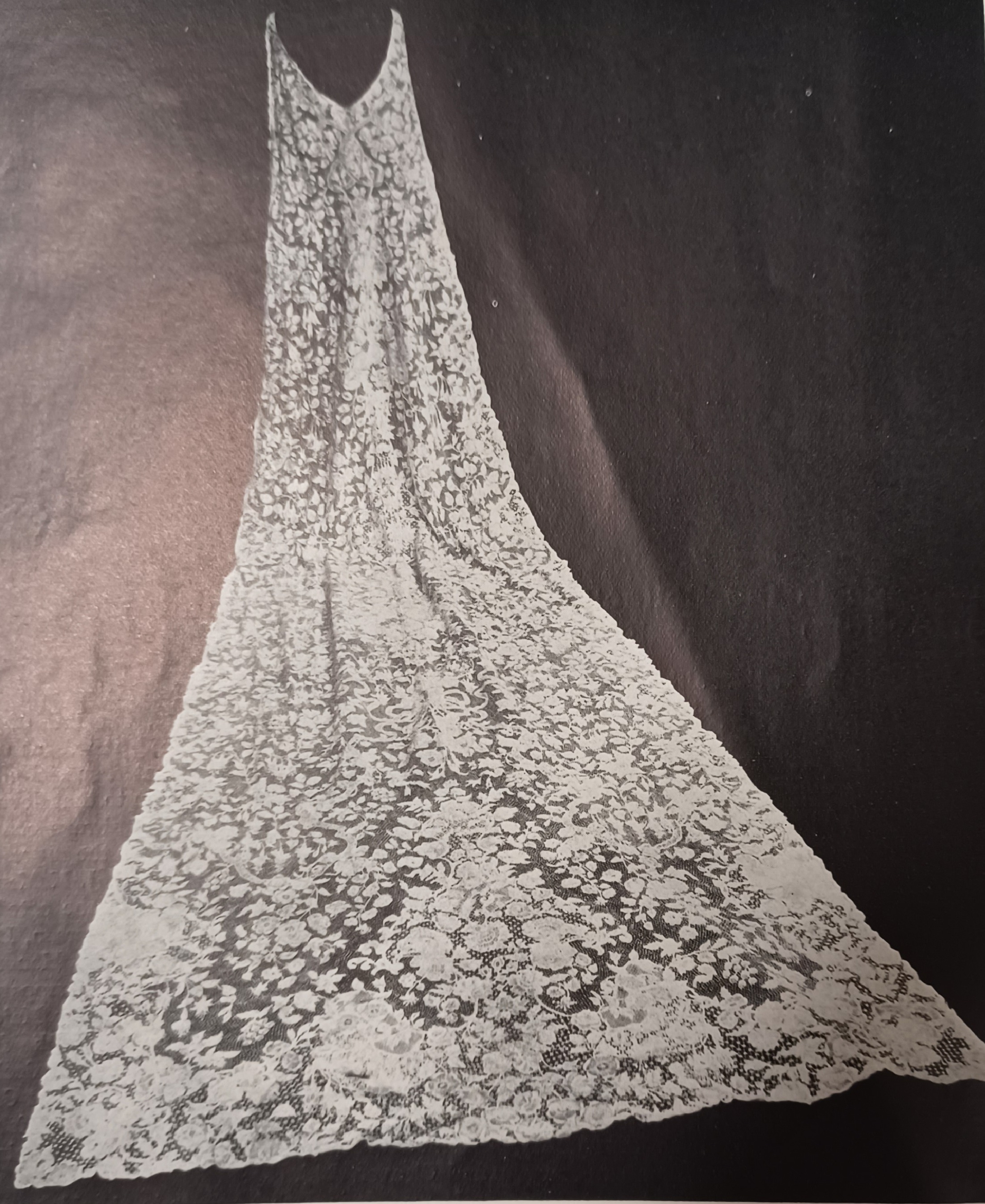
Queen Mary was an avid collector of art and artefacts and her lace collection was the subject of an article in The Connoisseur magazine of June 1928. Pride of place in the collection went to the court train of Irish needlepoint lace that was made for her to wear at the Coronation Durbar in Delhi in 1911. The train was commissioned by a group of influential ladies from Belfast, including the lady mayoress, who set up a committee and raised funds for the work. There was little time between the King’s accession and the Durbar so the train had to be made in 6 months. The Presentation Convent of Youghal in County Cork was given the task, and it is reported that 60 skilled lacemakers work in relays through the day and night to make the lace on time. It was estimated that one lacemaker would have taken about 30 years to complete the task alone.

The pattern includes scrolls and flowers, including the may flower as a reference to the Queen who was known as Princess May before her coronation. The lace is made with a needle and thread and the work is basically made up of blanket stitches and their various combinations to form intricate patterns.

 This type of needlelace is suited to collaborative work because the individual motifs are made separately by the lacemakers and then assembled and joined together with more fine needlelace. Each worker has her own specialism, such a drawing out the patterns, laying down the outlining cord, working the stitches or assembling the motifs and joining them with net stitches. It is a huge achievement to have completed a work of such intricacy, accuracy and beauty in 6 months and we should marvel at the skill of the Irish lacemakers involved in the task.