

It turns out
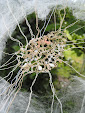
it is a depiction of the type of regimental cap badge that was used by soldiers
in the Dorsetshire regiment of the British army from 1900 to 1951. The regiment
was originally formed in 1702, under a different name, and underwent several
changes over the years. Then, in about 1898, the badge was redesigned to
reflect some of the battle honours the soldiers had achieved.

The castle
and key (the top of the key is the circle immediately under the castle) mark
the Great Siege of Gibraltar from 1779-1783. The scroll under the castle includes
the Latin inscription Primus in Indis (First in India) to acknowledge that the
regiment was the first British Regiment to serve in India in 1754.

The sphinx at the top of the design and the words Marabout under it refer to a battle during the Egyptian Campaign on 21 August 1802. The design of the castle and key is surrounded by a wreath of laurels and the scroll at the bottom is inscribed Dorsetshire. The mat is made of handmade bobbin lace and was probably designed by someone who had a relative serving in the regiment. It is well designed, and I’m impressed by the way the lacemaker has achieved the lettering. Having designed bobbin lace patterns with text in them I know how difficult it is to ensure the words are legible. I like the way she has depicted the bricks of the castle and the parts of the sphinx with a series of twisted threads, and the centres of the leaves too.
I think the piece was worked in two parts. First, the outer circle including
the laurels, sphinx and lettering and, second, the central panel with the castle
and key. The lacemaker then sewed the central panel inside the outer ring with
an oversewing stitch linking the two edges. I find that method of joining the
two parts interesting, because I would have looped pairs into the inner edge of
the outer circle and worked the central panel in situ, to ensure it fitted the
space correctly. It suggests to me that perhaps two people were working on this
piece at the same time, may be a mother and daughter as a reminder of a husband
and father far away in the army. However, the place where the beginning of the outer
lace circle meets the end of the lace is also joined by oversewing, rather than
looping the threads through the starting pinholes, so perhaps it was made by
one person and that was just the method she used to join pieces of lace – I will
probably never know!

No comments:
Post a Comment