Showing posts with label shawl. Show all posts

Wednesday, 9 July 2025

Icelandic lace knitting


I saw these lovely knitted lace shawls in the Textile Museum at Blonduos in the north of Iceland. There were various designs, some were large square shawls with scalloped borders, others were large triangles and one was a long straight shawl. They are all made from Icelandic wool, which is made of two distinct fibres. The outer ‘tog’ fibres of the sheep’s coat are long and water repellent and the inner ‘pel’ fibres are soft, fine and provide insulation. The two fibres can be spun alone or in various combinations depending on their final use, but the finest shawls are made from pel alone. It is claimed that these shawls, like those of Shetland, are so fine that they can be drawn through a wedding ring.

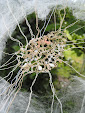
The wool is often used in the natural white, brown and black colours of the fleece, but some is dyed in delicate earth shades using natural plant dyes. The shawl with the brown edging in the main image was made by Pordis Egilsdottir (1878-1961) with pel wool in natural colours.

Helene Magnusson, who we were lucky enough to have as our guide, has carried out research into the collection at the Museum and most of my information comes from her book Icelandic handknits. She notes that this long white shawl was made by Johanna Johannesdottir (1895-1989) and was probably inspired by a motif in the 1885 edition of the handcraft book Kvennafraeoarinn by Elin Briem, which was one of the first books about handcrafts to be published in Icelandic. Helene has recreated this pattern and many other old patterns for the 21st century. She has also designed new patterns and garments inspired by the textile collection at Blonduos, and has created a lace weight yarn in which to work them.


Wednesday, 13 July 2022

Lace shawls, collars, pelerines, scarves, berthas and fichus


These shoulder coverings were all popular at different times during the 19 century and in many cases it is difficult to classify them. Scarves and stoles look very similar as do pelerines, fichus, berthas and collars depending on their width and when they were made. The examples here all come from the lovely ‘Lace in fashion’ exhibition which is currently on display at Wardown House Museum in Luton. Not only do they show the range of different fashions they also show how lace changed during the century from the entirely handworked, such as the fichu made in Bedfordshire Maltese lace, to a beautiful black machine lace collar.

There is a lovely wide Duchess collar of mixed Brussels bobbin and needle lace showing how the two types of handmade lace were traditionally combined and the image shows a detail of a beautiful dress including both types of Brussels lace applied to a machine lace background showing how handmade and machine lace were often combined. There is also a fichu combining pillow lace with machine lace as well as scarves with Honiton bobbin lace applied to machine made net. Several of the other collars have a machine net basis including a Limerick lace collar and another tamboured shawl. Other Irish laces popular in the second half of the 19 century are also represented with a Carrickmacross applique lace bertha, and an Irish crochet collar. I was also interested to see some examples of ‘imitation’ lace following on from my recent blog posts. The exhibition includes two Chantilly lace shawls one handmade and the other machine made; difficult to tell apart without close inspection as would have been the case when they were worn. There is also a chemical lace pelerine worked in the style of Irish crochet and a late 19 century collar worked in the style of 17 century lace, so lots of copying and convergence going on. If you want to see more you will have to visit the exhibition which includes much more lace than the few pieces I’ve described here and is well worth a visit. It is open until 11 September.

Wednesday, 14 August 2019

Brussels lace shawl


This beautiful Brussels lace mantle is illustrated in an interesting book I bought during my last visit to the Lace Guild. It’s a catalogue entitled Lace in fashion 1815 -1914 and was published to coincide with an exhibition of lace at Utrecht Museum in 1985. It includes some beautiful illustrations as well as two interesting essays about changing fashions for lace by Mary de Jong and Patricia Wardle (who also wrote the catalogue) and obviously brought together a range of lovely pieces from some of the major museums and collectors in the Netherlands. I thought the Brussels lace shawl, or more correctly mantle, in the illustration was an interesting example from the third quarter of the 19 century, as it is made of bobbin lace applied to machine net and embellished with needle made fillings, showing how all three types of lace could be combined. The design is also quite light and open and reminiscent of the Chantilly shawls that were also popular at this time. I wish I could have seen the original exhibition as it includes some lovely lace