Thursday, 19 March 2015

Photographing lace


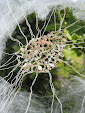
I’ve been trying to take photos of my lace again and have decided that the best way of doing it is to take close ups. It’s so difficult to get an overall view of most of the larger projects I make and when I do manage it all the details get lost. I also find with my net curtain and silk paper pieces that because they are transparent, the background is important. It’s no good having an ethereal piece of lace with an image of buildings behind it. I have tried taking photos in the garden, and that was quite successful but the slightest breeze can move the lace, which can lead to interesting effects but can be annoying, depending on the piece. So today I have concentrated on close ups, the image above is from ‘Frayed nerves’ which includes needle lace ‘nerves’ embedded in silk paper. I think the close up makes an interesting image regardless of the subject and at least it focuses on the lace!

Wednesday, 11 March 2015

Lace and science


Collecting some images of scientific subjects depicted in lace has confirmed what an excellent medium lace is for depicting biological and medical subjects. The piece above is a detail from a piece I made entitled ‘Thread of life’ showing a bundle of foetal cells dividing. Both bobbin and needle lace are excellent for depicting cells and histological structures as well as nerves, muscle fibres and other medical forms such as bacteria and viruses. Lace nets, both regular and irregular, can be used to suggest cellular structures, while intertwining plaits, threads and tallies can suggest nerves and other fibres. As you can see on my website lace can be used not just to depict biological images but also to represent concepts such as loss of memory and genetics. I’ve also used lace to depict the sleep cycle but so far no other physical, chemical or engineering subjects – a life time’s work awaits!

Wednesday, 4 March 2015

Tape lace


I’m working on a project at the moment for a mat that will use tape lace outlines, like the one above, entitled ‘Sweet dreams’. For that piece I made an oval edging, using a patchwork of fabrics, and joined the lace to the inner edge of the fabric as I worked round it. This time I’m going to use a continuous ‘tape’ of lace using cloth stitch and twists. I haven’t decided on the colours yet, but although I want to include some gold I think the other colours will be more subtle. I’ve always admired the way that many of the continental laces, such as Russian tape lace, use only a handful of bobbins, yet by working the tape backwards and forwards can make very intricate designs. That way of working has always seemed a much easier option than the straight laces that use numerous bobbins, although you have to keep doing sewings to join the tapes, which could be a drawback!

Wednesday, 25 February 2015

Lace for dust and decay


I’ve finished the first piece of lace for my Dust, Decay, Disintegration series. It’s inspired by my work on nineteenth century gothic novels and is looking at the decay of the home. This piece of lace is based on the tuberculosis bacillus, as consumption was a scourge of daily life and often mentioned in those novels (see posts in Nov and Dec 2014). I’m going to incorporate it into a curtain with silk fabric and silk paper combined with dust, as if the fluid material is stiffening into the crisp paper, due to the silting up caused by the dust in the home. I’ve started the lace for Decay, which represents the continuation of the silting up process, but although there will be less lace in that curtain – making the lace is more complicated because it has to give the impression of decay. It’s always difficult to mimic natural processes without looking contrived and I don’t have time to make the lace and let it decay naturally. Watch this space!

Thursday, 19 February 2015

Codes and keys


This work entitled ‘Sea/land’ by Ian Hamilton Finlay, which I saw recently at Bristol Museum and Art Gallery, caught my attention because it reminded me of cloth stitch in lacemaking. I liked the theme of the land and sea being interwoven and the idea of providing a key to explain the colour code for the different threads. I’m interested in coded communication and have worked with embroidered Morse code and QR codes to hide messages in textiles (see below).


Both Morse codes and QR codes require ‘keys’ to decipher them; the Morse code needs knowledge of the language and the QR code requires a reader on a smartphone. I also like to use layers of text that reveal hidden messages within them (see my virtual sampler post from  17 December 2014).

Thursday, 12 February 2015

Art chain: Art challenge


I’ve been busy this week taking part in the Art chain and Art challenge projects on Twitter.  When I was first nominated I felt a bit overwhelmed and wasn’t sure what to post – the idea is that you post three images of your work on 5 days and nominate someone else to take part each day. I began by finding some images linked to different lace techniques, but then decided that themed days would be better than unrelated pieces. I decided on five themes: cells, memories, whisperings, marking time and subversive stitching. Once I’d decided on my themes finding the images to fit didn’t take long. I found the greatest problem was nominating someone else. At first I started by linking my nominations to the projects, so for example on the day I posted my ‘Memories are made of this’ series on memory loss, I nominated Jenni Dutton who produces beautiful work linked to dementia and memories. However, I found that some of my choices had already been nominated and others I wanted to nominate didn’t link to a particular project, so in the end I just chose people whose work I admire. It’s been great fun and interesting find three images each day to represent themes in my practice.

Wednesday, 4 February 2015

Reality questioned


This exhibition at the Bristol Museum and Art Gallery brings together the work of several well known British artists from the early 20th century and a contemporary work by Tala Madani. The artists include Barbara Hepworth, Henry Moore, Ben Nicholson, and John Nash and the exhibition considers their engagement with reality. It also looks at their influences and how they experimented with abstraction and illusion. I was particularly drawn to Barbara Hepworth’s 1948 work ‘The hands’ which depicts medical staff about to undertake an operation and was inspired by Hepworth’s time in hospital when her daughter underwent surgery. I love its meditative quality and the emphasis on the serenity and calmness of the hands held as if in prayer.