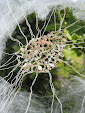
I decided to depict
the sleep cycle in bobbin lace and silk paper as they seemed appropriate media
to use. I thought the silk paper would represent the unconscious dreamlike
state of sleeping while the random lines of the bobbin lace show the way the mind
flits from idea to idea during the dream stage of sleep. I based the work on a typical
graph of the human sleep cycle, which I copied in a coarse thread. I made rectangular
areas of random bobbin lace to represent each of the dream phases and combined
them with the thread graph. The silk paper was worked round all of them to
represent the unconscious state from which they emerge and to act as a
practical binder to keep them all in place. The final piece is an ethereal dreamlike
hanging that wafts gently in the breeze.
Thursday, 2 May 2019
Wednesday, 24 April 2019
Filet lace design book
I was lucky
recently to buy a lovely book of filet lace designs. It’s called ‘Le filet ancient
au point de reprise’ and it was published in Paris; unfortunately it isn’t
dated but filet lace became popular in the late nineteenth and early twentieth
century. It is obviously one of a series and no instructions are given so the
purchaser was expected to know how to work the designs. The information about
how to make the net and work the reprise stitch used for all the designs could
have been obtained from books on domestic crafts, many of which were available
at the time. However, there are recommendations for the type of thread required
to make the net and carry out the embroidery, depending on the number of
squares required per centimetre. I’ve come across several of these design
folios and they show how popular filet lace was. The designs can also be used
for cross stitch and indeed any craft work based on a system of linked squares.
The image shows how complicated some of these designs were and also how well
the designers have achieved flowing lines even when working on a rigid grid
format.
Wednesday, 17 April 2019
Lace curtain designs
I’ve had a
good week researching lace curtain designs both in the Lace Archive at
Nottingham Trent University and in a private collection of designs. Unfortunately
most of them are not attributed to the designer or dated and for many of them it’s
even difficult to know who sold them. The image is of a design by Marcel Tuquet
and it comes from a folio of his designs published by Christian Stoll of
Plauen. The folio isn’t dated but they are all large bold designs which were
fashionable at the end of the nineteenth century. Compilations of images like
these were sold to lace and textile manufacturers as examples of good design
and this folio is known to come from the studio of a lace producer. The idea
was that they were used as inspiration and these pages are all marked with
pencil and ink suggesting they were well used and studied.
Wednesday, 10 April 2019
A Nottingham lace curtain collection
I’ve been writing
an article about lace curtains this week. It’s mainly about a collection of curtains
I’ve been studying in an archive, which were all produced at about the same
time but for different markets. It’s been interesting finding out about the
different lace curtain fashions and the associated window styles that
influenced them. It seems that curtain styles do not change very quickly and
many designs continued to be manufactured for several years. It’s also been
interesting to see how some curtains have been altered, often to shorten them
for use at smaller windows probably in the children’s or servants’ rooms when
they were no longer fashionable for the main rooms of the house. I’ve also been
looking at the factors influencing curtain styles including magazine articles, books
dealing with decorating and managing a home, and even the international
exhibitions that began with the Great Exhibition of 1851.
Labels:
curtains,
designs,
lace,
machine lace,
Nottingham lace
Wednesday, 3 April 2019
Lace sample books
I had an
enjoyable day earlier this week looking at some lace sample books with two
friends at an auction viewing. Lace sample books seem to fall into three groups,
but they all seem to be large, thick and heavy! They are all produced by lace-making
companies either to record their own products or to inspire their designers.
The first type include samples of the lace made by a producer and often show a
variety of laces based on a similar design. Some of these are for the producer’s
own use but others seem to be designed for salesmen to take to buyers to show
the different laces for sale and these may include prices and names. The third
type of sample book includes snippets of lace of all different types, both
handmade and machine made, glued onto the pages and these are generally
inspiration books for the lace designers. The image shows some samples of
designs that were put together as inspiration and includes lace and embroidery designs.
Wednesday, 27 March 2019
Exhibition of my Battle of Britain lace panels ending
My Battle of
Britain lace panels and the parachute installation will be taken down at Bentley
Priory next week, which means this is the last week they are all on exhibition.
It will be sad not to have them on show anywhere but they have been seen at
three venues in separate areas of the country: Nottingham; Gawthorpe Hall; and
London; so they have been widely seen. It was certainly an interesting project
which introduced me to many interesting people and widened my knowledge of the
Battle of Britain and the RAF and I hope I managed to convey some of that in my
work. My current project on Amy Atkin, the first female machine lace designer,
is certainly different but I’m sure will also lead to new knowledge and I hope
some insights into the role of women in design in the early twentieth century.
Wednesday, 20 March 2019
Filet lace patterns
I’ve been enjoying
reading the historical section in The technique of filet lace by Pauline
Knight. She notes that in the late nineteenth century few English magazines
published articles and patterns for filet lace but many French albums of
designs were produced, several of them reproducing designs from the sixteenth
and seventeenth centuries. These designs cover a variety of styles and also
include pictorial designs from the fables of La Fontaine and Perrault. These
designs were popular for filet lace and also for crochet so had a wide
audience. Interestingly Pauline suggests that the interest in filet lace at this
time may have been sparked by the availability of machine lace bedspreads and
curtains with elaborate designs. This reinforces my own idea that the lace curtain
designers were using the filet lace designs as inspiration for their own work
as both are based on a square mesh.
Subscribe to:
Posts (Atom)