Wednesday, 17 March 2021

Lace made from human hair


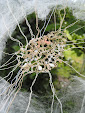
I’ve been looking at 16th century lace and came upon information about lace made from human hair. The example in the image is needlelace from the V&A Museum and is dated 1600. Janet Arnold notes that a silkwoman called Dorothy Speckard supplied Queen Elizabeth I with ‘heare braid’ and ‘two hundred devices made of heare in maner of leaves’. The slightly later fashion for strings of plaited hair looped round the neck or wrist seem to be keepsakes or love tokens but the earlier laces don’t seem to fulfil that function. Mary Jones refers to ‘point tresse,’ a type of lace made from human hair. She says this type of lace was understandably quite rare and commanded high prices. She records that Mary Queen of Scots received some point tresse from the Countess of Lenox, the mother of her former husband Lord Darnley, and that in the eyes of the family this gift exonerated Mary from the implication of having any part in Darnley’s murder. Jones also records that Louis XIV wore a cravat of silvery white hair at his coronation in 1614. Jones notes that point tresse was still being made in the 18 and 19 centuries by ‘Dalecarlian peasant girls’. Unfortunately this type of lace doesn’t last well so there are few examples but I assume it was all needlelace as finding enough human hair to wind round the lace bobbins required for even a simple pattern would have been no easy task.

Wednesday, 10 March 2021

Renaissance patterns for filet lace


I've been studying some of the filet lace designs given in Federico Vinciolo’s 1587 book of lace and embroidery patterns and comparing them with more modern pieces. The book was very popular and was reprinted at least 17 times between its inception and 1658. No instructions are given with the patterns, it was obviously assumed that needlewomen of the time would know how to work them. In the filet or lacis section of the book the patterns are reproduced on a square ground and in some cases the number of meshes it covers are enumerated although this could be deduced from counting them on the grid. 

Some are square geometric designs, others are sections or corners of a design. Some are specifically labelled as handkerchief edgings, but they are 35 meshes wide so would have been quite wide. Some of the patterns are figurative with gods and goddesses representing the seasons as well as hunters with dogs. There are also individual animals such as a stag, peacock, lion and pelican as well as mythical beasts such as unicorns and griffins. 

Although most of the patterns are just made up of white blocks on a black grid I was interested to see a few that included some filling and outlining stitches which I’ve come across in contemporary pieces.

Wednesday, 3 March 2021

Needle run Limerick style lace curtains

I bought this pair of dainty lace curtains at a busy market and wasn’t sure at the time whether they were machine or hand made lace. Clearly the curtains themselves were hand made as they were small cafĂ© curtain, with small hand-stitched brass rings at the top and seemed to have been cut down from a larger piece of lace. At first glance I thought they were made of machine lace because of the repetitive patterns, the solid cloth stitch and the amount of detail involved in the motifs. However on closer inspection I was delighted to find that the lace motifs had been needle run on to the net by hand in a technique similar to Limerick lace. 


I noticed that each motif was slightly different to the others, in particular the fillings of the main flowers and leaves and in some cases the fillings had been worked at different angles.


 Also the threads of the embroidery went through the net in different ways and looped round the net in a way that would have been impossible for a machine. I’m now wondering who the original lace was made by and what it was used for before it became a pair of small lace curtains.

Wednesday, 24 February 2021

Early twentieth century lace roller blinds


A slight change of direction today with a focus on roller blinds rather than curtains. The Samuel Peach catalogue for 1904 has several pages devoted to roller blinds, which they made to order from plain holland or linen. The greatest width available was 60 inches and the greatest length 90 inches, although the addition of a lace trim could be used to make them slightly longer. A variety of laces are available to add as trims to the end of the blind or include as insertions, although the impression is that only one insertion is included for the price given. There are several types of embroidered lace trims, one of which is 9 inches wide, although most seem about half that size. Other choices are machine lace, imitation cluny, corded applique and real guipure d’art. Two designs of ‘real Cluny lace’ are available as matching trims and insertions in fairly simple Torchon style patterns. Another matching duo of trim and insertion are made in ‘hand-worked corded lace’ which looks as if it’s a Russian style tape lace. Six Duchesse roller blinds are advertised which have embroidery worked directly into the fabric. These are promoted as ‘the newest and most artistic window blinds yet introduced’ and do seem to be both attractive and good value. For all the blinds, colonial customers are assured that the company takes great care in packing and despatching which suggests they had a wide overseas market. 

Wednesday, 17 February 2021

White wedding veils

Wedding veils have been in and out of fashion for the last two hundred years or so in Britain. The traditional white wedding with full veil is an upper class Victorian invention, before then most people just wore their best clothes for the ceremony. In the 1860s brides wore their veils hanging behind their heads with a wreath of orange blossom keeping it in place. In 1863 when Princess Alexandra married the Prince of Wales she wore a white dress and veil as did her eight bridesmaids. By the 1870s some brides came into the church with their veils over their faces and by the end of the nineteenth century it was only the bride who wore a veil, the bridesmaids wore hats or bonnets. In the 1900s fashions changed again and many brides wore hats rather than veils. If veils were worn they tended to be only waist length and hung down the back. Fashions became simpler during the first world war and veils became less elaborate. In the 1920s those brides who wore veils had them low down on the forehead in a style that mimicked the fashionable cloche hats of the period. Many brides wore veils that had become family heirlooms, for example when Lady Elizabeth Bowes-Lyons married the future George VI in 1923 she wore a veil loaned to her by Queen Mary. Princess Marina who married the Duke of Kent in 1934 wore her veil with a diamond tiara rather than flowers which started a craze for headdresses made of glass or paste. An indication of how royal bridal fashions have always influenced the wedding customs and dress of the general public.

Wednesday, 10 February 2021

Some unusual lace bobbin spangles

Spangles are the circles of beads attached to the end of English East Midlands lace bobbins to add weight and thus provide tension on the thread and also to stop the bobbin rolling on the lace pillow. I’ve written before about the most common type of spangles, composed of six square cut glass beads with a larger central bead and often two smaller beads at either side of the bobbin shank (see blog of October 2020). This time I thought I’d show you a few more unusual spangles. Two of those in the image above have buttons as the centrepiece of the spangle, which were probably of sentimental value to the original owner. Another incorporates a seashell which could have been given to the lacemaker by a sailor in the family or collected on a very rare trip to the seaside. The wooden bobbin contains a large decorated cylindrical bead and two carved smaller beads, interestingly I have seen similar large cylindrical beads in the collection of ‘trade beads for Central Africa’ at the Pitt Rivers Museum in Oxford. The bobbin below that has a good collection of glass beads and a silver coin dated 1837. The final bobbin in this image has a birdcage spangle where a ‘cage’ of beads has been made around a much larger bead by threading smaller beads on to wire and wrapping them round the large bead. These tiny beads were called ‘seed’ beads and are also the type of bead used to make striver pins (see my blog of September 2020).

Wednesday, 3 February 2021

Russian tape lace style mat

I’m making great progress on my Russian tape lace style mat, which is part of my series of subversive mats. Having made the centre with the text in a mixture of Bedfordshire and tape lace I’ve now started on the surrounding pattern, which is flowing very well. However, I’m learning all sorts of new techniques. Working with seven pairs of bobbins definitely has advantages as there’s no need to move sections of bobbins out of the way to tackle separate parts of the design. This style of lace does involve a lot of sewings though, which I’ve never been particularly good at and my bobbins are not designed for sewings, although the loops to sew into are quite large in this pattern which makes it easier. As with any lace pattern you have to think ahead and work certain areas before others but I’m becoming converted to the idea of working the central areas of crossed leaves without four plait crossings. Surprisingly, working leaves with a temporary pin supporting them and joining with a sewing works very well – I thought they would unravel with so little support but they haven’t so far! Also working the central area and then adding the half stitch tape round the outside means you don’t have to keep adding and removing pairs. I’ve also found that what I would describe as a ninepin edging is much easier using only two pairs and joining everything with sewings. I’m really enjoying this lace and learning a new way of working is quite eye opening!