Wednesday, 16 July 2025

Bayeux tapestry stitch


During our Icelandic textile tour we had a workshop to learn about Bayeux tapestry stitch, which was used to work the famous Bayeux Tapestry. It is a traditional technique in Iceland and is thought to have originated in Scandinavia. Fifteen ecclesiastical pieces worked in Bayeux stitch from the late 14th to the early 17th century still survive in Iceland.

The stitch is also known as ‘laid and couch work’ and is designed to fill a large area using minimal embroidery thread. A thread is laid across the area to be filled, a small stitch is used to secure it and the thread is then taken back to the original side, parallel to and adjoining the first thread, where another small securing stitch is made. The entire area to be filled is covered with thread in this way, on the surface, with the reverse of the work showing only the tiny securing stitches along the edge of the area.

Once the area is covered in close parallel lines of thread, another thread is laid, at a right angle to the original threads, on top of them. This thread is then secured at intervals with small couching stitches at approximately 5 mm intervals. As you can see from the images, the upper threads and the couching stitches can be the same colour as the main work or a different colour.

Working the upper thread in parallel lines is the traditional way of working but it is also possible to work curved lines as well. Once one upper line of thread has been worked others are then added to cover the entire area to be filled. To give some definition to the different parts of the design the area to be filled is usually outlined with stem stitch before it is filled with Bayeux tapestry stitch.

The earliest examples of Bayeux tapestry stitch are the Bayeux Tapestry and a fragment from a tomb in Durham, England, both from the 11th century. The Bayeux tapestry tells the story of the invasion of Britain by William of Normandy in 1066. It is 70 m long and about 40 cm deep and it is thought it was commissioned by William’s half-brother Odo Bishop of Bayeux and embroidered by women in Kent in the south of England in the 1070s. At that time, Anglo-Saxon needlework known as Opus Anglicanum was famous across Europe for its high quality. The Tapestry is housed in the Musee de la Tapisserie de Bayeux but is being loaned to The British Museum in London from September 2026 to July 2027. This will be the first time it has returned to England since being made in the 11th century.

Wednesday, 9 July 2025

Icelandic lace knitting


I saw these lovely knitted lace shawls in the Textile Museum at Blonduos in the north of Iceland. There were various designs, some were large square shawls with scalloped borders, others were large triangles and one was a long straight shawl. They are all made from Icelandic wool, which is made of two distinct fibres. The outer ‘tog’ fibres of the sheep’s coat are long and water repellent and the inner ‘pel’ fibres are soft, fine and provide insulation. The two fibres can be spun alone or in various combinations depending on their final use, but the finest shawls are made from pel alone. It is claimed that these shawls, like those of Shetland, are so fine that they can be drawn through a wedding ring.

The wool is often used in the natural white, brown and black colours of the fleece, but some is dyed in delicate earth shades using natural plant dyes. The shawl with the brown edging in the main image was made by Pordis Egilsdottir (1878-1961) with pel wool in natural colours.

Helene Magnusson, who we were lucky enough to have as our guide, has carried out research into the collection at the Museum and most of my information comes from her book Icelandic handknits. She notes that this long white shawl was made by Johanna Johannesdottir (1895-1989) and was probably inspired by a motif in the 1885 edition of the handcraft book Kvennafraeoarinn by Elin Briem, which was one of the first books about handcrafts to be published in Icelandic. Helene has recreated this pattern and many other old patterns for the 21st century. She has also designed new patterns and garments inspired by the textile collection at Blonduos, and has created a lace weight yarn in which to work them.


Friday, 4 July 2025

Wooden lace bobbins with inlaid pewter


These wooden lace bobbins are inlaid with pewter, which would have shone like silver when they were first made in the nineteenth century. The one on the right gives an idea of how they were made, by cutting channels into the wood, placing the bobbin in a fired clay mould and then pouring molten pewter into the grooves. Traditionally bobbins with pewter rings were called tigers, those with spots were leopards and those like the bobbin second from right with the V shapes were called butterfly bobbins. The bobbin on the left is interesting because it has pewter spots and fine wire wound round the channels rather than pewter. The spots were made by drilling straight through the wood and inserting a rod of pewter, which was then cut flush with the wood and smoothed to a shine. The bobbin with the criss-crossed pewter is also unusual mainly because of the amount of pewter used and the overall pattern. Pewter is an alloy of tin and lead and unfortunately the reaction between sweat from the lacemakers hands and the tin in the pewter can cause the tin to corrode and expand. This may make the surface of the bobbin feel rough and these rough edges can potentially catch on the lacemaker’s hands or the fabric of the lace pillow. In other cases, the pewter completely falls out of the bobbin, as it has started to do in this one, so it is common to find wooden bobbins with grooves cut into the wood but no pewter inlay. Although I do use the wire bound one, I tend not to use the others because of the likelihood of the pewter falling out.

Wednesday, 25 June 2025

Netted lace


Netting is made from a continuous thread wound round a netting needle, which is split at both ends. The stitches are worked from a base thread which is secured to a cushion or sewing vice or indeed any stable surface. The thread is then wound round a mesh stick, which regulates the size of the mesh, and is secured to the row of loops above, as shown in the diagrams below.

Plain netting is used in lace as the basis for embroidery and filet lace but decorative meshes and designs can also be produced to make more complicated patterns as shown in the main image.

These lace edges were made using fine linen thread using a knitting needle as the mesh stick. The instructions are given in Weldons encyclopaedia of needlework; a book written for the home needlewoman probably in the 1930s, although netting had been a popular pastime for women since the nineteenth century. Variations in the net are made by, for example, twisting threads, working several loops into one loop from the previous row, and altering the size of the loops on different rows.

Apart from lace edgings, netting was also used to make a variety of decorative mats and doilies, and in the nineteenth century it had been used to make antimacassars and purses. As well as these decorative items, the encyclopaedia also gives instructions for a child’s fishing net and a hammock, showing that netting is a versatile technique that has been adapted to changes in fashion through the years.

Wednesday, 18 June 2025

Queen Mary’s lace court train


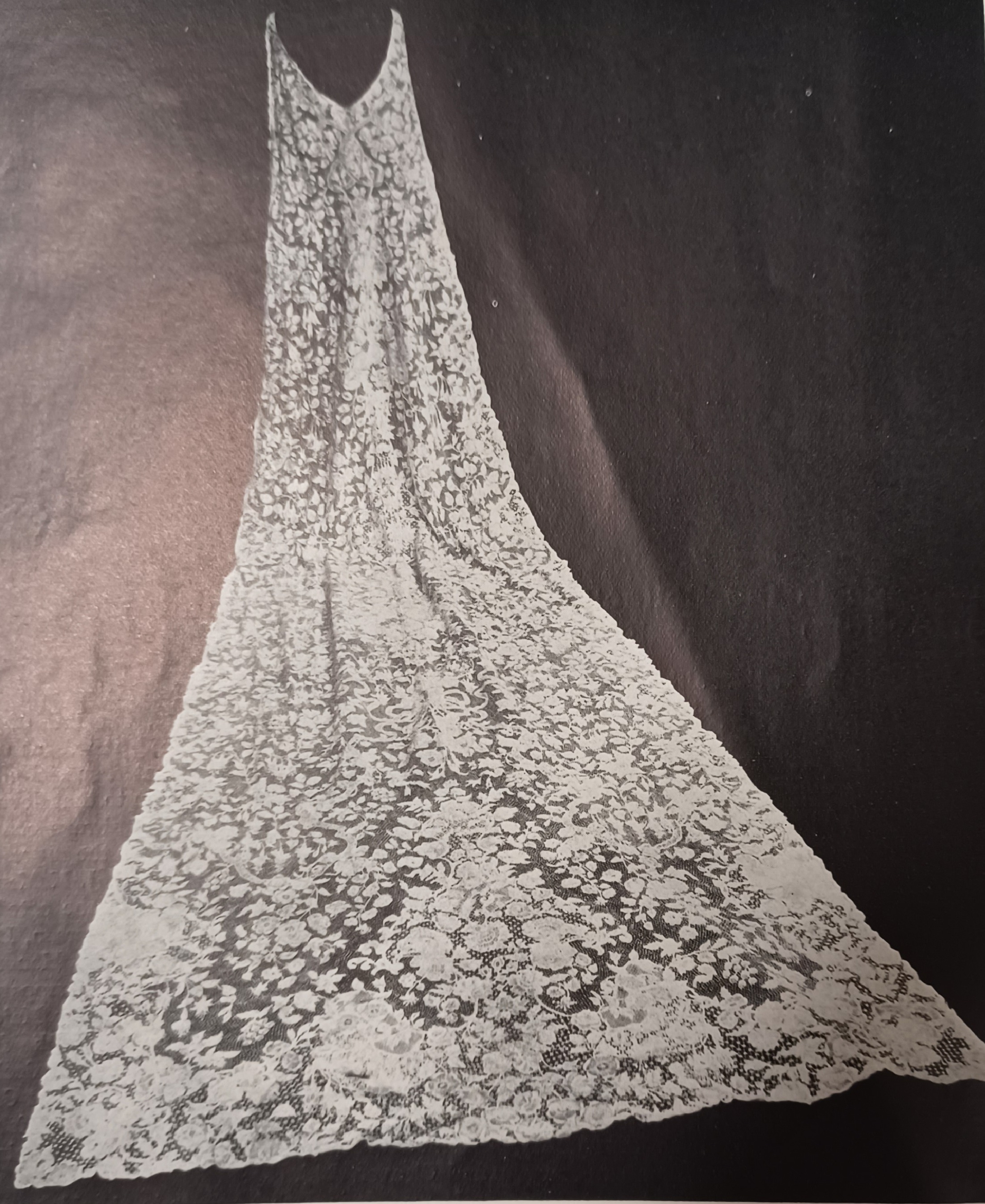
Queen Mary was an avid collector of art and artefacts and her lace collection was the subject of an article in The Connoisseur magazine of June 1928. Pride of place in the collection went to the court train of Irish needlepoint lace that was made for her to wear at the Coronation Durbar in Delhi in 1911. The train was commissioned by a group of influential ladies from Belfast, including the lady mayoress, who set up a committee and raised funds for the work. There was little time between the King’s accession and the Durbar so the train had to be made in 6 months. The Presentation Convent of Youghal in County Cork was given the task, and it is reported that 60 skilled lacemakers work in relays through the day and night to make the lace on time. It was estimated that one lacemaker would have taken about 30 years to complete the task alone.

The pattern includes scrolls and flowers, including the may flower as a reference to the Queen who was known as Princess May before her coronation. The lace is made with a needle and thread and the work is basically made up of blanket stitches and their various combinations to form intricate patterns.

 This type of needlelace is suited to collaborative work because the individual motifs are made separately by the lacemakers and then assembled and joined together with more fine needlelace. Each worker has her own specialism, such a drawing out the patterns, laying down the outlining cord, working the stitches or assembling the motifs and joining them with net stitches. It is a huge achievement to have completed a work of such intricacy, accuracy and beauty in 6 months and we should marvel at the skill of the Irish lacemakers involved in the task.

Wednesday, 11 June 2025

Leaves and tallies in bobbin lace


Leaves and tallies in bobbin lace are very similar in construction but vary in shape. Tallies, leaves and lead-work are all made by plaiting small blocks of lace, usually with two pairs of bobbins. Tallies are square or rectangular, leaves are pointed at both ends, and lead-works generally join two trails and are rectangular in shape, but wider than they are long. To make a leaf the two pairs are worked together with a cloth stitch and then the second thread from the right is woven over and under the other three threads, back and forth, until the leaf is the required length. The secret to a good shape is to hold the passive threads wide apart as the weaving progresses, until the centre of the leaf is reached, and then gradually bring them close together again. To finish the leaf a pin is put up between the two pairs of thread and a final cloth stitch is worked.

Both leaves and tallies can be raised, which means they lie above the base layer, as seen here with the leaves above the half stitch diamonds This is done by keeping two pairs to the side, away from the main work, until the base layer has been worked. Then making the leaf or tally above the base and joining the pairs back into the main work at the point where the end of the leaf joins the base layer.

Raised tallies can also be rolled, which makes them into a small tight cylinder that looks like a small roll or bead on the top of the work. This can be done by making a tally with the central pairs in a piece of lace, then either raising it into a loop over a pin laid across the work, or winding it round the pin. The pairs used to make the tally are then placed back in their original position and the rest of the lace continues. As you can see from this contemporary lace, tallies can also be twisted, laid over each other or moved from one area of the work to another. They are great for adding interest, little points of colour and relief to a piece of work.

Thursday, 5 June 2025

Early twentieth century lace cape


I saw this lovely lace cape in the Lace Gallery at Nottingham Castle. It dates from about 1900 and is made of silk gauze and machine-made lace, embellished with cords and soutache. Soutache is a narrow, flat, decorative silk braid which was often used to embellish dresses, mantles and smoking caps. It was also known as Russia braid and was sold in skeins in haberdashers for domestic embroidery projects.

Bold lace patterns, such as those made with Maltese lace or Irish crochet, were fashionable in 1900 and manufacturers made machine-made version in this style to compete with the handmade laces. However, a report from The Times newspaper in 1904 notes that the London store, Dickens and Jones, reported that their buyers were finding it difficult to source good quality handmade Maltese lace. This provided a gap in the market that the machine lace manufacturers were very happy to fill.

As you can see from this 1901 fashion plate, the S shaped figure was fashionable at the turn of the century. This was achieved by corsetry that pushed the bust forward, accentuated a tiny waist and pushed the bottom out. It resulted in a top heavy silhouette, so this cape would have covered the top half of the figure revealing the tiny waist and small hips below. The combination of lingerie materials and lace was also popular at this time for dresses, coats, hats and parasols, therefore this cape would have been the height of fashion.