Saturday, 31 December 2016

Lace review of 2016


2016 has been a busy year with lace exhibitions and events. I’ve exhibited in a variety of venues, including the lace event at Peterborough, the West Ox Arts venue in Bampton, the Hybrid lace exhibition in Limerick and the Knitting and stitching show at Alexandra Palace and Harrogate. I made a new body of work based on veiling inspired by Victorian gothic novels for the Knitting and stitching show in the autumn, which took up most of the year. It comprised two veils with bobbin lace edges, five with silk paper edges and two incorporating pins and embroidery. I had to schedule the work so that I had some bobbin lace on the pillow all year, the pieces with pins were also long term projects so I made them concurrently with the bobbin lace. The silk paper veils were made in batches and then embellished. The other exhibitions involved work I’d made previously which was easier and good to see the pieces exhibited again in different venues. My research also continued with visits to Nottingham and the V&A to discover more about curtains and lace panels, and I also spoke about my use of tambour lace in contemporary work at the Hybrid lace conference in Limerick. Thinking of the future, I applied to the Textile Society for a professional development award which I was honoured to receive and which will help fund my new project for next year – more details about that in the next blog!

Thursday, 15 December 2016

Biology based lace


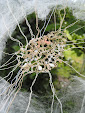
I hadn’t realised how much lace I had made based on biological themes until I wrote an article about it last month. I then found that I couldn’t include all the pieces in my 1000 word limit so had to leave many of them out. In the article I concentrated on my cell like pieces which are made of free bobbin lace without a formal pattern and include beads and tallies to suggest the parts of the cell. Some of those I had to exclude are the series based on a theme of genetics, chromosomes and cell division. An example is the piece above which was inspired by dividing cells seen under the microscope. It was made by producing a spiral piece of lace and then attaching pairs to the first piece of lace to add another layer to it, to give a three dimensional effect, as if the two layers were separating. Lace lends itself so well to reproducing the appearance of biological structures, with its combinations of holes, threads and more solid areas, that it should be no surprise that I’ve used it to represent so many different types of biological tissues.

Friday, 9 December 2016

Everyday lace


A friend has recently given me some of her lace and I’ve been looking through the pieces. There is nothing spectacular in the collection, no museum would be interested in any of it, but there is something special about lace that has been used and loved. Most of the pieces, such as the crochet edging below, would have been made at home by someone who enjoyed making a complicated pattern and was proud of her neat technique and it would have been appreciated by her friends and family.

The piece at the head of this post is made from a combination of tape lace and crochet so might have been made at home, perhaps following a pattern in a magazine, or might have been bought abroad.

The Nanduti style lace (above) was probably bought on holiday, but it is well used and has obviously been laundered. We admire so much of the finest laces in museums but tend to forget that there is great beauty in the everyday laces that used to be much more a part of our lives.

Wednesday, 30 November 2016

Knitting and stitching show at Harrogate


I’m just back from Harrogate where Gail Baxter and I exhibited our latest lace projects in one of the gallery spaces at the Knitting and stitching show. Gail’s work concerns netting, recycling and sustainability and mine was a series of veils inspired by nineteenth century gothic novels and their authors. The link between the two was the use of netting – fishing net for Gail and the fine net of wedding veils for me. The space was a different shape from our gallery at Alexandra Palace, which had been the first venue for the exhibition. The square gallery at Harrogate allowed us to group the work more effectively and I was pleased that my veils could be seen as a complete body of work and the relationships between them could be appreciated. The gallery was also at the entrance to the show so we had a constant stream of visitors who were interested in finding out the background to the work and the inspiration for it. I was especially pleased that at the end of each day several people leaving the show came up to us and said that they thought our exhibition was the best in the show.

Friday, 18 November 2016

Gallery labels for lace


It’s always difficult to know how much information to put on labels. Some galleries insist on dimensions and materials, which I’ve always thought rather odd if you have the work in front of you. For my latest exhibition of veils at the Knitting and stitching show I decided to give a flavour of the concept behind the work to pique the audience’s interest. For example, for ‘Pinned down’ (the veil fringed with pins see pic above), I gave the title and then added ‘A sparkling fringe of pins hides the sharper reality of conjugal bliss and domesticity’. That describes the work but doesn’t explain all the research into nineteenth century domesticity and gothic novels that lies behind it. The veil, and the idea of the pins forming a fringe, clearly resonated with many people and made them smile and those who were interested came over and we had a more detailed discussion about the ideas behind the work and the contrasts evident in using sharp pins within a soft veil. In many cases people were interested in one veil and reading the label made them realise how it related to the other veils and fitted into the body of work on display. The veils are attractive in their own right and I also wanted the labels to convey the idea that they are artworks not bridal wear. I thought that giving some idea of the concepts behind them would dispel that idea. For example, I would have thought that ‘Marriage lines’ with the text ‘Jane Austen’s equivocal view of marriage, pinned in place using her own system of rearranging ideas’ would have deterred most brides. Not all however – as some people did ask if I made bridal veils for sale!

Thursday, 10 November 2016

Hybrid lace exhibition in Limerick


The Hybrid lace exhibition in Limerick displayed a pleasing combination of traditional antique and contemporary lace, as well as drawings of lace, experimental work and a video showing the process of making machine lace. Some of the most beautiful designs (see above) came from the archive and were the work of Cecilia Keyes from Kinsale, who studied lace design at the South Kensington School of Art and won many prizes for her lovely work.


The image above shows how the traditional and modern were brought together in one part of the gallery. On the far wall is my triptych ‘Dust, decay and disintegration’ a combination of linen bobbin lace and silk paper, which is complemented by Gail Baxter’s stunning black and red, bobbin lace hangings entitled ‘Tracing the thread III’ on the left. In the centre is ‘THX.OBJ’ a robe of plastic lace by Nora O’Murchu and Hua Shu, and in the background Ruth Duignan’s two ‘Simple stitch’ blouses, one in red the other white, fabricated from tulle embroidered with a simple running stitch in a variety of threads inspired by native hedgerows, rushes and reeds. Traditional work was shown in the glass cases and modern lace drawings were displayed along the wall.


Much of the contemporary work used unusual materials to construct lace. For example, Dawn Cole’s print entitled ‘Wound in back and bullet came out in front’ (above) uses text from the diary of the World War I nurse Clarice Spratling to create images that resemble fine lace. Jane Murtagh’s etched and patinated copper entitled ‘The Lace maker’s garden’ is based on thoughts of a winter garden and the work Florence Vere O’Brien undertook to revitalise the Limerick lace industry at the end of the nineteenth century.


Neither Roisin de Buitlear nor Michael Canning are lacemakers but both have referenced lace in their work. Roisin with her beautiful lace etched on hand-blown glass and Michael with his diptychs inspired by Limerick lace, memory and loss, rendered in oil, wax, ash, and soot on linen. In contrast, Fiona Harrington and I are lacemakers and use traditional techniques in a modern way. Fiona with her pictorial pieces, such as ‘The chicken’ and ‘The lighthouse’ that combine Kenmare needle lace and Carrickmacross lace. And me with my three hangings entitled ‘Memories are made of this’ (above) which uses bobbin lace, made from string, and silk paper to depict the disintegration of memory with Alzheimer’s disease. It was good to see that the students from the Limerick School of Art are also being encouraged to use lace techniques in novel ways and interesting to see some of their experimental pieces and designs as part of the exhibition.


Tuesday, 1 November 2016

A taste of the Hybrid lace conference in Limerick


This conference in Limerick was linked to two exhibitions of lace and interventions throughout the city by the artist NeSpoon whose work is shown below. We were welcomed by Jacqui Hayes from the Limerick Archives and then addressed by the Mayor of Limerick. The conference was opened by Dr Matthew Potter, Historian from the Limerick Archives and organiser of the event, who talked about the history of Limerick lace. Giordana Giache, Lecturer at the Limerick School of Art and Design and curator of the exhibitions, then spoke about the liminal space that exists between the traditional and contemporary and the creativity that can be found there.


Several papers considered this theme of the traditional and the contemporary. Veronica Stuart, the Chair of the Traditional Lace Makers of Ireland, shared some of her expertise in Irish laces and showed some lovely examples of antique and modern work. The researcher Dr Gail Baxter spoke about plain net, its history and decoration, and showed us beautiful examples of traditional and contemporary work. I described my historical research into Victorian domesticity and the gothic novels that critiqued it, which led to the ‘Whispering’ series of lace curtains (detail below) in which I use tambour lace to tell a tale and reflect on social issues.


History lecturer Dr Maura Cronin, explained how much lacemaking in Ireland had been linked to the relief of poverty through Boards set up to encourage Irish manufacture. She also gave my favourite quote of the day which was taken from a Cork newspaper in 1854 and referred to lacemaking as ‘a substitute for sluttish indolence’. Elite patronage of lacemaking was also discussed by Veronica Rowe, whose grandmother Florence Vere O’Brien had been instrumental in setting up the Limerick Lace School in the 19th century. Alex Ward, Curator at the National Museum of Ireland, spoke about the fashion for Irish laces during the 19th and early 20th century, and showed some lovely images and fashion plates. The paper by Dr Amanda Briggs-Goode, Head of Fashion at Nottingham Trent University, showed how lace design had been taught in Nottingham from examples in the NTU Lace Archive. While Shazia Boucher, Deputy Director of the Calais Lace Museum, spoke about the approach the Museum takes to the display of lace by highlighting both the industrial heritage and the fashion heritage.


Toni O’Malley spoke about the difference between an artist and a craftsperson and considered the difference in value ascribed to their work. The glass artist Roisin de Buitlear showed us images of her beautiful work (detail above), much of it embellished with fine engraved lace patterns. Roisin also started an animated discussion about the role of lace in the modern world and suggested that cities like Limerick should celebrate and own their lace heritage by weaving lace into everyday lives, for example by marking bicycle routes with lace patterns and decorating bins with lace motifs. A topic that left everyone with plenty of food for thought.