Wednesday, 19 June 2019

Lace designing: the beauty of asymmetry


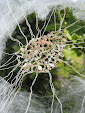
I’ve long been a fan of asymmetrical designs and used that style in my own designs, like the one in the image above. I like to use the same elements in a design but subtly alter them throughout just to maintain interest and also, to be honest, make working it more interesting too. One of the pieces of lace I admired at the ‘Hidden in stores’ exhibition at the Lace Guild last week was a Honiton fan leaf worked by Emma Radford in about 1878 (see below).
I studied it for a while and I think one of the things that made it so attractive was that it wasn’t symmetrical. Although the edging was the same repeated motif all round, and several elements of the main design, such as the leaves and flowers, were the same they were arranged differently on both sides of the fan. Honiton and other pieced laces are obviously at an advantage here as you can move the motifs around to make a pleasing design once they have been made. So many fan designs are mirror images on both sides and although they may be beautifully worked it doesn’t always make for a good design. I think that so often we expect lace mats and fans to be symmetrical that when they aren’t it subconsciously makes us look again and appreciate the lace even more.

Wednesday, 12 June 2019

Figures in lace at the Lace Guild


I went to see the ‘Hidden in stores’ exhibition at the Lace Guild this week. What a treat to see some beautiful lace loaned from the V&A collection and the Dr Spriggs Loan collection. There were some lovely pieces on display and I was struck by the number of them that included figures. The Brussels bobbin lace cravat end illustrated above, from the Spriggs collection, includes several figures playing musical instruments and may date from the 18 or 19 century. Variations of this design exist in other museums and the fact that it is composed of several separate motifs may have meant it was easy to reproduce.
The most obvious figurative piece that dominated the room was the filet lace panel from the Spriggs collection depicting the sons of Joseph with their accoutrements. This was one of the older examples (c 1600) of lace on show and had clearly been worked in separate panels which were then joined together. Another old piece, from the late 16 century, was a scalloped bobbin lace edging showing alternating images of a sheep and a man, probably used as domestic lace bordering a cloth. The catalogue notes that this lace includes woven almond shaped leaves instead of plaits and that this can be used to identify the lace as originating from Genoa or Milan. 

Another very interesting piece was a pair of lappets from the V&A, thought to include portraits of John Churchill the first Duke of Marlborough and his wife Sarah. These are made in Honiton lace and date from 1710-1720. It was unusual to include recognisable people in lace and these may have been made to indicate the wearer’s (or her husband’s!) political allegiance. 

One of my favourite pieces was a bobbin lace flounce, from the V&A, made using a braid lace with linen and silver thread. It was made in northern Italy in the late 17 century. The design, made up of braids and net, is quite solid but what is so attractive is all the little animals, people and angels concealed within it. The silver thread has tarnished now but when it was made it would have sparkled beautifully in candlelight. The final figurative piece in the exhibition was a coloured needlelace purse depicting Chinese figures. It dated from 1700 but looked quite modern in its use of colour and design.

I have only talked about the figurative pieces here, but there is much more to see, including fine Honiton and needle laces. The exhibition ends on 21 June so do try and visit before it closes.

Wednesday, 5 June 2019

Buttonhole stitches in needle lace


Buttonhole stitches are so versatile - they are the basis of needle lace and are also used in white work, embroidery and general sewing. It never fails to amaze me how a skein of thread can be turned into the most delicate needle lace using the humble buttonhole stitch. Therese de Dillmont in her Encyclopedia of needlework explains how to execute the stitch in her section on plain sewing and describes many variations on the basic stitch in her chapter on needle-made laces. She shows how to make joining bars with picots and longer branched bars with double buttonhole stitches to form a more rigid structure. She also describes how to make various ground stitches using more open loosely formed buttonhole stitches, which she calls Brussels stitch. In total, she describes 40 needle lace stitches all based on the same buttonhole stitch model. The image shows a detail of some needle lace showing an open Brussels stitch, another worked over a guiding thread, and open stitches over a gimp composed of several threads forming joining bars. All made using the simple buttonhole stitch!

Wednesday, 29 May 2019

Veiled threats: the ambiguity of pins


I love the ambiguous nature of pins – they are small, shiney and useful but have a sharp edge to them. Their attractive appearance masks a tendency to inflict hurt and pain randomly. Katherine Walker expressed it well in 1864 in her short story ‘The total depravity of inanimate things’, in which she humorously suggests that pins and needles, among other household objects, have a life of their own. She says ‘the similar tendency of pins and needles is universally understood and execrated, - their base secretiveness when searched for, and their incensing intrusion when one is off guard’. In ‘Pinned down’ the wedding veil I made fringed with pins, a detail of which is shown in the image above, they form a beautiful glistening fringe but on closer inspection reveal their true nature to comment on the sharp reality of matrimony. Interestingly Yvonne Verdier, in a study of folk tales in rural France, links pins to maidenhood, so they seem to be an appropriate edging for a white wedding veil.  

Wednesday, 22 May 2019

Why do we make?


Why do we make? was one of the interesting questions explored at the ‘Craft(ing) the body’ conference held at UCA Farnham today. Although it wasn't the theme of the day it was a thread running through all the presentations. Professor Catherine Harper felt that there was a need to craft and that the interaction between the body and the thing being made was visceral. She commented that we don’t need craft but we desire it. Her keynote paper on ‘Chasing the impossible: crafting the intimate body’ compared the different approaches of female representation expressed in Judy Chicago’s Dinner party and Helen Chadwick’s Eat me, arguing that Chicago stylised and unified women as biologically feminine while Chadwick’s response was more personal and placed femininity between the biological and the social allowing multiple definitions. Interestingly the artists Gayle Matthias and Karina Thompson, who work in glass and textiles respectively, both said that it is only as mature artists that they have had the confidence to produce, exhibit and verbalise personal autobiographical work. The potter Gareth Mason noted that we make sense through craft, while artist Fiona Curran argued that craft is a form of discovery and curiosity. Daniel Fountain spoke of his practice, crafting a queer society in the form of nests from salvaged materials. The ceramicist David Jones speaking about his own practice noted that giving matter form is significant. He quoted Richard Sennett’s words that ‘making is thinking’ and Hannah Arendt’s idea that craft requires a narrative rather than mindless making. Jones argued that craft is not art or a subsidiary of art but lies parallel to it. During the question time many in the audience said they felt compelled to make, others said that they made because they had ideas to express and disseminate. Many agreed with Jones that what we can make goes beyond what we can see and thus produces nuanced layers of meaning.

Wednesday, 15 May 2019

Amy Atkin machine lace designs


I’ve been busy studying the lace designs of Amy Atkin who claimed to be the first female designer of Nottingham machine lace. The reasons are twofold, first I want to do some academic research into her life and her designs, and second because I’m planning a practice-based response to her designs as well. The format for my own lace designs will be long thin rectangles so I’ve been trying to work elements of Amy’s designs into that shape and you can see my initial thoughts in the sketches above. Studying Amy’s designs, which are mainly deep valances or curtains rather than strips of lace, suggests that she designed a main focal element for the base of the lace and worked upwards. She favours designs that incorporate flowers and foliage, whether this was her preference or the favoured style of the time I don’t know. Some of the designs also have an Art deco feel to them which would have been a new influence at the time she was designing in the early twentieth century. I’m enjoying trying to get the feel of her style and find her flowing style of design is easy to work with and lends itself to handmade as well as machine made lace.

Wednesday, 8 May 2019

Needle lace sampler of Susanna and the Elders


I saw this lovely needle lace sampler in the Ashmolean Museum in Oxford over the weekend; it is part of the Feller collection. The subject is the Biblical story of Susanna and the Elders, in which two lecherous Elders watch Susanna bathing and then accuse her of promiscuity. She is condemned to death until the prophet Daniel proves her innocence and the guilt of the two men. What intrigued me about the sampler was not the theme but the variety and technical skill of the different panels of needle lace. The top band drew my attention because from a distance I thought it was filet lace but it is actually a type of pulled work based on the grid of the fabric. The second band is much freer needle lace with some applied pieces and beads, although still maintaining the background grid of the underlying fabric. I love the subtle shading in the leaves, and what looks like two squirrels in the tree. The attitudes of the people in the story are beautifully depicted too – Susanna is quite rightly indignant at having her bathing interrupted. Originally the water would have sparkled and the beads in the pool would have glittered making the scene appear quite three dimensional. 
The third layer also keeps the grid but includes needle lace mermaids and boats and a central pattern that has an Art deco look to it and includes some tiny coral beads. The next layer is white cut and drawn work on a very fine scale and the final band is counted thread embroidery in a border pattern of lozenges and acorns. The whole piece is beautifully designed and made; it dates from the late 1600s.