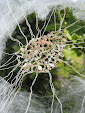
This Torchon style lace was inspired by old Italian roof
tiles which are half cylindrical in shape and lovely ochre, orange and brown
colours. I spent several summers drawing and painting interesting rooves and
chimneys and this work and four other lace pieces were the result. Some are based
on square or diamond shapes, which is how the tiles appear when you see them
face on, and others reflect the long cylindrical appearance the tiles show from
the side view. I’ve used the same rich brown threads for all of them.
They are all mounted on hand made paper and strips of Italian newspaper to
suggest rafters underneath them. Some like this one suggest some wear and tear
at the edge, reflecting the fact that many of the most interesting and older
tiles are found on crumbling buildings.
Wednesday, 8 January 2020
Wednesday, 1 January 2020
January lace challenge
Happy new year! I’ve taken on an Instagram lace challenge
for January. It’s been organised by Jane Fullman and involves a different
prompt for every day of the month – for details have a look at Jane’s Instagram
account jane.fullman_bobbinandwire. Some of the prompts are fairly easy like ‘bobbins’
but others such as ‘spring’ will require a bit of lateral thinking! It starts
today with ‘your story’ so if you’re on Instagram why not join in, it’s a great
way to promote lace and lacemaking in all its varieties to a new audience. I’m
going to try and respond to every prompt as I enjoy the challenge but you can
just respond to a few if that’s what suits you. If you do decide to join in
remember to use the hashtag #lacechallenge_january2020 so that all the posts
end up in the same file. I’m looking forward to an interesting month of lace.
Wednesday, 18 December 2019
Lace edged cards
I saw an exhibition of these lace-edged devotional cards in
Bruges last year. This one was produced by Turgis of Paris, probably in the
nineteenth century, and depicts Saint Vincent de Paul and the children of
charity. The Turgis company printed many types of cards celebrating different
saints and the holy family; they were printed in black and white with a surround
of punched out lace. The company also produced cards to celebrate personal life
events, such as first communion. Most have a prayer on the reverse and were
designed to be kept in a prayer book or bible. I like the way several different
lace designs are used in this example and especially the way the stars, moon
and tree are depicted on the left hand side – they made the scene seem quite
Christmassy!
Wednesday, 11 December 2019
Antique Christmas lace bobbins
I’ve been trying to find some antique Christmas lace bobbins
for the festive season but have had no success. Many current bobbin makers
produce bobbins celebrating Christmas but I have found no old ones and neither
T L Huetson nor the Springetts mention them in their histories of lace bobbins.
Both sources describe some religious bobbins and Huetson does record a bobbin
inscribed ‘Easter’ which he thinks was given as a gift. Many are inscribed with
Mary and Joseph but these could also be commemorating friends and family of the
lacemaker as they were popular Christian names. I do have one inscribed Jesus
though (see the pic above). For most lacemakers religion would have been an
important part of their lives, shaping the calendar of the year with celebrations
such as Easter and Christmas, but also their own personal lives with
christenings, marriages and burials. Many would have followed nonconformist Christian
doctrines which emphasise a personal relationship with God, hence the bobbins
in the image with the messages ‘Thou O God seest mee’ and ‘Jesus for me died’.
Other popular inscriptions were ‘God is love’, ‘Love one another’ and ‘I love
Jesus yes I do I do’. I was surprised not to find any mention of Christmas bobbins
especially as the Victorians keenly celebrated Christmas and many nonconformists
wrote the carols we now sing at Christmas. Perhaps the gift of a bobbin at
Christmas was considered unsuitable because it was a working tool and Christmas
was considered a day of rest, like a Sunday. Or perhaps there was no spare
money to buy bobbins at Christmas time. The nineteenth-century bobbin makers certainly don’t seem
to have them in their general stock so there was clearly no demand for them.
Wednesday, 4 December 2019
Japanese lace fan
Just to show that my interest in Japan and things Japanese goes
back a long way I thought I’d blog about this Japanese lace fan I made for City
and Guilds many years ago. I remember researching Japanese patterns for kimono
fabric and finding one depicting weeping willows, on which I based this design, and another of fan shapes which inspired the idea of producing a single fan as a hanging.
The leaves and stems are all lace plaits and leaves, with four plait crossings
where they intersect. I also added small gold beads at intervals to catch the
light and add some highlights. The golden full moon was also inspired by
another kimono fabric. The sumptuous black, red and gold colours epitomised
Japanese style to me and were picked out from the clothing of some Japanese dolls
in my collection. As part of the C&G exam I remember producing design
boards to accompany the lace with all these samples on them, as well as showing
the various stages of the design process, stitch samples and images of the lace
being made. It was a lot of work but a good exercise in recording every step
and formalising the process of designing. I learnt a lot from it - it’s a great
shame that C&G in lacemaking no longer exists.
Wednesday, 27 November 2019
Printing and dyeing in Japan
It’s always interesting seeing other people’s tools and
working processes. We were lucky in Japan to see several master craftsmen at
work and also to see their workshops and some of the behind-the-scenes work of
other people in their ateliers. Most wouldn’t allow photography in the studio
but we were able to see some of the tools in museums. The image above is of a
stencil and cutters in the Hosoo Gallery Museum. These stencils are widely used
in Japan and we were lucky enough to see them being used in the Edo Komon
stencil printing process in Tokyo. As well as stencil printing we also saw resist
fabric painting in Kanazawa, which was a similar process to silk painting with
fine gradations of tone producing beautiful effects.
As well as printing and painting we also saw a variety of types
of dyeing. The image shows a woman demonstrating the technique of arashi shibori
in the tie dye museum at Arimatsu. There are two ways of doing this technique.
She is using a fine hook to catch the material which she then softened in water
to form a long tower which she twisted thread around. Her companion was doing
basically the same process but didn’t use a hook just laid the fabric over an
upright pin to push the farbic into a tower so she could wrap thread round it. Once
the fabric has been dyed the threads are removed and a pattern of dots is
revealed where the threads held the material. We then took part in a shibori
workshop, luckily using a much easier technique. We folded a length of material
into a triangular shape and then depending on which part of the triangle we
dipped in the dye baths formed various star like patterns on our cloth. I think
we’d still be there twisting threads if we’d used the arashi technique!
Wednesday, 20 November 2019
Textile study tour to Japan
I’ve just returned from a fascinating study tour exploring Japanese
textiles as well as having a taste of ancient and modern Japanese culture. We travelled
to Tokyo, Kyoto, Arimatsu, and Kanazawa as well as the world heritage site of Miyamachokita
and visited the workshops of experts in stencil printing, various types of
shibori dyeing, ikat weaving, indigo dyeing, and yuzen fabric painting. Many of
these experts have been designated national living treasures and they were all the
third or fourth generation of their family to continue their particular traditional
technique. Their expertise and attention to detail was astounding.
As well as visiting the ateliers of those master craftsmen,
we also visited modern galleries and shops which exhibited and sold
contemporary textiles. In Tokyo we visited Reiko Sudo’s stylish Nuno shop. Reiko
showed us some beautiful textiles and many of us bought scarves and socks. In
Kyoto we were met by Keiko Kawashima who had organised some fascinating opportunities for us including
a visit to her own gallery GalleryGallery to see
an exhibition of the work of Yasuko Fujino and hear an impromptu talk by
Chiyoko Tanaka about her work. It was fascinating to hear how both of them
approach their weaving practice.
We also visited an exhibition of student textile work and a
stunning display of different textiles in the Hosoo Gallery (image above). It
was interesting to see how many of the traditional textile producers are
developing new markets for their work as the use of textiles for kimonos is
declining. The decline in the use of kimono was evident in the shops selling
secondhand kimonos, jackets and obis, but all provided wonderful buying opportunities
for those of us interested in textiles. One place where we did see families
wearing kimonos was at a the Hiejinja shrine in Tokyo where there was a celebration
of children aged 7, 5 and 3 years of age, all dressed traditionally and having
their photos taken. That was just one of the lovely shrines and temples we visited
during our trip.
We also managed to fit in some interesting museum visits
including those dedicated to indigo, shibori, weaving and gold leaf. Visiting the
Miho Museum proved to be an experience as its position in the countryside among
trees and streams and the fact it is situated on a split site, which involves
entering it through a tunnel and walkway, made it seem like a pilgrimage. Once
there the exhibits were beautifully displayed in the tranquil contemporary
setting and there was an interesting exhibition of Bizen ceramics. In contrast,
our final day was spent at the Teamlab digital exhibition in Tokyo (image
above) which was an immersive light and sound experience – magical in its own
way, which highlighted the combination of ancient and modern that is today’s
Japan.
Subscribe to:
Posts (Atom)