I’ve made great progress this week on my lace panel – it’s
interesting how some weeks you put in loads of work but have little to show for
it whereas in others you seem to steam ahead! This week I’ve been applying the
new digitally printed photographs onto the net base. I’ve never used digitally
printed images before and I naively assumed that as the images I’d supplied were
perfect rectangles the printed versions would be too. I hadn’t accounted for
the fact that obviously the material must move slightly in the printing process
so I’ve had to tweak some of them a bit. Luckily I had already decided to add a
small strip of lace to the top and base of each image to neaten it, and to run
a scalloped lace right along the edge of each net panel to mirror the scalloped
edge of the original. These edges of lace have allowed me to straighten up the
photographic prints by hiding some areas so they are now roughly rectangular
again. However, despite the technical problems, machine stitching the lace to
the images and net has been very quick and I’m pleased with the results, so I
feel I can have a break over Christmas!
Wednesday, 20 December 2017
Thursday, 14 December 2017
Woman’s Hour Craft Prize exhibition
I was interested to see the exhibition of work by the
finalists of the Woman’s Hour Craft prize at the V&A Museum last week. The
well-deserved winner was Phoebe Cummings with her beautiful unfired clay
fountain which is designed to dissolve as the show progresses; the image shows
a detail from it. However, looking at the exhibition got me thinking again
about the difference between craft and art. I’ve been trying, unsuccessfully,
to define both terms.
Various crafts are represented in the exhibition for sure,
Laura Ellen Bacon’s woven structures and Celia Pym’s darning for example, but
Laura admits to never having woven a basket and you wouldn’t ask Celia to
invisible darn anything. As far as I’m concerned both are artists who use their
craft skills to produce work that reflects movement and narrative,
respectively. Of the ceramicists in the show, Alison Britton makes containers that
are functional but speak of containment, Neil Brownsword highlights the loss of
industrial ceramic skills by making and discarding clay flowers, and Phoebe
Cummings deals with the ephemeral. Andrea Walsh initially studied fine art and
developed the idea of a vessel into her glass boxes, which are sculptural and
jewel like. Emma Woffenden also combines sculpture and glass to create
strangely distorted figures while Laura Youngson Coll makes intricate
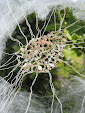
biological sculptures (see the picture above). Of the jewellers in the
exhibition, Lin Cheung acknowledges her ideas-based approach while Romilly
Saumarez Smith gives antique finds a new life and narrative by turning them into
jewellery. The other two exhibitors, Caren Hartley who makes bespoke bicycles,
and Peter Marigold who initially studied sculpture but now makes what can
loosely be described as furniture, seem to be more traditional craftspeople
rather than fine artists.
It seems to me that most of these pieces combine craft and
fine art. Does this signify the elision of the line between craftspeople and
fine artists? Are most craftspeople now using their skills to produce work with
conceptual ideas behind it? I doubt they are, as a visit to any gallery would
show. Should we welcome this merging of art and craft? Do these definitions and
categories matter anyway? Should we just enjoy the work whether it is art,
craft or a combination? Food for thought!
Wednesday, 6 December 2017
Working Carrickmacross lace
I’ve been doing some Carrickmacross lace on my Battle of
Britain lace panel which has made me appreciate the skill of the person who
made this lovely piece from the UCA Textile archive. Having worked some of this
lace I realise that cutting round the fabric shapes once they’ve been sewn down,
without cutting the net underneath, is one of the most difficult parts of the
technique. However, you soon get used to the feel of the fabric being cut. I
found that if I used my nail to stretch the fabric above the net it was easier
to cut and ‘gave’ as I cut it away, which made it easier to distinguish fabric
and net. I also realised that the placement of the grain of the fabric was
important too as some of the shapes are very small and tend to come away from
the sewn edge if they aren’t placed and cut on the grain. The fabric I’ve used also
seems to be more open than in traditional examples, which gives it a very lace-like
appearance, but makes it less stable when its cut. I’m very impressed that in
this beautiful example from the archive the fabric is cut very closely to the
sewn edge and has worn so well without unravelling.
Wednesday, 29 November 2017
Lace in Weldons encyclopedia of needlework
I was delighted to buy a copy of Weldons encyclopedia of
needlework in my local Oxfam bookshop, especially as the final section of the
book is an illustrated supplement of lace. It gives a brief and not entirely
accurate description of ‘needlepoint lace’ and ‘bobbin or pillow-made lace’ but
mainly consists of photographs of lace from the Victoria and Albert Museum. The
pictures are a bit grainy but do give an idea of the different types of lace
and it’s encouraging to see so many illustrations, particularly in such an old
book. The image shows a detail of Point d’Argentan lace with its distinctive
hexagonal mesh. Although the book is mainly a how to do it manual, there are no
instructions for making either needle or bobbin lace but there are sections on
other types of lace such as netting, embroidering on net, drawn work, crochet
and knitting which I shall enjoy discovering.
Wednesday, 22 November 2017
Carrickmacross lace
The next stage of my Battle of Britain lace panel requires
some Carrickmacross lace so I’ve been reminding myself how to do it. The last
time I made any Carrickmacross lace was a while ago when I made this cape
inspired by peacock feathers. Basically the technique is to lay a piece of
fabric on to the net, then outline the shape you want with a thickish thread
without cutting out the material. Then you couch the thread down using a fine
thread and finally cut away the excess material to leave the shape you want
outlined in a thicker thread. The secret is not to cut into the net as you
remove the excess fabric round the edge of your design or to cut the outlining
thread, so precision is required! As you can see, for the cape I used several
layers of chiffon to make the peacock eyes so the technique was quite
complicated. This time I’m just using one layer of fabric with an outlining
couching thread so it should be simpler, however the net I’m sewing on to this
time is firmer and has less give than the gold mesh I used for the cape. I’ll
need to try a few different types of fabric on a sample before I work on to my
panel to see which one works best with the net.
Wednesday, 15 November 2017
Needlerun lace
I’ve been doing quite a lot of needlerun lace recently for
my Battle of Britain panel so was interested to find this example in the UCA Textile
archive. It’s a collar worked by hand on a diamond-shaped machine-made net and
while I’ve just been using outlining stitches this includes blocks of shaded
areas as well. Embroidering on net was the first type of ‘mechanised’ lace and
in the early nineteenth century numerous lace runners were employed in
Nottingham to embroider the net produced on machines designed by John Heathcoat
and John Leavers. Although lace machines were then developed that could produce
patterned lace, the technique of needle run lace continued to flourish,
particularly in Ireland. It had been introduced to the country by Charles
Walker who took 24 skilled English women to Limerick in 1829 and set up
production there using machine net imported from Nottingham. They trained local
women to make needlerun and tambour lace and the technique soon spread to other
towns although it is always referred to as Limerick lace. The reason I’ve been
using the technique is that it is fairly quick and covers a large area quite
easily – bobbin or needle lace would take considerably more time because you’re
making the net as well as the patterns. Also, in my case, I wanted a technique
that referenced the origins of the original Battle of Britain lace as a net
curtain panel and working on machine net gives that link to machine-made net.
Wednesday, 8 November 2017
Lace fashion reports 1930
I recently spent a day in the Lace Archive at Nottingham
Trent University doing some research and came across a folio of lace fashions
from the 1930s. It contains reports of the Paris fashion shows written for the
lace manufacturers in Nottingham showing the latest trends. It is all quite
detailed and as well as the report, which includes some sketches, the
correspondent has sent samples of the lace and photographs of it with detailed
measurements. There were also photos of ladies wearing lace fashions at the races.
This type of information was obviously useful to the manufacturers in designing
lace and finding out what the trends for the coming year would be. In fact the
report is marked ‘Confidential’ so it was obviously highly sensitive
information.
Subscribe to:
Posts (Atom)